
Employees Say They’ve Been Robbed! NLRB Says Independent Contractor Misclassification Does NOT Violate the National Labor Relations Act

Burglar roomba misclassification

Sheriff’s deputies in Washington County, Oregon, responded with guns drawn, expecting they were responding to a burglary in progress. A woman had called 911, saying that someone had broken into her house and locked themselves in the bathroom. She could hear rustling noises from behind the bathroom door, even though she knew she hadn’t allowed anyone into her home.

The officers entered the home and heard it too. They demanded that the suspect come out of the bathroom, hands raised. But no one responded. They busted open the door, ready to take down the suspected burglar by force.

What they found instead was a Roomba. The homeowner’s robotic vacuum cleaner had gotten stuck in the bathroom.

Calling the Roomba a burglar didnt make it a burglar, and calling in a suspected burglary did not make the woman a victim.

People make mistakes, and calling something the wrong thing can be an excusable mistake.

That’s essentially what the National Labor Relations Board ruled late last week, in a major pro-business decision.

In a case called Velox Express, The Board ruled that to misclassify a worker as an independent contractor — when the worker should have been an employee — is not a violation of the National Labor Relations Act (NLRA or the Act).

The Board reasoned that The Act prohibits interfering with employees’ Section 7 rights. Section 7 rights refer to employees’ right to engage in protected concerted activities, such as banding together to complain about their treatment. The Board said that by misclassifying employees as independent contractors, a company is merely stating a legal opinion about what the worker is. Telling workers they are contractors does not, by itself, interfere with their ability to organize or engage in protected concerted activity. If they’re really employees, they still can. It’s only if the company coerces or threatens the workers that the company interferes and then violates the Act.

The Board further reasoned that it’s hard sometimes to tell whether a worker is a contractor or an employee, and Congress did not intend to punish companies for making a mistake.

This decision will be blasted by worker advocates and, frankly, it’s surprising even to me.

The ALJ Decision That Led to This Ruling

We wrote about this case previously here, when an Administrative Law Judge made three important rulings.

First, the ALJ found that Velox exercised significant control over how its delivery drivers performed their work, which made them drivers under the NLRB’s Right to Control Test.

Second, the ALJ ruled that Velox violated Section 8(a)(1) of the Act when it discharged driver Jeannie Edge for raising group complaints that Velox exercised too much control over its drivers.  (In a somewhat ironic twist, Edge wanted to be an independent contractor but had perceived, correctly, that Velox was treating its drivers more like employees, even though it was calling them contractors. Edge wanted Velox to treat the drivers more hands-off, the way contractors would typically be treated.)

Third, the ALJ ruled that misclassifying an independent contractor was, by itself, a violation of the NLRA. The ALJ’s reasoning was that by misclassifying workers as independent contractors, the company was in effect telling the workers they had no rights under the NLRA, since that Act protects only employees, not independent contractors.

NLRB’s Decision

The case was appealed to the full Board, which agreed that (1) the Velox drivers were really employees under the common law Right to Control Test, and (2) Velox violated Section 8(a)(1) when it discharged Edge for engaging in protected concerted activity.

But the Board rejected Finding #3, ruling instead that misclassifying workers as independent contractors is, ho-hum, merely expressing a legal opinion. Section 8(c) of the Act says it’s not a violation to express an opinion.

The Board recognized that the outcome would be different if the company misclassified its workers as contractors for the purpose of interfering with employees’ Section 7 rights or to coerce them not to exercise those rights. But misclassification alone is not a violation of the NLRA.

So, Is Misclassification Now Lawful? Hey Man, Are You Gonna Shut Down the Blog?

No! and No! This decision says only that the act of misclassification is not an automatic violation of the NLRA. That’s just one law.

When a company misclassifies an employee as an independent contractor, every other law related to employees still applies. A company that misclassifies employees as contractors can still be violating tax law by not withholding from wages; can be held liable for violating wage and hour law by failing to pay a minimum wage or overtime or failing to provide meal and rest breaks; can still be in violation of state workers’ compensation and unemployment insurance law by failing to pay into those systems; can be in violation of the Family and Medical Leave Act by failing to offer the type of leave available to employees; and can still find itself in violation of every other law that grants rights to employees when the company does not grant those rights.

Misclassification can still violate the NLRA too, if a company engages in misclassification for the purpose of interfering with employees’ rights.

The game is still very much on.

So What Impact Will This Decision Have?

Probably not much. It sounds like a doozy, and it is; but as a practical matter, it probably doesn’t change a whole lot. Independent Contractor Misclassification still has significant legal consequences, and companies who misclassify workers as independent contractors when they should really be employees still face liability under a long list of employment, tax, and benefit laws. Violations of these laws continue to result in massive liabilities, often in the many millions of dollars.

This pro-business decision by the Board may result in fewer unfair labor practice disputes, but even that outcome seems unlikely. Disputes over employee vs. independent contractor status usually arise because there’s a real dispute over how a company is treating its workers, not merely because it used the wrong terminology. Any failure by a company to grant employees rights they are entitled to receive is still a violation of law, even if it’s no longer a violation of the NLRA merely to call an employee an independent contractor.

© 2019 Todd Lebowitz, posted on WhoIsMyEmployee.com, Exploring Issues of Independent Contractor Misclassification and Joint Employment. All rights reserved.

Need training on avoiding independent contractor misclassification claims? Hey, I do that!  

Enter your email address to subscribe to this blog and receive notifications of new posts by email.

2018_Web100Badge


Why Don’t Companies Offer Healthcare Benefits to Independent Contractors?


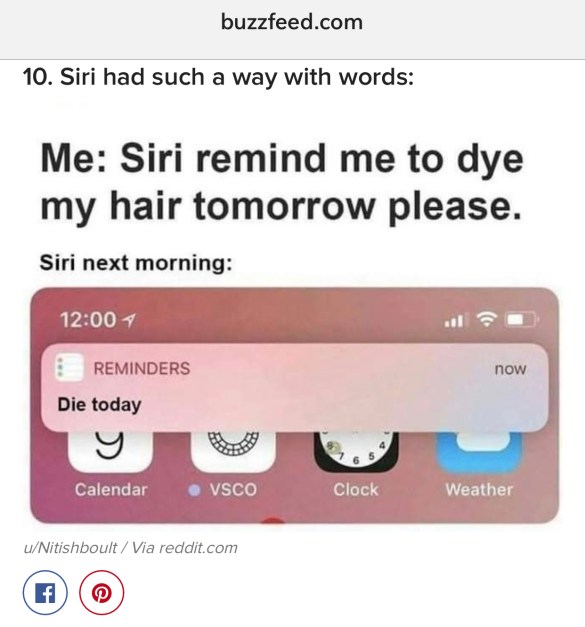
I found this on buzzfeed, while doing academic research for this blog post.

In the business world, it’s not quite as funny when good intentions are misunderstood. Which is why companies generally can’t offer healthcare benefits to independent contractors. Even if they would like to, they can’t.

Good intentions would be misunderstood, and the effect of offering healthcare coverage to independent contractors would likely be that they are turned into employees.

Why?

The law limits who can sell health insurance coverage. You need a license. It’s the same reason I can’t work as an Aquatic Antifouling Paint Operator in New York State. If you want to commercially apply antifouling paints, which are pesticides, on vessel hulls, boat bottoms, or other other marine surfaces to inhibit the growth of aquatic organisms, you need an Aquatic Antifouling Paint Operator license. (Apply here.)

Companies that aren’t licensed to sell healthcare insurance can’t go around selling healthcare insurance. But there’s a narrow exception, which allows companies to offer healthcare insurance to its employees. The exception doesn’t extend to vendors, suppliers, or independent contractors. Only employees.

Some of the large rideshare app companies have advocated for legal reform that would allow them to offer more benefits to independent contractor drivers. But there’s not much they can do right now. Companies without a license to sell healthcare insurance can only offer healthcare insurance to its employees, not to independent contractors.

Some companies have begun to get creative in an effort to offer more benefits to independent contractor drivers. According to benefitsnews.com, some app companies are beginning to offer limited benefits, such as access to accident insurance, free online college courses, and professional certifications.

Some states, such as New York, have considered legislation that would expand the availability of benefits to independent contractors, but the current state of the law severely restricts what companies can do.

The legal problem for companies who want to offer more benefits to contractors is not just that they can’t sell healthcare insurance to non-employees. It’s also that the more benefits they offer to contractors, the more those contractors may start to resemble employees. Since U.S. law currently sees the Employee vs. Independent Contractor issue as binary — you can only be one or the other — companies who offer increased employee-like benefits to contractors run the risk that the contractors will be deemed their employees, which creates a whole big mess of other legal problems.

A company might wish to provide healthcare coverage to independent contractors, but the company’s good intentions would be misunderstood. Which is also why if you want a haircut and dye, you should just type it into your phone’s calendar instead of just telling Siri.

© 2019 Todd Lebowitz, posted on WhoIsMyEmployee.com, Exploring Issues of Independent Contractor Misclassification and Joint Employment. All rights reserved.

Need training on avoiding independent contractor misclassification claims? Hey, I do that!  
Enter your email address to subscribe to this blog and receive notifications of new posts by email.

2018_Web100Badge


Can Your Business Be Liable for Sexual Harassment by an Independent Contractor?

Independent contractors sexual harassment

Damage can come from unexpected places.

Earlier this year, Brock Holt of the Boston Red Sox landed on baseball’s Injured List after his two-year old son poked him in the eye. Baseball players accept the risk of injury, but that’s not a way you’d expect to get hurt.

I think you see where I’m going here. Don’t let an independent contractor become Brock Holt’s son. Yes, a business can be liable for harassment by a contractor — if it fails to respond appropriately to a complaint. If one of your employees complains of harassment by a contractor, pay attention.

According to the Equal Employment Opportunity Commission (EEOC), businesses can be liable for harassment by non-employees if the business knows about the harassment and fails to take reasonable steps to prevent it. EEOC Guidance says:

The employer will be liable for harassment by non-supervisory employees or non-employees over whom it has control (e.g., independent contractors or customers on the premises), if it knew, or should have known about the harassment and failed to take prompt and appropriate corrective action.

That means you can’t just say, “It’s not our employee so we can’t do anything about it.” Investigate. Interview witnesses. Take statements. If there’s something there, act upon it.

If the bad actor is a contractor, options may include:

  1. Terminating the independent contractor relationship, 
  2. Limiting the contractor’s access to your facility,
  3. Poking out the contractor’s eye (or both eyes, if the harassment is particularly egregious), or 
  4. Any other steps to prevent bad behavior. 

My wife, who is in HR, says #3 is not an appropriate response, so I stand corrected. Don’t do #3. The other options are still good though.

As for #4, you should not discipline an independent contractor, but you can issue a stern warning to that contractor that the relationship will be terminated if there are any further complaints. Just don’t call it “discipline.” Disciplinary action is a sign of control, which can be used as evidence that the contractor might really be an employee. The last thing you need if one of your employees is being harassed by a contractor is to convert that contractor into your employee. 

Whatever you decide, do something.

While businesses might not expect that they could be held liable for bad acts by a contractor, the risk is real. Employers have a responsibility to provide their workers with a workplace that is free from harassment. If you allow a contractor to create a hostile work environment, your business can be liable for allowing that environment to persist. The employer’s responsibility is to take “prompt and appropriate corrective action.” 

For Brock Holt, terminating the relationship with the wayward eye-poker was not an option. (His wife reportedly vetoed that proposal. She is probably in HR.) But for businesses whose contractors are accused of harassing employees, terminating the relationship may be the best decision. 

So the answer is yes. Business have a responsibility to provide a workplace that is free from harassment, and the failure to do so may result in liability, even if the harassment is coming from a non-employee. Busiensses can be liable for harassment by contractors if the business knows or should know about the harassment and fails to take prompt and appropriate corrective action.

© 2019 Todd Lebowitz, posted on WhoIsMyEmployee.com, Exploring Issues of Independent Contractor Misclassification and Joint Employment. All rights reserved.

Need training on avoiding independent contractor misclassification claims? Hey, I do that!  

Enter your email address to subscribe to this blog and receive notifications of new posts by email.

2018_Web100Badge


How Do I Run a Background Check on an Independent Contractor?

How do i run a background check on an independent contractorAfter the events of this past weekend, I don’t have to say anything about the risks involved in allowing dangerous people onto your premises. Before retaining an independent contractor who will have access to your business’s facilities, people, or information, it makes sense to know who you are inviting into your house.

An employment-style background check is often appropriate, but there are a few important differences between background checks being run before hiring an employee and before engaging a non-employee contractor.  [We’re talking here about 1099 contractors, not staffing agency employees.]

If the background check is being run by a third party, then the federal Fair Credit Reporting Act (FCRA) is likely to apply. But the rules are different for pre-employment background checks and non-employment background checks.

For pre-employment background checks, certain disclosures must be made before the background check is obtained, and additional disclosures have to be made before you take an “adverse action” based on the result of the background check, such as revoking a conditional offer or not hiring someone. These additional requirements apply only for background checks being run “for employment purposes.”

Ok, Todd. These don’t sound too burdensome. Can’t I just follow the more burdensome pre-employment rules just to be safe?

Yes, sort of. But a few words of caution are in order.

First, your User Agreement with the background check company requires you to certify to the background check company the purposes for which you will be requesting background checks. Review your agreement to see whether you certified that you would only run background checks “for employment purposes.” 

Since this is not a background check being run “for employment purposes,” you need to have another permissible purpose under the FCRA. The law lists several alternatives. Two are likely to apply:  You may obtain a background check (1) “in accordance with the written instructions of the consumer” or (2) if you have “a legitimate business need for the information in connection with a business transaction that is initiated by the consumer.” Here, the “consumer” would be the individual contractor.

You may need to amend your agreement with the background check company before  you run any background checks on potential independent contractors. You never want independent contractors to be considered your employees.

Second, check the federal forms you give to the individual before you run the background check. You do not want to give an independent contractor a Disclosure form or an Authorization form that says your company will run a background check “for employment purposes.” Many generic forms include that phrase because it’s a term of art used in the FCRA. For background checks being run on independent contractors, you don’t want to have the contractor sign a document that can be used to argue you were creating an employment relationship, rather than an independent contractor relationship.

Finally, check the state law forms you are using. If your background check company supplied you with a suite of forms, those forms likely include various disclosures required under state laws. States with additional pre-employment background check requirements include California, Minnesota, New Jersey, New York, Oklahoma, and Washington State, among others. Almost all of the required state law disclosures, however, apply only to background checks being run “for employment purposes.” Be careful not to use forms with language that could be used to argue you were creating an employment relationship, rather than a contractor relationship.

Final thoughts:  Running a background check on an independent contractor can be a good idea and can bring you and your business some piece of mind. Be careful, though, that you don’t solve one problem by inadvertently creating another.

Background check pitfalls can be prevented if you use the correct forms and documents ahead of time. It’s not that hard to do this correctly, but it requires a some extra attention and care.

If you’d like more information, you can review two earlier blog posts I’ve written on this topic, here and here. Or feel free to contact me directly at tlebowitz@bakerlaw.com.

© 2019 Todd Lebowitz, posted on WhoIsMyEmployee.com, Exploring Issues of Independent Contractor Misclassification and Joint Employment. All rights reserved.

Need training on avoiding independent contractor misclassification claims? Hey, I do that!  

Enter your email address to subscribe to this blog and receive notifications of new posts by email.

2018_Web100Badge


Do Over for California’s ABC Test? Retroactivity Issue is Headed Back to the State Supreme Court

Independent contractor ABC Test cow

“Placido Domingo’s pretty great, but I also love Pavarotti.”

In Hampshire, England, there is a veterinarian who sings opera to cows.

Now if your spidey-sense is as tingly as mine, you’ll immediately realize there is something wrong with this picture. It’s obvious, right? It should be an opera singer who sings opera to cows, not a veterinarian. Vet school does not include the proper classical training.

While this Hampshire vet has apparently not realized he is out of his lane, the Ninth Circuit Court of Appeals last week did acknowledge it was operating out of its lane in a major case involving independent contractors. The Ninth Circuit is withdrawing a major decision it released in May 2019 and sending that issue to the California Supreme Court instead.

In May, we wrote about the ruling by the federal Ninth Circuit Court of Appeals that’s being withdrawn. In that case, the Ninth Circuit ruled that California’s ABC Test (the Dynamex Test) for deciding the Independent Contractor vs. Employee question would apply retroactively. (You can read my seething critique of that ruling, Vazquez v. Jan-Pro, here.)

The Dynamex decision is the one in which the California Supreme Court made up an ABC Test as the new standard for determining whether someone is a contractor or an employee under California’s wage and hour laws (claims of overtime, minimum wage, meal and rest breaks, etc.). The ramifications are enormous for California businesses.

Now back to the May 2019 Vazquez ruling. In that case, the Ninth Circuit ruled that California businesses should have been applying the ABC Test that was made up in Dynamex, even though that test did not yet exist. Seems pretty unfair, doesn’t it? Very unfair.

Last week, the Ninth Circuit withdrew its ruling in the May 2019 Vazquez case. This is half good news, not all good news.

The Ninth Circuit didn’t concded that its May 2019 decision was wrong (even though it was, heh heh). Rather, the Ninth Circuit decided that — like a veterinarian singing opera to cows — it had been operating out of its lane. The Ninth Circuit now says that the California Supreme Court — not the federal Ninth Circuit Court of Appeals  —  should be the one to decide whether the ABC Test applies retroactively.

The California Supreme Court case is definitely one to watch. Industry groups from around the country are likely to weigh in. Many will file amicus briefs (non-party “friend of the court” memos) to try to persuade the court that retroactivity would be unfair and would have significant negative effects on California businesses and the state’s economy.

For now, the question of whether the Dynamex ABC Test applies retroactively is again unresolved. That means there is a period of a few years extending back from April 2018 in which nobody knows what the test is for determining whether someone was then an employee or an independent contractor under California’s wage and hour laws.

That’s important because the are a lot of lawsuits alleging that independent contractors are misclassified. Some have been decided, some have not. Could some cases that were already decided be reopened?

We’ll keep an eye on this case as it makes its way through the California Supreme Court. We’ll also be watching for new developments among bovine opera aficionados. I want to know whether the cows think this veterinarian singer is any good.

© 2019 Todd Lebowitz, posted on WhoIsMyEmployee.com, Exploring Issues of Independent Contractor Misclassification and Joint Employment. All rights reserved.

Need training on avoiding independent contractor misclassification claims? Hey, I do that!  

Enter your email address to subscribe to this blog and receive notifications of new posts by email.

2018_Web100Badge


Will NY Lawmakers Create a New Class of “Dependent Contractors”? If So, It Could Be a Work of Art.

Horse no shadow - independent contractor misclassification - dependent contractor - Todd Lebowitz

This piece of art hung in the bedroom at the apartment I rented on my recent vacation in Paris. See the shadow of the dog? Yep. See the shadow of the horse? Yep. See the shadow of the rider?

Oops. I expected it to be there. Chalk up another win for bad art.

Art requires creativity and, sometimes, a different perspective. Things are not always the way we expect them to be. That can be due to oversight (such as with bad art) or due to creativity. New York lawmakers are looking at new ways to approach the Independent Contractor vs. Employee question, and under one recent proposal, lawmakers could get creative.

A proposed bill would create the status of dependent worker, allowing gig workers to form quasi-unions to negotiate fees and directing the state to hold public hearings exploring ways to provide other rights to gig workers, such as minimum wage and anti-discrimination protections.

The bill was withdrawn just before summer recess, but the question will be revisited in the next legislative session. 

Some worker groups say the bill does not go far enough. Many worker advocates would like to see a new law that presumes all gig workers to be employees, unless the hiring party can prove an exception. ABC Tests are one example of that type of law. Business groups seem more open to the proposal, recognizing that labor laws probably need to start recognizing a middle ground between employees and independent contractors. (You can read more about that movement here, in last week’s post.)

We’ll have to wait until the fall, when New York lawmakers return to Albany, to see how this plays out in New York. In the meantime, if anyone is looking for something fun to do during summer break, I know of at least one amateur French painter who could use some tutoring.

© 2019 Todd Lebowitz, posted on WhoIsMyEmployee.com, Exploring Issues of Independent Contractor Misclassification and Joint Employment. All rights reserved.

Need training on avoiding independent contractor misclassification claims? Hey, I do that!  

Enter your email address to subscribe to this blog and receive notifications of new posts by email.

2018_Web100Badge


Opinion Piece Asks California Not to Be the Pigeon in this Photo

Pigeon head Tuileries - independent contractor misclassification Todd LebowitzI took this picture last week in Paris, walking through the Jardin des Tuileries with my family, just outside the Louvre.  

If you think of the statue as being ride-share giants Uber and Lyft, and if you think of the California state legislature as the pigeon, you’ll know why Uber and Lyft’s chief executives joined forces to write this opinion piece in the San Francisco Chronicle.  

As we explained here, California seems likely to pass a bill that would rewrite California law in a way that will instantly convert many — perhaps most — independent contractors into employees.  The bill would take the ABC Test created last year in the Dynamex case and apply it to the entire California Labor Code, as well as to state unemployment law. (Currently, the ABC Test applies only to state wage and hour claims, and a more neutral balancing test applies to other state law claims.)

The law, if passed, would undoubtedly fuel new claims against Uber and Lyft, alleging that ride-share drivers are employees under state law.

In the opinion piece, the companies argue in favor of legal reform, but in a way that does not threaten to change drivers into employees.

The Uber-Lyft proposal would secure three new types of protections for ride-share drivers, while safeguarding their status as independent contractors. The proposal would:

  1. Set up a portable benefits system for gig workers, including retirement savings accounts, paid time off, and lifelong learning opportunities;
  2. Create a drivers’ association, in partnership with state lawmakers and labor groups, to represent drivers’ interests and administer benefits; and
  3. Establish a new driver pay system that includes greater earnings transparency for the work performed between accepting a ride and dropping off a passenger after accounting for reasonable expenses.

So why can’t Uber and Lyft just do these things on their own? Because if they did, the current legal system would likely treat those acts of goodwill as evidence that Uber and Lyft were treating the drivers as employees.

Current labor laws were not written with the gig economy in mind. The law right now is an all-or-nothing proposition — independent contractor or employee. The modern economy, though, requires a middle ground — an alternative that allows app companies to provide greater benefits and protections to drivers without running the risk that these well-meaning gestures could convert the drivers into employees.

Pigeons are going to poop on statues forever. Marble heads provide a comfortable spot for loosening the ol’ avian bowels, and we all know it’s hard to find a good public toilet these days. But some things should not be set in stone. Let’s hope the California assembly backs off of the fast track for A.B. 5 and instead tries something new. The system proposed in the joint Uber-Lyft opinion piece would help drivers and would help the gig economy continue to thrive. 

© 2019 Todd Lebowitz, posted on WhoIsMyEmployee.com, Exploring Issues of Independent Contractor Misclassification and Joint Employment. All rights reserved.

Need training on avoiding independent contractor misclassification claims? Hey, I do that!  

Enter your email address to subscribe to this blog and receive notifications of new posts by email.

2018_Web100Badge


Reefer Madness? Did Colorado Just Criminalize Independent Contractor Misclassification?

Colorado independent contractor misclassification wage theft law 2019

The state that brought us legalized recreational marijuana and local decriminalization of psychedelic mushrooms may be a bigger buzzkill than we thought — at least for businesses using independent contractors.

A new Colorado law reclassifies the failure to pay wages as theft, which sounds pretty chill; but the way the law is written, it could have the effect of making independent contractor misclassification a crime.

Failing to pay wages under Colorado law includes failing to pay a minimum wage or overtime. When independent contractors sue and allege they were really employees, one of the most common claims asserted is that, since they were really employees, they were entitled to a minimum wage and overtime pay. In these lawsuits, contractors often allege they worked enough hours that they should have been paid overtime. Colorado overtime law requires employees to be paid overtime not only after working 40 hours in a workweek, but also after working more than 12 hours in a workday or 12 consecutive hours over two days.

It is unclear whether the new law was intended to criminalize independent contractor misclassification, but it may have that effect. On the other hand, Colorado businesses may be able to an assert a good faith defense, arguing that the new criminalization law is intended only to cover willful acts of failure to pay, not legitimate disputes over whether someone is legitimately classified as an independent contractor.

It remains to be seen how things play out, but when Colorado businesses get an occasional break from making sure their laborers aren’t high, it might be a good idea to double check independent contractor relationships to make sure they can withstand a legal challenge.

© 2019 Todd Lebowitz, posted on WhoIsMyEmployee.com, Exploring Issues of Independent Contractor Misclassification and Joint Employment. All rights reserved.

Does your business need training on avoiding independent contractor misclassification claims? I do that!

Enter your email address to subscribe to this blog and receive notifications of new posts by email.

2018_Web100Badge


After Robert R Died, the State Agency Kept Sending Him Assessments. Then I Did This…

Graveyard independent contrractor misclassificationThis is a true story — and it was the most fun I ever had as a lawyer.

I was representing the administrator of an estate. The deceased, Robert R, had required round-the-clock care before his demise, and his family retained several home heath care nurses. The family treated them as independent contractors. When one nurse was no longer needed, she filed for unemployment.

The state agency decided she was an employee, not a contractor. The agency sent a bill to the family for not paying into the state unemployment fund. The assessments covered all of Robert R’s nurses, not just the one who filed for unemployment. The agency also assumed that Robert R continued to retain nurses, and it issued new assessments each quarter.

But then Robert R died. At that point, he no longer needed nurses.

That’s where I come in. Shortly after Robert R’s death, I wrote a polite letter to the agency, informing it that Robert R had passed. I attached the death certificate and told the agency there were no more nurses, so please do not send any new assessments.

But the next quarter, the state agency sent a new quarterly assessment.

I sent another letter. I attached a second copy of the death certificate and again informed the agency that Robert R had died and no longer had any nurses, so please stop sending new assessments.

The next quarter, the state agency sent another new quarterly assessment.

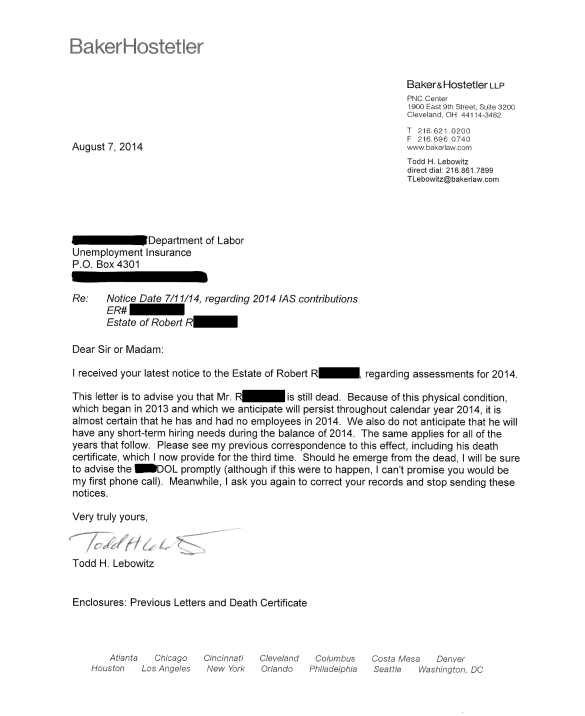
Exasperated, I then sent this.

THL letter - why we are not paying these assessments

The agency stopped sending assessments, and I never heard from them again.

© 2019 Todd Lebowitz, posted on WhoIsMyEmployee.com, Exploring Issues of Independent Contractor Misclassification and Joint Employment. All rights reserved.

Need training on avoiding independent contractor misclassification claims? Hey, I do that!  

Enter your email address to subscribe to this blog and receive notifications of new posts by email.

2018_Web100Badge


A New Low for California’s Independent Contractors? ABC Test May Be Adopted for the Whole Labor Code

Death valley for independent contractors - california dynamexCalifornia is the home of both the highest and the lowest points in the continental U.S. — Mt. Whitney at 14,495 feet and Death Valley at -282 feet. As far apart as these two sites are on the altimeter, they’re less than 100 miles apart on the odometer.

That’s a lot of up and down. If you follow California’s developing law on Independent Contractor vs. Employee tests, you’ve also seen a lot of ups and downs recently. If a pending bill passes (as expected), businesses using independent contractors may be about to experience a new low.

Remember the Dynamex case? As explained here, that’s the California Supreme Court decision that enacted a strict ABC Test for determining whether someone is an employee or an independent contractor under California’s wage orders. As we discussed here, though, the ABC Test only applies to certain state law employment claims. Other less stringent tests still apply when analyzing whether a contractor should really be considered an employee under other state employment laws.

But that may be about to change.

Assembly Bill 5 would adopt the Dynamex ABC Test as the way to determine whether someone is an employee under all parts of the California Labor Code and under state unemployment law.

In its current form, the law would exempt certain licensed professions from being subject to the ABC Test. Extensive lobbying efforts are underway by various trade associations to carve other trades out of the law as well. For those professions excluded from the law’s reach, the test for determining whether a contractor is really an employee would be the S.G. Borello balancing test, a much less stringent standard than the Dynamex ABC Test.

The bill is now pending before the state senate. If it passes, it will become even harder to be a legitimate independent contractor in California. The state with one of North America’s highest peaks will become a virtual Death Valley for contractors trying to maintain their independent status.

We’ll continue to follow the status of this bill.

© 2019 Todd Lebowitz, posted on WhoIsMyEmployee.com, Exploring Issues of Independent Contractor Misclassification and Joint Employment. All rights reserved.

Enter your email address to subscribe to this blog and receive notifications of new posts by email.

2018_Web100Badge