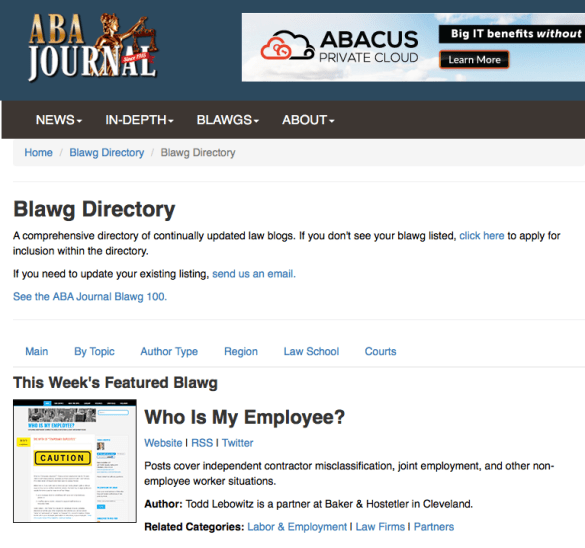
WhoIsMyEmployee.com named “Featured Blog of the Week” by American Bar Association’s ABA Journal

Thanks to the ABA Journal for recognizing WhoIsMyEmployee.com as its Featured Blog of the Week for the week of May 18, 2017. I appreciate the recognition!

To my readers: I hope you have been enjoying the blog, and I encourage you to email me with ideas for posts, along with any questions or comments.

Thanks!

Todd Lebowitz

Screen Shot 2017-05-21 at 1.48.09 PM

Never Been Sued? Congratulations! Here’s Why You Should Re-Evaluate Your Use of Independent Contractors Now.

IMG_1072Have you ever heard someone say, “The definition of insanity is doing the same thing over and over and expecting a different result“? That’s just wrong. No, it’s insanely wrong. (Irony! Actual definition, click here).

  • If you flip a coin 5 times and it comes up heads each time, is it insane to think it might come up tails next time?
  • If you play golf in a lightning storm five times and never get hit, is it insane to think you might get a nice electrical jolt next time?
  • If you root for the Browns to win a football game and they never do, is it insane to think they never will? [Note to self: Delete that. Bad example. It is true that they might never win a game. Shameful admission: I am a Browns fan.]

My consistent advice to companies that use independent contractors is to be proactive. Review your policies, practices, and documents now — before you get sued or audited. Many take this advice. Those who do not generally give two reasons:

  1. We don’t want to spend the money now; and
  2. We’ve always done it this way and have never been sued.

Folks, that kind of thinking is: n. extreme foolishness; folly; senselessness; foolhardiness.

Here are a few quick facts:

  1. Every company that has been sued for independent contractor misclassification had never been sued before the first time it was sued.
  2. Every company that has been audited for independent contractor misclassification had never been audited before the first time it was audited.

Continue reading

Today’s Tip: Avoid Telling Contractors How to Perform the Work (with Stones lyrics)

IMG_1066The great scholar Mick Jagger reminds his followers that you can’t always get what you want, but if you try sometimes well you might find you get what you need. This is good advice, not just for Mr. Jimmy (who did look pretty ill), but also for companies who use independent contractors.

In a true independent contractor relationship, the hiring entity knows what it needs. It needs results, but the details about how, when, and where to work toward those results are left to the contractor’s discretion. There is no oversight or supervision.

The more direction a company provides a contractor on how to perform the work, the more likely the contractor is misclassified and the relationship will be deemed employment. You might want to control these things, but if they are not necessary to get what you need, then you should try sometimes and you might find you can get what you need without exerting extra control over the contractor. Continue reading

New Florida Law Grants Independent Contractor Status to App-Based Drivers

IMG_1064In December 1965, the Beatles released Rubber Soul, which led with Drive My Car.  (“Asked a girl what she wanted to be/She said Baby, can’t you see?/I want to be famous, a star on the screen/But you can do something in between.”) You can thank me later for getting that song stuck in your head all day.

Under a new Florida law, online ride hailing service are singing “Baby you can drive my car, and maybe I’ll love you.” If certain easy-to-meet conditions are satisfied, drivers for online ride hailing services are declared independent contractors by law, not employees. This new law protects Uber, Lyft, and similar services from misclassification class actions brought under state law.

The requirements for being granted independent contractor status under the new law are simple. Continue reading

Trump’s Tax Plan Is Great News for Independent Contractors! Here’s Why.

IMG_1063

[Important Note to Readers, 1/15/18: This post is dated May 2017, before the final tax plan was passed, and the final version is slightly different than described in this post. For a revised 2018 analysis based on the final tax bill, click here.]

President Trump’s tax plan, released last week, is great news for independent contractors. Contractors may be able to cut their tax rates by half (or more) by creating an entity, instead of contracting as an individual. Indirectly, this would help companies who use contractors as well. Here’s why:

Benefit to Individuals:

For individuals, the proposal would reduce personal tax rates modestly. An individual being paid as an independent contractor will likely see a reduction in marginal tax rates, but the range is likely to remain somewhere between 25% and 35%, depending on income level.

For individuals being paid through their homemade entities, however, the proposal could result in substantial savings. Currently, pass-through entities like LLCs pay taxes at the rate of the individual. The sole owner of an LLC would pay taxes on the LLC’s profits at the individual’s personal income tax rate, likely between 25% and 35%.

Under the proposal, however, pass-through entities such as LLCs and partnerships would instead be taxed on pass-through business income at 15%. That’s a sizable savings compared to 25-35%. [Note 9/29/17: Latest proposal would tax entities at 20%, not 15%, but there’s still a long way to go before any of this becomes law.  And it may never become law.  For now, it’s just a proposal.]

If this proposal passes, individual independent contractors will have a strong financial incentive to incorporate. Creating an LLC is relatively inexpensive. If it leads to Continue reading

Avoid this ADA Trap When Using Staffing Agency Workers

ADA staffing agency reasonable accommodation ambulance-2166079_1280ADA Quick Quiz: Your company uses staffing agency workers. A staffing agency worker discloses a medical need and asks for a reasonable accommodation — maybe a computer screen reading program, or an ergonomic chair, or a modified work schedule.

1. Which company must have the interactive conversation to determine what reasonable accommodation is appropriate?

(A) Your company
(B) The staffing agency
(C) Both

2. Which company is obligated to provide the reasonable accommodation?

(A) Your company
(B) The staffing agency
(C) Both

3. Which company is obligated today for the reasonable accommodation?

(A) Your company
(B) The staffing agency
(C) Both

Answers: Continue reading

Maximum Badass Trucker Fight Fails to Break Up Independent Contractor Status

boxing-independent contractor or employee - independent contractor misclassification 0 100733_1920

In 2012, Mens Fitness Magazine ranked the “12 Most Badass Fight Scenes of the Millennium.” An obscure Ohio rest stop battle between two truckers didn’t make the list, but one attacked another viciously with a metal bar, breaking his leg and causing permanent injuries after being cut off in traffic.

But that’s not why I mention the Rest Stop Rumble (a/k/a Herndon v. Torres). The victim trucker sued both the trucker and the trucking company whose load the wannabe Maximus Decimus Meridius was hauling.

The trucking company avoided liability, however, by proving to the court that its relationship with Maximus was that of an independent contractor. While an employer can be held vicariously liable for the badass acts of its employees, there is generally no vicarious liability for independent contractors.

The court evaluated the relationship between Mad Max and the trucking company using a Right to Control Test, which is used to determine Who Is My Employee? under Ohio tort law.

The following factors helped establish that Max Zorin, while still the story’s villain, was not an employee of the trucking firm: Continue reading

What’s Up? Black Car Drivers Are Independent Contractors. Here’s Why.

balloons-1786430_1280At the end of Pixar’s Up, Carl and Russell sit on a curb pointing out cars: “Red one!” “Blue one!” Then Dug (the dog) calls out “Gray one!” which I find endlessly funny every time I watch it.

Whatever color the car, they sat there content, eating ice cream.

Black car companies in New York are celebrating too (hopefully with ice cream), after a recent decision preserving their drivers’ status as independent contractors. In Salem v. Corporate Transportation Group, the Second Circuit Court of Appeals ruled that drivers were not entitled to overtime pay, since they were not employees, but rather independent contractor franchisees.

We’ve written often in this blog about the different tests for determining Who Is My Employee? This case was brought under the Fair Labor Standards Act (FLSA) and comparable New York law, so the Court applied an Economic Realities Test. This test measures whether workers are economically dependent on one company to earn a living or are in business for themselves.

Relying on the Economic Realities factors, the Court ruled the drivers were economically independent and were in business for themselves. Here are the keys to victory:

  1. The drivers purchased franchises, choosing from a variety of options (rent, own);
  2. The drivers used their own cars and paid all their own expenses;
  3. The drivers could drive for competitors or for personal clients;
  4. The drivers were entrepreneurs, controlling many significant aspects of their personal driving business;
  5. The drivers were free to accept or reject jobs;
  6. The drivers chose when, where, and how often to work; and
  7. The franchisor company could not freely terminate the drivers’ franchise agreements.

While independent contractor relationships remain under fire, this decision shows that there’s still hope. Companies can win these cases when they carefully construct the facts, relinquish control, and allow contractors to run their own enterprises.

Although these drivers had considerable discretion over how to run their individual businesses, none (unfortunately) had the creativity to ditch the car and transport customers in a helium-balloon powered house.  Now back to the film.

film-158157_1280

© 2017 Todd Lebowitz, posted on WhoIsMyEmployee.com, Exploring Issues of Independent Contractor Misclassification and Joint Employment. All rights reserved.

Are Independent Contractors Exempt from the FLSA?

hurry-FLSA-independent contractor -2119711_1920Sort of. The Fair Labor Standards Act (FLSA) covers only employees, not independent contractors. The FLSA’s requirements on minimum wage and overtime, therefore, do not apply to independent contractors.

But wait, dear reader, don’t click away quite yet! There’s more! The real question is whether your independent contractor is really an independent contractor.

The question of Independent Contractor vs. Employee is determined under the FLSA by applying an Economic Realities Test to the facts of the relationship, not by deferring to how the parties have characterized they relationship.

The Economic Realities Test evaluates whether the worker is economically reliant on the company for which services are being provided, as opposed to in business for himself/herself.

I have written about the Economic Realities Test here, walking the reader through the various factors that courts and the DOL use to determine Who Is My Employee? under the FLSA.

The bottom line: A true independent contractor is not covered by the FLSA, but an Economic Realities analysis must be applied to determine whether a worker is truly an independent contractor.

© 2017 Todd Lebowitz, posted on WhoIsMyEmployee.com, Exploring Issues of Independent Contractor Misclassification and Joint Employment. All rights reserved.

How Can There Be Misclassification When The Worker Prefers to Be an Independent Contractor?

Alan Hudock

Photo of Singer Dave Mason (We Just Disagree), by Alan Hurtock

Let’s start with this: Everyone is happy being an independent contractor until they’re not.

What do I mean by that? Right now, the relationship works. The contractor performs, and you pay for the work.

But what happens when things go south? As soon as you decide you no longer need those services, the contractor might stop being your BFF.

A disgruntled former contractor has some options, all of which involve some variation of this story: “Once upon a time, I was misclassified and should have been an employee.” None of the former contractor’s possible next steps are good for you: Continue reading