California is the home of both the highest and the lowest points in the continental U.S. — Mt. Whitney at 14,495 feet and Death Valley at -282 feet. As far apart as these two sites are on the altimeter, they’re less than 100 miles apart on the odometer.
That’s a lot of up and down. If you follow California’s developing law on Independent Contractor vs. Employee tests, you’ve also seen a lot of ups and downs recently. If a pending bill passes (as expected), businesses using independent contractors may be about to experience a new low.
Remember the Dynamex case? As explained here, that’s the California Supreme Court decision that enacted a strict ABC Test for determining whether someone is an employee or an independent contractor under California’s wage orders. As we discussed here, though, the ABC Test only applies to certain state law employment claims. Other less stringent tests still apply when analyzing whether a contractor should really be considered an employee under other state employment laws.
But that may be about to change.
Assembly Bill 5 would adopt the Dynamex ABC Test as the way to determine whether someone is an employee under all parts of the California Labor Code and under state unemployment law.
In its current form, the law would exempt certain licensed professions from being subject to the ABC Test. Extensive lobbying efforts are underway by various trade associations to carve other trades out of the law as well. For those professions excluded from the law’s reach, the test for determining whether a contractor is really an employee would be the S.G. Borello balancing test, a much less stringent standard than the Dynamex ABC Test.
The bill is now pending before the state senate. If it passes, it will become even harder to be a legitimate independent contractor in California. The state with one of North America’s highest peaks will become a virtual Death Valley for contractors trying to maintain their independent status.
Everyone loves a fun funeral story, right? Apparently so. AARP.com posted this article about creative cremations. Available options for ashes include:
Being blasted out of a cannon to the tune of “Mr. Tambourine Man,” (Thank you, Hunter S. Thompson);
Being placed in an “environmentally safe, ball-shaped concrete memorial reef” and placed in the ocean to create a marine habitat, (giving a new and more literal meaning to “sleeps with the fishes”);
Being launched into space for an earth orbit; and
My personal favorite – being loaded into a five-foot biodegradable helium balloon and launched over the hills surrounding the deceased owner’s ranch so his buddies could shoot at the balloon until it burst, spreading the ashes over the surrounding foothills (so beautiful it almost makes me want to weep in my moonshine).
A cremation company had a less fun time last month, when a judge approved a $2.5 million settlement for independent contractor misclassification. The settlement included $1.65 million to a class of independent sales representatives and $825,000 in attorneys’ fees to the plaintiffs’ lawyers.
The company’s independent sales representatives had claimed that they were really employees, despite having signed an Independent Contractor Agreement in which they agreed they were contractors.
As we’ve noted many times before, though, it’s the facts of the relationship that matter, not what the parties call themselves. According to the plaintiffs, the cremation company told them when to work and where to work, paid them an hourly non-negotiable rate, required frequent reports, supervised their work, and provided them a handbook instructing them how to conduct themselves and how to perform their work. These are all facts that weigh in favor of employment status.
The sales reps’ lawsuit alleged that, when assessing the facts of the relationship, they were really employees and not independent contractors. They alleged violations of several laws that apply only to employees, including violations of California’s overtime, meal and rest break, waiting time, recordkeeping, and business expense reimbursement laws; and violations of the federal FLSA overtime rules.
The parties settled the dispute, and a federal judge approved the settlement.
There’s nothing suprising here, but the settlement should remind us that:
The facts of the relationship are what matter, even if the parties agree to call the workers “independent contractors” and they sign an Independent Contractor Agreement;
Different tests apply to different laws; here, there were claims that would have to be evaluated under:
Independent contractor misclassification remains a real and potentially costly risk.
The settlement did not say whether any of these sales representatives sold cannon, reef, space, or skeet shooting funerals along with cremation services. But I sure hope they did.
According to The Atlantic, when a peacock spreads and shakes its elaborate feathers, it shakes them at 26 times a second, which creates a pressure wave that is sensed by a female peahen through the crest atop her head. This precise frequency causes the female’s crest to vibrate in a way that is apparently very sexy for peafowl. The male seeks attention and, with just the right vibrations, he lets all the single pea-ladies know that he wants some action. Note to pea-fellas: If you like it, then you shoulda put a ring on it.
In a crowded field of Democratic Presidential hopefuls, something similar is happening, but it’s less pretty, less sexy, and less appealing for businesses across the country.
As Democratic legislators vie for union support in the upcoming 2020 election, they’re making sure to signal to workers and unions that they’ve got pretty feathers and they’re not afraid to use them. A new bill co-sponsored by Presidential hopefuls Kamala Harris (Calif.), Bernie Sanders (Vt.), Elizabeth Warren (Mass.), Cory Booker (N.J.), Kirsten Gillibrand (N.Y.), Amy Klobuchar (Minn.), and Rep. Tim Ryan (Ohio) would amend the National Labor Relations Act (NLRA) to redefine “employee” and “joint employment.”
The Protecting the Right to Organize Act of 2019 would impose a strict Dynamex-style ABC Test for determining Who Is My Employee? under the NLRA. A worker would be deemed an employee under the NLRA by default and could only be deemed an independent contractor if all three of the following could be proven:
(A) the worker is free from the control and direction of the hiring entity in connection with the performance of the work, both under the contract for the performance of the work and in fact, and
(B) the worker performs work that is outside the usual course of the hiring entity’s business, and
(C) the worker is customarily engaged in an independently established trade, occupation, or business.
This is the same strict ABC Test adopted by the California Supreme Court in Dynamex and by the Massachusetts legislature for its state wage and hour claims.
The Act would also redefine joint employment. It would require that an entity be deemed a joint employer under the NLRA if it “codetermines or shares control over the employee’s essential terms andconditions of employment.” So far, so good. But then there’s this: “In determining whether such control exists, the Board or a court of competent jurisdiction shall consider as relevant direct control and indirect control over such terms and conditions, reserved authority to control such terms and conditions, and control over such terms and conditions exercised by a person in fact.”
The Act would stymie the NLRB’s current effort at passing a new regulation that would limit “joint employment” to situations where actual control is exerted (not merely reserved) and where that control is exerted over essential terms and conditions of employment, such as hiring, firing, and pay.
Most damaging of all (but not related to independent contractor or joint employment issues), the bill would fundamentally change the collective bargaining process by imposing binding arbitration on the parties to resolve any disputes in contract negotiation. That change, if it were ever adopted, would change the nature of bargaining as we know it, potentially removing much of the incentive for unions to bargain in good faith.
If the Act emerges from committee, it will likely pass the House but has no chance of success in the Senate. Even if it passed, it would almost certainly be vetoed by Trump anyway.
For now, the Act is a political move intended by the Democratic Presidential hopefuls to demonstrate their pro-worker, pro-union credentials. For a certain audience, the Act looks pretty and may vibrate some crests. But for at least the next two years, this display of feathers is not likely to lead to any action.
Bonus feature: For another peacock-related post, click here.
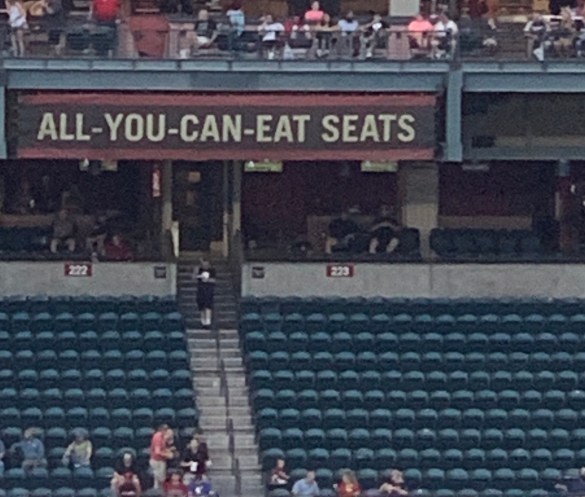
I was in Phoenix last week and saw this sign at a Diamondbacks Game. The seats in Section 223 were probably plastic and hard to chew but otherwise looked pretty tasty. Still, I don’t think I could eat more than a few at a time.
Ok, I know what the sign intended, but my reading is a fair one too. Right? The message wasn’t quite clear.
The NLRB was much more clear in the message it sent last week in an Advice Memorandum from the Office of the General Counsel. The Board opined that UberX and UberBLACK drivers were independent contractors, not employees of the ride-share app.
The opinion letter applies only to federal labor law (the NLRA), not to wage and hour law, employee benefits law, tax law, or the vast potpourri of state laws, but it’s another sign that the current administration is intent on protecting independent contractor relationships — if the relationships are properly structured.
The memo applied the same Right to Control Test for determining Independent Contractor vs. Employee that the Board used in January in its SuperShuttle decision. In SuperShuttle, the Board ruled that a group of airport van drivers were independent contractors, not employees, under the National Labor Relations Act. The ten-factor Right to Control Test used by the Board is explained here.
This NLRB Advice Memorandum arrives less than three weeks after a similar opinion letter from the Department of Labor (DOL). The DOL’s April 29 letter concluded that service providers who use “virtual marketplace” apps to find customers are independent contractors, not employees. While the letter doesn’t identify the app it reviewed, the DOL’s analysis seems to apply to Uber and other ride-share apps and to the service providers (drivers) who use these apps to find customers. The DOL’s letter addressed only the Fair Labor Standards Act (FLSA), which applies a six-factor Economic Realities Test for determining Independent Contractor vs. Employee. Different law, different test.
Here are four takeaways from the two letters, viewed together:
Different tests apply to different laws, even for similar circumstances. That’s been a consistent theme in this blog, and these two letters — one interpreting the NLRA and the other interpreting the FLSA — reinforce the different approaches. Click here for a chart showing the different tests for Independent Contractor vs. Employee, as of January 2019.
The current administration and its executive agencies are much friendlier toward independent contractor relationships than their Obama-era predecessors. The Obama DOL and NLRB were outright hostile toward independent contractor relationships (see examples here for DOL and here for NLRB), so this is a major change.
These are not court decisions and do not bind the federal courts, even as to NLRA and FLSA cases.
These opinions apply only to the NLRA and the FLSA — two of the many federal laws that apply only to employees, not independent contractors. The opinions do not directly impact federal tax law or employee benefits law, and they do not impact any of the myriad state laws. In other words, the states don’t care.
The area of independent contractor misclassification and the never-ending quest to determine Who Is My Employee? continues to evolve at a pace that should keep readers on the edge of their seats. Just don’t sit too close to the edge, because if you abandon your seat, someone at a D-Backs game might try to eat it.
A Mongolian couple died from the bubonic plague earlier this month after eating raw marmot meat. An official from the World Health Organization told the BBC that the couple ate the rodent because they believed it would bring them good health. It didn’t.
Positive thinking can be powerful, but not as powerful as bubonic plague.
California businesses that use independent contractors should be similarly cautious about any positive thinking. After a series of court decisions and a new opinion letter from the California Labor Commissioner, use of the Dynamex ABC Test for determining Independent Contractor vs. Employee is expanding.
Which claims now use the Dynamex test for determining Independent Contractor vs. Employee? Here’s the latest list — at least according to the California Labor Commissioner and my reading of recent court decisions:
Dynamex ABC Test applies:
Overtime;
Minimum wage;
Reporting time pay;
Record keeping (including itemized pay stub obligations);
Business expense reimbursement for cash shortages, breakage, or loss of equipment;
Business expense reimbursement for required uniforms, tools, and equipment; and
Meal and rest periods.
It depends:
Payment of wages upon termination of employment, under Section 203 of the California Labor Code; and
To determine Independent Contractor vs. Employee for these claims, the Labor Commissioner and a California Court of Appeal instruct that the Dynamex ABC Test applies if the claim is focused on enforcing payment of minimum wage, overtime, and other obligations set forth in the Wage Orders. If not, then the ABC Test does not apply.
The opinion letter does not carry the weight that a court decision does, and it makes some assumptions that the California Supreme Court did not make when it adopted the ABC Test in Dynamex. So there’s always a chance that the California Supreme Court might rule that the scope of the Dynamex test is supposed to be limited to a narrower range of claims. But this is California, so that does not seem likely. In other words, don’t sample that marmot meat.
For these claims, either the S.G. Borello balancing test should apply if the claims are asserted under California law. For tax and employee benefit claims asserted under federal law, the Right to Control Test will apply. Read more here to understand how one California Court of Appeals determined which test applies to which claim. (Including entirely unnecessary references to G-L-O-R-I-A Gloooooria!)
One of the reasons independent contractor misclassification claims can be so challenging to defend is because different tests apply to different claims. This is not just a California problem.
Here is a similar chart, showing which test applies to which federal law claims.
In California, it’s getting harder and harder to prove independent contractor status, especially for claims applying the Dynamex ABC Test. Many Californians are into zen, meditation, and positive thinking, but the power of positive thinking might not get you too far when it comes to trying to preserve independent contractor status. There are still defenses, and it’s still possible to maintain independent contractor status in California, but it’s not easy.
Fighting misclassification claims in California can sometimes feel like eating raw marmot meat. It might seem like a good idea at first, but then you could end up with bubonic plague.
In a mediocre and overplayed 1989 pop song, Cher sang about how she wished she could turn back time. If she could turn back time, according to the song, she’d take back those words that’ve hurt you and you’d stay.
The music video for “If I Could Turn Back Time” takes place on the deck of the battleship USS Missouri, which the U.S. Navy allowed because it believed the video could help boost recruitment. (How, exactly?) The song reached number one on the pop charts in Australia and Norway, causing me to question the collective judgment of the citizens of these otherwise fine nations.
As Cher well knew, you can’t turn back time. Doing so would cause all sorts of problems. As we will now see in California.
On May 2, the Ninth Circuit Court of Appeals ruled that California’s Dynamex decision (from April 2018) must be applied retroactively. In the Dynamex case, the California Supreme Court had ruled that a strict ABC Test should be used to determine whether workers are considered employees or independent contractors under California’s wage orders.
You can read more about the test here, but what’s most important for now is that the test is really hard to meet. That’s why in Vazquez v. Jan-Pro Franchising International, Jan-Pro argued that since it was being sued for events that took place before the Dynamex ruling, its lawsuit should be decided under the test that was used before the Dynamex ruling. Jan-Pro argued that the Dynamex decision made up new rules in the middle of the game, and Jan-Pro should not be held to the new, made-up rules for time periods before the new rules were made up.
That seems logical to me, but not to the Ninth Circuit. Instead, the Court of Appeals ruled that Dynamex must be applied retroactively. The Court’s reasoning makes little sense.
The Court based its decision on the general rule that new statutes are applied prospectively, but court decisions are applied retrospectively. That makes sense as a default rule — but only if the court decision is interpreting the text of a statute or is applying a well-known rule to a set of facts.
The ABC Test was invented by the California Supreme Court in its April 2018 Dynamex ruling. That test did not exist in any California statute enacted by the legislature or in any regulation. Before the Dynamex case, no business in California had any reason to believe that an ABC Test was the test — especially since for decades a different test had been used. The Dynamex decision, therefore, was much more like the enacting of a new statute than the judicial interpretation of a long-standing law.
In fact, the Ninth Circuit’s decision last week goes so far as to admit that the Dynamex decision was, in essence, the adoption by California’s Supreme Court of a Massachusetts statute that had never been passed by California’s legislature.The Ninth Circuit ruling includes this sentence, which precisely demonstrates my point:“Thus, by judicial fiat, California incorporated Massachusetts’ employment classification statute into its labor laws.” Before April 2018, Massachusetts had an ABC Test, by statute. California did not.
Judicial fiat! That quote says it all. Judicial fiat is when the judiciary (not the legislature) creates a new law. It is a term most commonly used to criticize a judicial decision as going too far and usurping the role of the legislative branch.But here the Ninth Circuit concedes that’s what the California Supreme Court did in Dynamex.Since the Dynamex decision adopted a Massachusetts statute by judicial fiat, then the only fair way to apply that rule is to treat it like a statute and apply it only prospectively. But no.
It seems blatantly unfair for a court to make up new rules by adopting a different state’s statute — one that California’s legislature never adopted — and then to hold California’s businesses liable for failing to comply with a set of rules that did not yet exist.
So, Todd, tell me how you really feel.
Anyway, that’s now the law in California. The ABC Test invented by California’s Supreme Court in the Dynamex court now applies when determining whether someone is an employee under California’s wage orders, even for time periods before the test was invented.
You can read more about the Dynamex decision here and here.
California business are being advised to consider moving to Australia.
Long before mobile apps were a thing, Pete Townsend and The Who were already going mobile. In the 1971 song, Townsend sings about the virtues of life on the open road, living in a mobile home. I’m an air-conditioned gypsy.
In an important opinion letter released this week, the DOL went mobile too, lending support to businesses in the “on-demand” or “sharing” economy. The letter is the first significant ruling that supports independent contractor status for service providers who obtain work through virtual marketplace apps.
A virtual marketplace app is a matchmaking service. It connects consumers who need a service (driving, housekeeping, handyman, anything) with service providers who do the work. Virtual marketplace companies (VMCs) are frequently the target of misclassification claims. In these types of claims, service providers — and the plaintiffs’ lawyers who love them — file lawsuits claiming that the service providers are really employees of the VMC. Frequent targets have been Uber, Lyft, Doordash, and Grubhub.
In Monday’s letter, the DOL opined that service providers are indeed independent contractors of the VMC, not its employees, at least under the facts of this particular case. The letter does not identify the specific VMC at issue, but the facts in the letter are going to be generally applicable to lots of VMCs.
Meatloaf’s “You Took the Words Right Out of My Mouth” opens with a dialogue by Jim Steinman, who wrote the song, and actress Marcia McClain, who played Dee Stewart in the soap opera As the World Turns. He asks, “On a hot summer night, would you offer your throat to the wolf with the red roses?”
For a quick trip back to 1978-79, listen to the album version, not the shortened single, which cut out the dialogue, presumably because it distracted the roller skaters. The song is about teenage lovers and passion, and the lyrics are rich with intense imagery.
Offering a new twist on this old classic, the Supreme Court last week issued a ruling on arbitration agreements that can be paraphrased as “You took the words right out of the air because they weren’t in my arbitration agreement.” This decision will inflame passions in the pro-worker camp, but it’s a good decision for businesses. The case is called Lamps Plus v. Varela.
Yesterday I was at Ohio E-check. When they use their fancy vehicle emissions testing equipment, they ask you to get out of your car and wait in a small glass-walled waiting area. Inside there are two signs. The first says: “Ohio E-Check. No cell phones!” The second says: “Ohio E-Check. How are we doing? To comment, use this QR code.”
Regrettably, I complied with the first sign, so I do not have a picture for you of the two signs. (While waiting, I tried like hell to memorize that QR code!)
When waiting for E-Check, mixed messages are funny. When retaining independent contractors, however, mixed messages are no joke. If enough signs suggest that a contractor is really an employee, the risk of a misclassification finding is heightened, and the consequences of misclassification can be severe.
Forgive me in advance if I sound condescending. And skeptical. And incredulous. But above all, I am amused.
This is the story of a strip club called the Godfather. When one of its dancers, a young lassie named Tassy, tried to sue, alleging that she had been misclassified as an independent contractor, the Godfather asked the court to send her claims to arbitration, as required under the Godfather’s dancer agreement.
But the Godfather had one small problem. It could not produce the agreement because, it claimed, the agreement was washed out in a flood caused by a rusted-out water heater in the back room. As everyone knows, the flood-prone back room with the rusted-out water heater is the best place for storing corporate legal documents. (Note to self: update template document retention guidelines.) Preferably, as the Godfather did, store them in unmarked boxes with no index or system for determining exactly what was in the boxes. But Tassy’s agreement was in there. They’re pretty sure, anyway.

 California is the home of both the highest and the lowest points in the continental U.S. — Mt. Whitney at 14,495 feet and Death Valley at -282 feet. As far apart as these two sites are on the altimeter, they’re less than 100 miles apart on the odometer.
 Everyone loves a fun funeral story, right? Apparently so. AARP.com posted