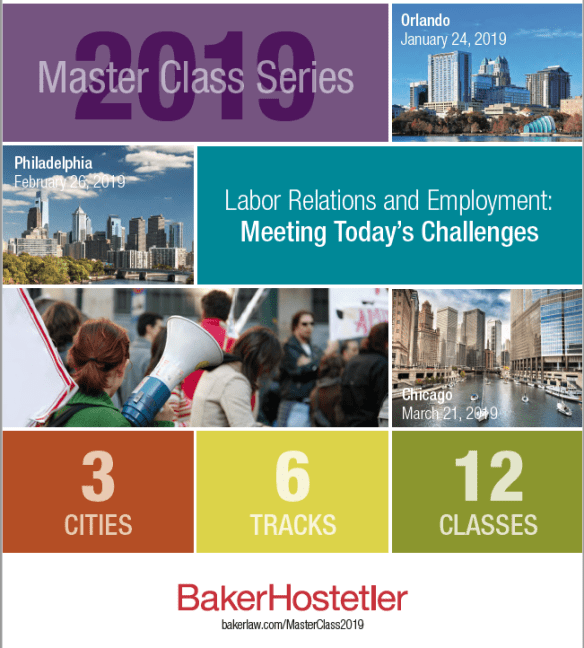
Join Me at Baker Hostetler’s 2019 Master Class on Employment Law (Three Locations)

2019 master class logoPlease join me and my colleagues in the Employment Group at Baker Hostetler for the 2019 Master Class on Labor Relations and Employment Law.  This year’s event will take place in three locations:

I will be presenting on the Gig Economy: Labor Relations Issues, with my colleague Peter Fischer.  We’ll cover 2018-19 developments in joint employment (there are many!) and the future of portable benefits for gig economy workers.

One of the best parts about the format of the Master Class is the ability to customize your day. Each attendee will choose 6 of 12 possible classes to attend and will receive a customized schedule. We’ve added several new hot topics to this year’s program, including #MeToo, Artificial Intelligence, and Union Organizing through Social Justice Campaigns.

To register, click here, or you can contact me directly at tlebowitz@bakerlaw.com.  If you list me as the attorney who invited you, I will have your admission fee waived.

More information is available by clicking the links to any of the cities listed above.

I hope to see you there!

© 2019 Todd Lebowitz, posted on WhoIsMyEmployee.com, Exploring Issues of Independent Contractor Misclassification and Joint Employment. All rights reserved.

Enter your email address to subscribe to this blog and receive notifications of new posts by email.

2018_Web100Badge

Backfired? New Ruling May Threaten NLRB’s Proposed Rule on Joint Employment

Joint employment bagpipe

The word “backfire” derives from the grooming practices of 15th century Scottish noblemen, who grew beautiful long fiery-red flowing back hair, which they brushed and braided into elaborate patterns, including the “Haggis Flow” and the “Scotch Tape.” Ok, not really. Efforts to rewrite history and change definitions can sometimes fall short of the mark.

The NLRB’s grand strategy for rewriting the definition of joint employment may have just backfired. A Court of Appeals decision issued late last week may jeopardize the Board’s rulemaking authority, even though that was not the issue before the Court.

Before we dive into the December 28, 2018 ruling, here is a quick refresher on how we got here:

  • In 2015, the Democratic-majority Board adopted a vastly expanded definition of joint employment, allowing a business to be deemed a joint employer (1) even if it did not control working conditions but merely retained the right to do so, or did so indirectly, such as through third party subcontracting, and (2) even if the working conditions that could be controlled were non-essential working conditions, not just the key terms and conditions like hiring, firing, and disciplining. This was the Browning-Ferris decision.
  • In early 2018, the newly constituted Republican Board tried to reverse its 2015 Browning-Ferris decision in a case called Hy-Brand, in which the Board enacted a much narrower, pro-business definition of joint employment, requiring direct and immediate control over essential terms and conditions of employment before a company could be deemed a joint employer.
  • Several weeks later, however, the Board reversed itself and rescinded the Hy-Brand decision after conflict of interest questions arose relating to one of the board members (Member Emanuel) who decided Hy-Brand. When the Board rescinded its Hy-Brand decision, the effect was to re-establish the expansive 2015 Browning-Ferris test as the operative definition of joint employer.
  • In light of its failed effort in Hy-Brand, the Board then chose to pursue a two-step Plan B for overruling Browning-Ferris and for narrowing the definition of joint employment.
  • Step 1 would be to enact a new regulation, creating a narrower definition of joint employment that would, in effect, overrule Browning-Ferris prospectively. That process is ongoing. Step 2 was to ask the D.C. Court of Appeals to reopen the otherwise mothballed appeal of the Board’s 2015 decision in Browning-Ferris, which adopted the current broad definition of joint employment.
  • In Step 2, the Board expected the Court of Appeals to find that the 2015 Browning-Ferris decision was an overreach and that the vastly expanded definition of joint employment could not survive. That ruling would have nicely positioned the Board to roll out its new regulation, which would substantially narrow the definition of joint employment, as it tried to do in the Hy-Brand case.

That brings us to this past Friday’s decision by the D.C. Circuit Court of Appeals (Dec. 28, 2018) and the real meaning of the word “backfire.” Step 2 did not go the way the NLRB had planned.

The Court of Appeals’ Ruling and Its Effect on Joint Employment

According to the 2-1 majority opinion, the question of whether there is a joint employment relationship under the National Labor Relations Act (NLRA) must be answered by applying the common law test for whether there exists an “agency” relationship.  The Board has no special expertise relevant to defining the common law of agency. Therefore, according to the Court of Appeals, the Board is awarded no deference in this area. In other words, the Board does not have the right to define or redefine joint employment in a way that would be inconsistent with the common law meaning of “agency.”

The Court of Appeals said that the Board’s 2015 ruling in Browning-Ferris — that indirect or reserved control can be considered when determining whether a joint employment relationship exists — was appropriate because it is consistent with the common law of agency.  Under the common law, it is the right to control that matters, even if that control is not exercised. In fact, the Court of Appeals concluded that Board has no authority to prohibit the consideration of indirect or reserved control when evaluating whether there is joint employment. (That’s what the Board is currently trying to do through rulemaking.)  The reason the Board cannot prohibit consideration of indirect or reserved control is that the common law definition of agency examines whether an entity has the right to control how work is performed, regardless of whether that control is exercised. This last point is important for reasons that the D.C. Court of Appeals was not directly addressing. That point — if it hold true — would cast doubt on the Board’s ability to implement its proposed new regulation. The regulation would require a showing of direct and immediate control (not merely indirect or reserved control) before joint employment can be found.

The D.C. Circuit Court of Appeals did not, however, give the Board’s 2015 Browning-Ferris ruling its full backing. Where the Browning-Ferris ruling went wrong, according to the Court of Appeals, was in allowing the consideration of indirect or reserved control over non-essential terms and conditions of employment.  The common law agency test requires control (or indirect or reserved control) over essential terms and conditions of employment (e.g., hiring, firing, disciplining).  The Court therefore ruled that the Board lacks authority to change that definition in a way that make a business a joint employer merely by entering into a standard subcontracting or staffing agency agreement. All such relationships involve some level of control over non-essential working terms, such as defining the type of work to be done by the subcontractor or staffing agency workers and dictating the desired result.

The 2015 Browning-Ferris case is now being remanded back to the Board to take another shot at it. That would be fine and dandy with the now-Republican-majority Board, except for the fact that the Board may now be impotent to make a meaningful pro-business change in this case, since Member Emanuel might be precluded from participating in the decision due to Littler’s representation of Leadpoint, the staffing agency in the Browning-Ferris dispute (or maybe he is not precluded now, since the one-year conflicts period has now lapsed). Member Emanuel was a shareholder in the Littler firm before his appointment to the Board in September 2017. Further complicating the possible recusal issue is the fact that Trump required his appointees to sign an Ethics Pledge that provided a two-year conflict of interest period, rather than the standard one-year period.

The most lasting effect of this Court of Appeals decision is likely to be that it calls into question whether the Board can, through rulemaking, redefine joint employment in a way that eliminates consideration of indirect or reserved control by a putative joint employer.  If the definition of joint employment under the NLRA is determined by the common law of agency, and the Board — according to this Court of Appeals — lacks the expertise to interpret the common law of agency, then the Board would lack authority to change the definition in the way it proposes.

On the other hand…

On the other hand, it may be that this decision has no lasting impact at all on the definition of joint employment under the NLRA. This was a 2-1 decision by U.S. Court of Appeals, not by the U.S. Supreme Court. The two judges in the majority were Obama appointees. The full D.C. Circuit could be asked to reconsider the issue in an en banc proceeding.  Or the matter could go to the Supreme Court (which seems unlikely).

Or, if past practice is any indicator of future behavior, the Board might just ignore the D.C. Circuit Court of Appeals, on the basis that there are 12 Circuit Courts and they often disagree. The Board is required to follow rulings by the U.S. Supreme Court, but it often ignores legal opinions issued by the individual Courts of Appeal. The Board must, of course, follow the D.C. Court of Appeals’ ruling as it relates to this particular dispute, but it will not necessarily take the Court of Appeals’ broader rulings as controlling authority on what the Board can or cannot do.

So where are we?

We’ll see. But two things are certain.  First, the definition of joint employment will continue to evolve; and second, the definition of backfire has nothing to do with Scottish nobleman or their back hair.

And at the end of the day, joint employment continues to be a messy, messy situation.

© 2019 Todd Lebowitz, posted on WhoIsMyEmployee.com, Exploring Issues of Independent Contractor Misclassification and Joint Employment. All rights reserved.

Enter your email address to subscribe to this blog and receive notifications of new posts by email.

2018_Web100Badge


NYC May Expand Anti-Discrimination Law to Cover Contractors, Interns

NYC anti discrimination gapI will admit, without shame, that in the 1980s, I loved the Gap Band. Songs like “You Dropped a Bomb on Me” and “Burn Rubber on Me” were just plain fun to listen to. Tip: Try it!

The band’s name didn’t refer to any actual gap — the name comes from the first letters of streets in Tulsa, Oklahoma — but I do know there are many gaps in anti-discrimination law, leaving some types of workers without adequate protection.  

The federal laws that prohibit discrimination in employment, like many (but not all) state laws, protect only employees. That leaves a gap. Independent contractors and interns who have been discriminated against may have no recourse.

The New York City Council is trying to close that gap.

In the same bill we excoriated on Monday for unfairly attacking the franchise model, the New York City Council also proposes to expand the protections of the City’s anti-discrimination law (section 8-107 of the Administrative Code) to protect independent contractors and interns, not just employees. 

Closing that gap makes sense. Hopefully this bill will be amended to keep the parts that expand anti-discrimination protection to non-employee workers (a good idea), while removing the parts that would expand liability to companies not responsible for the discrimination (a bad one).

© 2018 Todd Lebowitz, posted on WhoIsMyEmployee.com, Exploring Issues of Independent Contractor Misclassification and Joint Employment. All rights reserved.

Enter your email address to subscribe to this blog and receive notifications of new posts by email.

NYC to Franchisors: We’re Going “Crazy on You”!

Barracuda NYCIn 1976, the band Heart released the album Dreamboat Annie. Soon after its release, the label (Mushroom Records) released a suggestive National Enquirer-style ad suggesting that sister Ann and Nancy Wilson might also be lesbian lovers. Ann’s outrage led her to write the song “Barracuda,” about ambush and false accusations.

A different Heart song title came to mind as I read the latest attempt by the New York City Council to hold franchisors responsible for acts they did not commit. 

A bill co-sponsored by 19 council members would amend the City’s anti-discrimination law to hold franchisors strictly liable for discriminatory acts by their franchisee. We have seen many attempts to expand the definition of “joint employer” to include franchisors, but this proposal goes beyond anything we’ve seen. This bill doesn’t even deal with the concept of “joint employment.” It just says that franchisors are liable for discriminatory acts of their franchisees, without any analysis of their involvement in the discriminatory acts or their level of control over the franchisee. It’s automatic.

That’s crazy. Holding one company strictly liable for the wrongful acts of another raises all sorts of legal concerns and, if passed, the bill will certainly be challenged in court.

Franchisors, the Council wants to go “Crazy on You.”

Now, truth be told, in the Heart song, going “Crazy on You” has a very different meaning than I intend it here. Ann Wilson and Roger Fisher (her bandmate, co-writer, and lover) meant it in an amorous way, but there is certainly no love between NYC and franchisors. The attacks by NYC on the franchisor-franchisee relationship are more like those of the sharp-toothed predator of the sea, the Barracuda.

© 2018 Todd Lebowitz, posted on WhoIsMyEmployee.com, Exploring Issues of Independent Contractor Misclassification and Joint Employment. All rights reserved.

Enter your email address to subscribe to this blog and receive notifications of new posts by email.

Preview of 2021? New Bill Would Revoke Arbitration Agreements, Raise Stakes for Independent Contractor vs. Employee Disputes

Independent contractor misclassification epic systems congressRegardless of your politics, I think we can all agree that the best part of Election Day being over is that there will be no more political ads for a while. You know what I mean: “Candidate A hates you and your family and supports legislation to tax you into bankruptcy. I’m Candidate B and I approve this message.” Or, “Candidate B hates you and your family and supports criminals and gangs. I’m Candidate A and I approve this message.” Finally and mercifully, that’s going to end for a while.

So let’s look ahead to 2020, when another vicious round of political ads will be unleashed upon your television screen, punishing all who have not yet cut the cord.

With the Democrats taking control of the House, and with several key Republican seats expected to be in play in 2020, a Democratic presidential win in two years could mean that the Democrats enter 2021 in control of both houses of Congress and the Executive Branch.

A bill recently introduced by prominent Democrats provides a hint of what would happen to recent wins for businesses in the areas of employee arbitration agreements and class action waivers.

H.R. 7109, the Restoring Justice for Workers Act, would prohibit class action waivers in employment contracts and would prohibit agreements to arbitrate future claims. The proposed law would roll back the Supreme Court’s recent Epic Systems decision and shift the balance of workplace power back toward employees.

According to a study cited in Justice Ginsburg’s dissent in Epic Systems, about 65% of companies with more than 1,000 employees have mandatory arbitration agreements. These contracts would become void.

The bill would also increase the stakes for businesses that use independent contractors. If employee arbitration agreements and class action waivers were unenforceable, then the determination of Independent Contractor vs. Employee becomes even more important. A misclassified contractor (who is deemed to be an employee) could then bring class action claims in court, rather than being restricted by contract to seeking an individual remedy through arbitration.

The bill has no chance of passage in the current Congress, but a tsunami of pro-worker legislation may be coming after the next couple of years. 

Meanwhile, enjoy the resumption of TV ads about erectile dysfunction and drugs that you should ask your doctor about even side effects include rare incurable cancers and in some cases death. These are the ads we know and love.

© 2018 Todd Lebowitz, posted on WhoIsMyEmployee.com, Exploring Issues of Independent Contractor Misclassification and Joint Employment. All rights reserved.

Enter your email address to subscribe to this blog and receive notifications of new posts by email.

Is this weird trick the key to defeating independent contractor claims? (Hahahahahaha. No.)

Weird trick to defeat independent contractor claims Jani-King

As everyone with an internet connection now knows, articles promising “one weird trick” to solve some real-world problem are everywhere. These articles are annoying. (It’s called clickbait.) You open up the article, and the “weird trick” is usually something you already knew anyway. Or the weird trick just doesn’t work.

So what’s the “weird trick” here?

Requiring independent contractors to form corporate entities. Then you have a business-to-business contract, not employment. Right?

Ok, it’s not weird at all. Lots of companies use this approach.

But does it work? Not necessarily.

Let’s consider the issue under the Fair Labor Standards Act (FLSA). The FLSA requires employees to be paid a minimum wage and overtime (unless there’s an exemption) and requires employers to keep certain kinds of pay records.

The test for determining whether someone is an employee under the FLSA is Ye Olde Economic Realities Test. 

Dear Reader, hold onto your seat, because we’re about to see this test in action!

Can you defeat independent contractor misclassification claims by requiring workers to form legal entities? Let’s see…

A federal appeals court recently considered a dispute involving Jani-King and its franchise model for providing janitorial services. Under Jani-King’s business model, the individuals who provide cleaning services are not treated by Jani-King as its employees. Rather, Jani-King requires that anyone who wants to provide janitorial services under the Jani-King name must form a legal entity, like an LLC. Then Jani-King enters into a franchise agreement with the LLC, and the LLC/franchisee provides the cleaning services. There is no job offer or employment agreement between Jani-King and the individuals performing the services. It’s all treated like a business-to-business, franchisor-franchisee relationship.

The Department of Labor (DOL) is questioning the legitimacy of this model.  The DOL began an investigation and then filed a lawsuit, claiming that Jani-King’s franchisees are really Jani-King’s employees under the FLSA, and Jani-King therefore had to comply with FLSA record-keeping requirements, as well as its overtime and minimum wage rules.

The reason Jani-King’s “one weird trick” doesn’t necessarily work is because to determine whether someone is an employee under the FLSA, it doesn’t matter what you call the worker. You can call the worker a contractor or a franchisee, but using that tag doesn’t mean the worker is not an employee under the FLSA. That’s a legal determination made using the Economic Realities Test.

In this case, the trial court judge in Oklahoma had dismissed the DOL’s case, ruling that Jani-King’s contracts were with entities, not individuals, so there could not be an employment relationship. The Tenth Circuit Court of Appeals, however, said that’s not true. 

The Court of Appeals ruled that a six-part Economic Realities Test must be used to determine whether the individual franchisees who performed the janitorial work should be considered employees under the FLSA. Under the Economic Realities Test, a court must examine the economic realities of the relationship, not merely rely on the parties’ labels. 

In the Tenth Circuit (which covers Oklahoma, New Mexico, Kansas, Colorado, Utah, and Wyoming), here are the factors to consider under the Economic Realities Test:

1) The degree of control exerted by the alleged employer over the worker; 

2) The worker’s opportunity for profit or loss; 

3) The worker’s investment in the business; 

4) The permanence of the working relationship; 

5) The degree of skill required to perform the work; and 

6) The extent to which the work is an integral part of the alleged employer’s business.

The not-so-weird trick of requiring workers to set up a legal entity does not necessarily work. It can be helpful, but only if the facts show that the entity is not economically reliant on the other party. The facts matter, not the labels.

This case is headed back to the trial court for some fact-finding to determine how these six factors play out.

In the meantime, remember that “one weird trick” to solve some real-world problem is probably not weird at all, and it may or may not work. But it may arouse your curiosity and cause you read the article. Here, Jani-King’s one weird trick aroused the DOL’s curiosity, which is not something a business should want to do.

© 2018 Todd Lebowitz, posted on WhoIsMyEmployee.com, Exploring Issues of Independent Contractor Misclassification and Joint Employment. All rights reserved.

Enter your email address to subscribe to this blog and receive notifications of new posts by email.


What does the NLRB’s Proposed New ‘Joint Employment’ Rule Mean for Businesses?

360 degrees joint employment NLRB new rule

True story. Late 1980s. Early days of fantasy baseball. One of my high school buddies — we’ll call him The Beast — finishes last but decides he’s ready to turn things around. The Beast stands up at the next year’s draft and announces his new team name, intending to show us that he’s about to reverse last year’s standings: 360 degrees.

No one had the guts to say it. Only later did someone tell him he probably meant 180 degrees. He finishes last again. The Beast no longer plays fantasy baseball but lives a comfortable life as a tax lawyer in Florida.

A complete turnaround may now be in the works when it comes to defining “joint employment.” Recent actions by the National Labor Relations Board signal an upcoming 180-degree shift.

Click here to read the rest of the story, recently published in Westlaw’s Journal Employment and Practitioner Insights.

© 2018 Todd Lebowitz, posted on WhoIsMyEmployee.com, Exploring Issues of Independent Contractor Misclassification and Joint Employment. All rights reserved.

Enter your email address to subscribe to this blog and receive notifications of new posts by email.


New Definition of Joint Employment Still Appears Likely, Despite Efforts to Smack NLRB Chair in Face with an Octopus

octopus kayaker seal joint employment NLRB nature-3262715_1920

When this kayaker was slapped in the face by an octopus wielded by a seal, he just laughed it off. It didn’t seem to hurt, and I guess that’s just a thing that seals sometimes do.

Q. Now, Lebowitz, how are you going to work that intro back into something related to joint employment?

A. Watch this!

Similarly, it didn’t take long after the NLRB proposed a new regulation that would redefine joint employment (see this post) for two prominent Democrats to try to octo-seal-slap the NLRB’s Chair into backing off. Not gonna happen. The Board will not abandon its kayak.

Last week, Senator Patty Murray and Representative Bobby Scott sent a letter to Board Chair John Ring, arguing that there is “scant research or analysis” to support the Board’s call for a new joint employment standard. Um, so everything in the joint employment world has been peaches and cream? Heck, there’s so much uncertainty in the joint employment world right now that someone could devote a whole blog just to that topic!

In an effort to stall the rulemaking process, Murray and Scott asked the Board to extend the comment period on the proposed new rule by another 60 days (because no one saw this coming?) and demanded that the Board produce of all sorts of records relating to joint employment cases filed over the past several years. They also tried to re-raise concerns that there might be a conflict of interest affecting two of the three Republican Board members. The letter demanded the production of 21 categories of documents within 12 days, including asking for the name and case number of every joint employment case during the past six years fitting into various categories.

Let’s be realistic. This letter is basically outreach by Sen. Murray and Rep. Scott to labor unions, showing that they’ve got their back on the joint employment issue (to the detriment of businesses). I expect the letter will have no real effect on the process for rulemaking or on the timetable for adoption.

While few people may read that letter, the Go-Pro video of the seal smacking the kayaker in the face with an octopus has received a boatload of hits. I highly recommend watching. It is far more entertaining than this blog.

© 2018 Todd Lebowitz, posted on WhoIsMyEmployee.com, Exploring Issues of Independent Contractor Misclassification and Joint Employment. All rights reserved.

Enter your email address to subscribe to this blog and receive notifications of new posts by email.

Five Things You Should Know About Joint Employment

Everyone knows that two’s company but three’s a crowd. Except, of course, for Three’s Company with Jack, Janet, and Chrissy (or Cindy or Terri). But how many of you recall that one is the loneliest number that you’ll ever do? Two can be as bad as one. It’s the loneliest number since the number one. I know this because of Three Dog Night.

For musical tastes, the number four can mean Tops, Seasons, or Non Blondes.

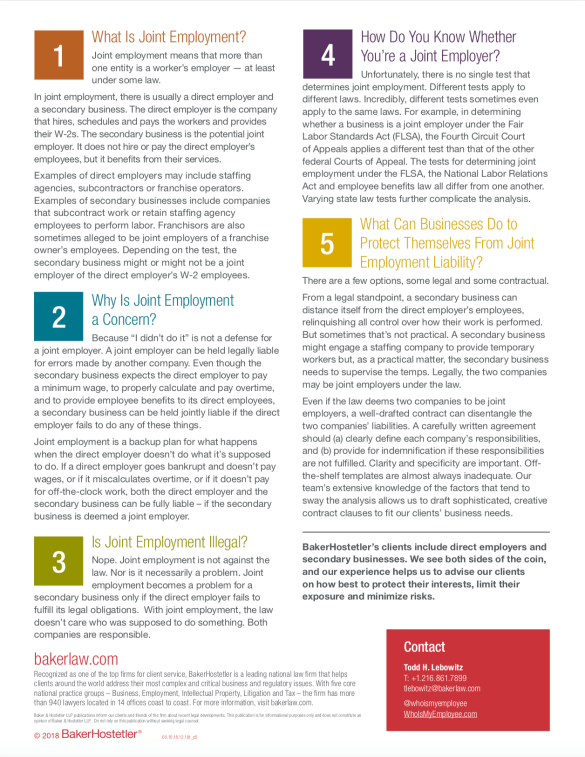
But today’s number is FIVE.  Here are Five Things You Should Know About Joint Employment.  (click here to download the PDF.)

Five things You Should Know About Joint employment - page 1 screenshot

Five things You Should Know About Joint employment - page 1 screenshot

© 2018 Todd Lebowitz, posted on WhoIsMyEmployee.com, Exploring Issues of Independent Contractor Misclassification and Joint Employment. All rights reserved.

Enter your email address to subscribe to this blog and receive notifications of new posts by email.

Truckers Fight to Preserve Independent Contractor Status, But Appellate Rulings Create Uncertainty

independent contractor driver trucking faaaa

Big Mutha Truckers was a 2002 video racing game in which four sibling truckers compete to make deliveries in fictional Hick County, with the most successful driver inheriting the family business. I had never heard of the game until now, but apparently it  was not very successful and is panned thoroughly by whoever spent precious life-minutes writing a comprehensive Wikipedia entry about this game, time that the author sadly will never be able to recover.

The real life trucking industry has its own problems, and they extend far beyond Hick County. The independent contractor owner-operator model, which has been common in the transportation industry for decades, is under attack. The situation is most critical on the West Coast, and owner-operator drivers are taking action to protect their livelihood — and their independent contractor status.

The Coalition for Independent Truckers announced the formation of a new Independent Contractor Ambassador program. The program’s mission is to protect the independent contractor/owner-operator model in the trucking industry. It aims to educate policymakers, the media, and the general public on the value of the independent  contractor model.

Three recent court decisions will it more difficult for these drivers to preserve their independent contractor status.

Last week, the Third Circuit Court of Appeals ruled that Illinois* state wage laws may be applied to professional motor carrier drivers, even though federal law is supposed to override state laws that are “related to” motor carrier prices, routes, or services.

Earlier this month, The Ninth Circuit Court of Appeals ruled that California’s meal and rest break laws may be applied in the motor carrier industry, despite federal law that seems to pre-empt state law in that field.

The Federal Aviation Administration Authorization Act (FAAAA) prevents states from enacting laws that are “related to” motor carrier prices, routes, or services. It seems hard to imagine that California’s mandatory meal and rest breaks (at issue in the 9th Circuit case) would not affect services and routes. Illinois wage law (at issue in the Third Circuit case) seems like a closer call.

Other federal courts have ruled that states cannot apply their wage and hour rules to motor carrier drivers because of FAAAA preemption. For example, a the First Circuit Court of Appeals previously ruled that Massachusetts’ ABC Test could not be applied to owner-operator drivers, since the state law test was preempted by the FAAAA.

But these new decisions from the Third and Ninth Circuits go the other way, saying that the state laws at issue do not sufficiently “relate” and therefore are not preempted by the FAAAA. These rulings create uncertainty and inconsistency across the industry, with different rules applying to interstate drivers in different locations. That’s what the FAAAA and other federal transportation laws aim to prevent.

This is an issue to watch. The Supreme Court may soon be called upon to resolve the circuit split. The national transportation industry relies heavily on the use of independent contractor owner-operators. These two appellate decisions make it increasingly difficult for legitimate independent contractor owner-operators to maintain their independent contractor status. Instead, these professional drivers may be subjected to reclassification as employees under some state laws, despite working in an industry that federal law tries to pre-empt,

Keep an eye on this one. Unlike Big Mutha Truckers, this saga will not be derailed by “repetitive gameplay, dated graphics, and lackluster sound.”

*Not an error. Yes, the case was decided in the Third Circuit, even though it relates to Illinois law.

© 2018 Todd Lebowitz, posted on WhoIsMyEmployee.com, Exploring Issues of Independent Contractor Misclassification and Joint Employment. All rights reserved.

Enter your email address to subscribe to this blog and receive notifications of new posts by email.