Podcast: What You Need to Know About Independent Contractor Misclassification

IMG_1073This week, I am encouraging readers to tune in to this podcast from XpertHR, in which I discuss issues and hot topics related to independent contractor misclassification.

Topics covered include:

  • The attack on business models that rely on the use of independent contractors;
  • The future of misclassification claims;
  • Possible updates to the FLSA;
  • Industries that are most at risk for independent contractor misclassification claims; and
  • Common misconceptions.

I hope you enjoy this interview, and thank you to David Weisenfeld and Xpert HR.

Security Guards: Employees or Contractors?

security guard employee or independent contractorI never saw the movie Paul Blart: Mall Cop and almost certainly never will. (Do I really need explain that decision?)

The Independent Contractor vs. Employee question often arises in the context of security guards, though. I confess to not knowing how Paul Blart was classified but, for companies who retain security guards, the decision whether to hire them as employees or to contract with a security firm is an important one.

The main advantage of hiring security guards as employees is the ability to retain control over how an individual guard does the job. The company can select who it wants to work and when, and can provide as much supervision and direction as needed.

The biggest disadvantage to using employees for security work, however, is the risk of Continue reading

Court Rejects Mandatory Arbitration for Independent Contractor Truckers

truck independent contractor arbitrationArbitration agreements can be an effective way to manage disputes with independent contractors. The Federal Arbitration Act (FAA) and Supreme Court decisions support arbitration as an efficient way to resolve disputes outside of the courtroom.
But what happens when an independent contractor with an arbitration agreement claims to have been misclassified as an employee? Can these disputes be forced into arbitration?

Usually yes, but this blog post by my colleague, John Lewis, highlights the limitations of arbitration agreements when applied to transportation workers. Although federal public policy — as articulated in the FAA — generally favors arbitration as a way to resolve disputes, Section 1 of the FAA lists a few situations where the FAA does not apply. One type of excluded dispute is over “contracts of employment” with transportation workers.

Are independent contractor agreements with owner-operator truckers “contracts of employment” with transportation workers? Continue reading

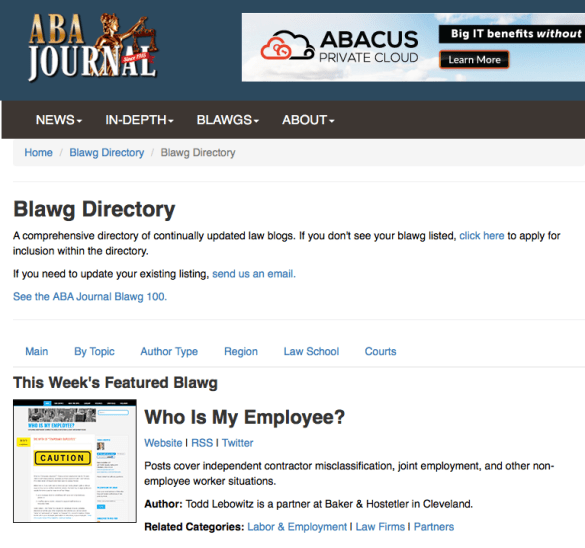
WhoIsMyEmployee.com named “Featured Blog of the Week” by American Bar Association’s ABA Journal

Thanks to the ABA Journal for recognizing WhoIsMyEmployee.com as its Featured Blog of the Week for the week of May 18, 2017. I appreciate the recognition!

To my readers: I hope you have been enjoying the blog, and I encourage you to email me with ideas for posts, along with any questions or comments.

Thanks!

Todd Lebowitz

Screen Shot 2017-05-21 at 1.48.09 PM

Never Been Sued? Congratulations! Here’s Why You Should Re-Evaluate Your Use of Independent Contractors Now.

IMG_1072Have you ever heard someone say, “The definition of insanity is doing the same thing over and over and expecting a different result“? That’s just wrong. No, it’s insanely wrong. (Irony! Actual definition, click here).

  • If you flip a coin 5 times and it comes up heads each time, is it insane to think it might come up tails next time?
  • If you play golf in a lightning storm five times and never get hit, is it insane to think you might get a nice electrical jolt next time?
  • If you root for the Browns to win a football game and they never do, is it insane to think they never will? [Note to self: Delete that. Bad example. It is true that they might never win a game. Shameful admission: I am a Browns fan.]

My consistent advice to companies that use independent contractors is to be proactive. Review your policies, practices, and documents now — before you get sued or audited. Many take this advice. Those who do not generally give two reasons:

  1. We don’t want to spend the money now; and
  2. We’ve always done it this way and have never been sued.

Folks, that kind of thinking is: n. extreme foolishness; folly; senselessness; foolhardiness.

Here are a few quick facts:

  1. Every company that has been sued for independent contractor misclassification had never been sued before the first time it was sued.
  2. Every company that has been audited for independent contractor misclassification had never been audited before the first time it was audited.

Continue reading

The Myth of “Temporary Employees”

IMG_1067What is a “temporary employee”? I have practiced employment law for 20 years (Note to self: Keep practicing; someday you’ll get good at it.) and I can’t tell you. It’s a state secret. All lawyers have been sworn to secrecy forever.

Either that or, if you really want to know and say “pretty please” (with or without sugar on top, but no artificial sweetener please), that term has no legal significance. Usually the term is used to mean one of two things:

  1. your employee, hired on a trial basis with some sort of probationary period; or
  2. a staffing agency worker, retained to augment staff levels on a temporary basis.

Under option 1, the “temp” is a regular W-2 employee of yours, probably employed at will like your other employees, but whether you call that person “temp” or “permanent” or “regular” or “irregular” (?), none of it matters. A temp worker who is your employee, paid subject to deductions, is your employee.  Temp time counts toward FMLA eligibility. Continue reading

Can an Intern be an Independent Contractor? (Answers revealed in James Bond movies)

IMG_1068Among James Bond films, Rotten Tomatoes ranks Never Say Never Again 18th out of 26, with a mediocre 63% rating. (Bond movie quiz at the end of this post, for patient readers.)

It’s a cliche saying, I know, but my first reaction when asked this question was, “I’d never say never, but it’s hard to imagine a scenario where that would work.” (That was also my second reaction and my third. Let’s just say that’s my reaction.)

Let’s run this through the gauntlet. Remember, it’s not your choice whether an intern is an independent contractor or an employee. The law decides that for you, based on the nature of the relationship.

Test #1: Economic Realities Test. Under federal wage and hour laws, an independent Continue reading

Today’s Tip: Avoid Telling Contractors How to Perform the Work (with Stones lyrics)

IMG_1066The great scholar Mick Jagger reminds his followers that you can’t always get what you want, but if you try sometimes well you might find you get what you need. This is good advice, not just for Mr. Jimmy (who did look pretty ill), but also for companies who use independent contractors.

In a true independent contractor relationship, the hiring entity knows what it needs. It needs results, but the details about how, when, and where to work toward those results are left to the contractor’s discretion. There is no oversight or supervision.

The more direction a company provides a contractor on how to perform the work, the more likely the contractor is misclassified and the relationship will be deemed employment. You might want to control these things, but if they are not necessary to get what you need, then you should try sometimes and you might find you can get what you need without exerting extra control over the contractor. Continue reading

New Florida Law Grants Independent Contractor Status to App-Based Drivers

IMG_1064In December 1965, the Beatles released Rubber Soul, which led with Drive My Car.  (“Asked a girl what she wanted to be/She said Baby, can’t you see?/I want to be famous, a star on the screen/But you can do something in between.”) You can thank me later for getting that song stuck in your head all day.

Under a new Florida law, online ride hailing service are singing “Baby you can drive my car, and maybe I’ll love you.” If certain easy-to-meet conditions are satisfied, drivers for online ride hailing services are declared independent contractors by law, not employees. This new law protects Uber, Lyft, and similar services from misclassification class actions brought under state law.

The requirements for being granted independent contractor status under the new law are simple. Continue reading

Trump’s Tax Plan Is Great News for Independent Contractors! Here’s Why.

IMG_1063

[Important Note to Readers, 1/15/18: This post is dated May 2017, before the final tax plan was passed, and the final version is slightly different than described in this post. For a revised 2018 analysis based on the final tax bill, click here.]

President Trump’s tax plan, released last week, is great news for independent contractors. Contractors may be able to cut their tax rates by half (or more) by creating an entity, instead of contracting as an individual. Indirectly, this would help companies who use contractors as well. Here’s why:

Benefit to Individuals:

For individuals, the proposal would reduce personal tax rates modestly. An individual being paid as an independent contractor will likely see a reduction in marginal tax rates, but the range is likely to remain somewhere between 25% and 35%, depending on income level.

For individuals being paid through their homemade entities, however, the proposal could result in substantial savings. Currently, pass-through entities like LLCs pay taxes at the rate of the individual. The sole owner of an LLC would pay taxes on the LLC’s profits at the individual’s personal income tax rate, likely between 25% and 35%.

Under the proposal, however, pass-through entities such as LLCs and partnerships would instead be taxed on pass-through business income at 15%. That’s a sizable savings compared to 25-35%. [Note 9/29/17: Latest proposal would tax entities at 20%, not 15%, but there’s still a long way to go before any of this becomes law.  And it may never become law.  For now, it’s just a proposal.]

If this proposal passes, individual independent contractors will have a strong financial incentive to incorporate. Creating an LLC is relatively inexpensive. If it leads to Continue reading