
 Your contracts with staffing agencies and consultants probably include a bunch of legalese boilerplate mumbo jumbo at the end, which no one ever reads. One of those standard clauses is a “force majeure” clause. That’s French for “Skim over this clause.”
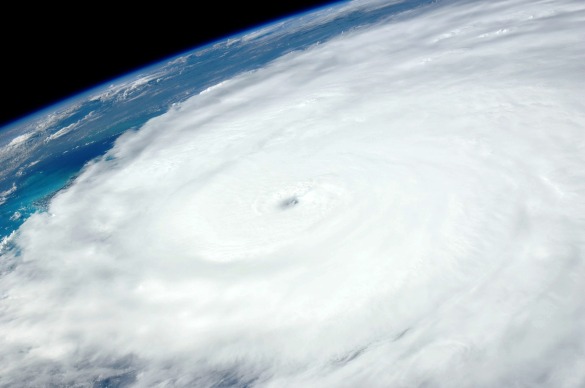
Companies affected by Irma and Harvey, however, may have good reason to check their contracts for these clauses. “Force majeure” means, literally, superior force.
These clauses typically say that So-and-so is excused from performing under the contract in the event of uncontrollable circumstances, such as war, terrorism, hurricanes, voodoo curses, other Acts of God, or anything caused by Pedro Cerrano and Joboo’s Cult (Major League) [Ed. Note: “Hats for Bats!”].


 If you could ask me one question about independent contractors and non-compete agreements, what would it be?
 A legal battle in Seattle (“The Battle of Seattle!”) may soon determine whether independent contractor drivers can form unions. In 2015, the city
  Trump and Sessions wants to prosecute the leakers. As we’ve seen before, stopping leaks can become a Presidential obsession. In Nixon’s White House, the Plumbers were tasked with stopping leaks of classified information, such as the Pentagon Papers. Through the Committee to Re-Elect the President (fittingly,
  Congress may finally provide some clarity in determining who is a joint employer. In legislation introduced last week, the House proposed a bill that would rewrite the definition of “joint employer” under federal labor law (National Labor Relations Act) and federal wage and hour law (Fair Labor Standards Act).
 If you retain freelancers in New York City, pay attention.
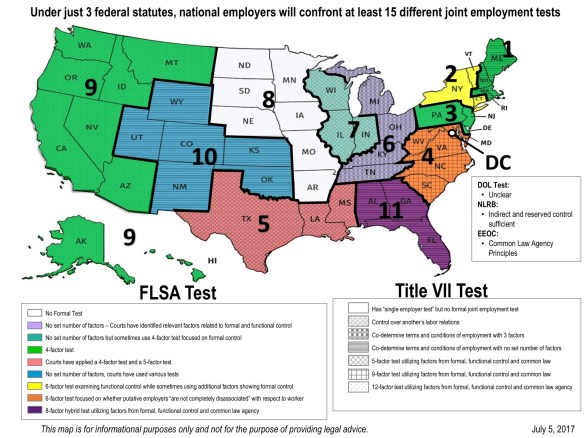 The tests for determining whether a business is a joint employer vary, depending on which law applies. That means there are different tests under federal labor law, wage and hour law, and employee benefits law, to name a few. There are also different tests under different states’ laws.
