

Time to Dance? Momentum Builds for Proposed New Joint Employment Law

Screen Shot 2017-10-28 at 11.47.09 AM

Leadership Lessons from Dancing Guy is a low-quality youtube video that has somehow amassed more than a million hits. In the video, a lone (possibly intoxicated) festival goer starts dancing in a field. After a minute or so, momentum builds and others join him, showing off their terrible dance moves in a video you’ll wish you hadn’t wasted three minutes watching. (Just speaking from experience here.)

Several weeks ago, the House began considering a bill that would rewrite the definition of “joint employment” under federal wage and hour law (Fair Labor Standards Act) and federal labor law (National Labor Relations Act). The Save Local Business Act would require “direct” and “significant” control over “essential terms” of employment before a business could be considered a joint employer of a worker employed by another business (such as a staffing agency or a subcontractor). Read more here and here.

Originally sponsored by Rep. Bradley Byrne of Alabama (you might think of Rep. Byrne as the original dancer in the Leadership video, but dressed as a conservative Southern gentleman), the bill now has 112 co-sponsors, including a few Democrats. Dance party!

Continue reading

Court Rules That Shadowing Dad at Work Might Require Payment

Shadow - Trainee or Employee  death-2577486_1280In the 1930s, the popular radio program The Shadow featured an invisible avenger who possessed “the mysterious power to cloud men’s minds, so they could not see him.” (He supposedly picked up this power in East Asia, which must have seemed mysterious in an era before Kung Pao Chicken was widely available.)

Eighty years later, “shadowing” has a different meaning. An unpaid trainee follows around a more experienced employee as a way to learn the business. Few trainees have mastered the power of invisibility [Note: only the best ones have, and they’re hard to find … ba-dum-bum], and often the nature of being a trainee involves getting in the way of the real work.

Scott Axel was a trainee who shadowed his father at an automobile wholesaler in Florida. He had no expectation of pay, and the business said it would not hire him. As a favor to his dad, the business let him learn the business by shadowing his dad.

Continue reading

Would You Like Some Pepperoni with Your (Oops) Joint Employment?

Joint employment pizza 31E83EC5-E554-428A-A5D6-37F13905C3B9According to pizza.com, “There are approximately 61,269 pizzerias in the United States.” That number seems pretty precise to me, not an approximation, but who am I to question something I read on the internet?

Approximately 4 of the 61,269 pizzerias are owned by a New Yorker named Paola P., who runs each of the 4 under a different LLC. Paola’s employees can be assigned to any of the 4 pizzerias on their workdays. Seems boring so far, but stay with me. Now say this three times fast:

Paola’s practice prompted problems since Paola P’s pizzerias were impermissibly positioning personnel to prevent paying overtime. 

Pity.

Continue reading

For the Greater Good: When Do You Have to Pay Volunteers?

One of my favorite movies is Hot Fuzz, the story of an overzealous London policeman (Simon Pegg), who transfers to a small town where things are not as they seem. Throughout the movie, various characters declare that something is being done “for the greater good.” Watch the movie. I won’t play spoiler. After you watch, go to imdb.com and read more about all the subtleties you may have missed. Trust me on this one.

Anyway, this is the part of the blog post where I segue from a totally unrelated pop culture reference to something related to employment.

Today we’ll talk about volunteers — you know, those who perform work “for the greater good” (nailed it!).

Where is the line between volunteers and employees, and when must volunteers be paid?

The Department of Labor (DOL) is pretty tough when it comes to determining Who Is My Employee?  As explained here, a worker not in business for himself/herself is usually presumed to be an employee under the Economic Realities Test.

The DOL, however, recognizes an exception for work that is truly volunteer work — so long as it’s not wink wink nod nod really employment.

What’s the difference?

Continue reading

When to Embrace Joint Employment, and When to Run Like Hell (Pink Floyd, 1979)

Joint employment risks dangers choices joint employer IMG_1101Life is full of serious questions. For example, Should I stay or should I go? (The Clash, 1982). Or, Will you love me forever? (practically every song ever, but for now, we’ll go with Meatloaf in Paradise by the Dashboard Lights, 1977).

When engaging non-employee workers, businesses must also confront a serious question: Embrace joint employment, or try to avoid it? (Frank Zappa confronted a different kind of serious question in Why Does It Hurt When I Pee?, 1979, but that’s beyond the scope of this blog.)

Many of my posts have been geared toward strategies for trying to avoid joint employment. There is another way, though. Sometimes, it may be better to embrace joint employment. But know the pros and cons.

Here are some things to consider: Continue reading

Joint Employment Legislation Needs to Be Expansive — If It’s to Be Effective

IMG_1093On Monday, we wrote about the Save Local Business Act — proposed legislation that, if passed, would create a new definition for joint employment under the NLRA and FLSA. But would that law go far enough?

No. Not at all.

On the bright side for businesses, the law would provide some predictability in that staffing agency workers would most likely be excluded from bargaining units. It would also remedy the current unfairness that results when a staffing agency makes payroll and overtime miscalculations but the company using the workers is held responsible as a joint employer.

But much more needs to be done to provide real clarity and predictability for business owners.

First, the law fails to address who is a joint employer under other federal employment Continue reading

Congress May Rewrite “Joint Employment” Definition

IMG_1092Congress may finally provide some clarity in determining who is a joint employer. In legislation introduced last week, the House proposed a bill that would rewrite the definition of “joint employer” under federal labor law (National Labor Relations Act) and federal wage and hour law (Fair Labor Standards Act).
The Save Local Business Act — despite lacking a fun-to-say acronym — would create a new standard for determining who is a joint employer under these two laws. The proposed new standard would allow a finding of joint employment “only if such person [business] directly, actually, and immediately, and not in a routine and limited manner, exercises significant control over the essential terms and conditions of employment….”

The definition provides examples of what are “essential terms and conditions,” including: Continue reading

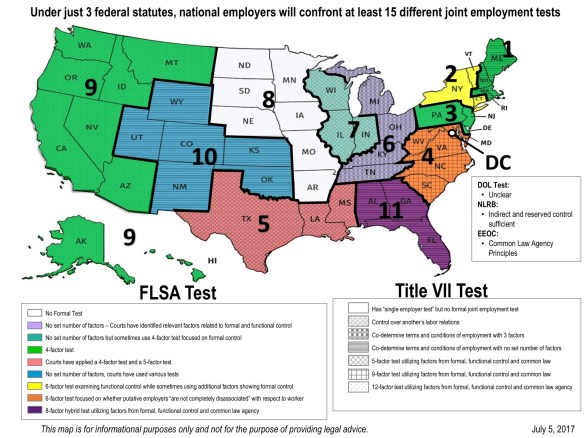
Map Shows Joint Employment Tests Are a Mess!

IMG_8284The tests for determining whether a business is a joint employer vary, depending on which law applies. That means there are different tests under federal labor law, wage and hour law, and employee benefits law, to name a few. There are also different tests under different states’ laws.

Further complicating the analysis, there are even different tests when applying the same law — depending on where you live.

Yes, you read that right. Even though the Fair Labor Standards Act (FLSA) is a federal wage and hour law that applies across the country, federal courts in different states use different methods for determining whether a business is a joint employer under that single law.

Continue reading

Misclassification settlement strips $6 million from Club Assets

IMG_1090When I was an undergrad at Michigan, any time I would drive to the airport or to Tiger Stadium, I’d see billboards for Deja Vu, a strip club with (apparently) lots of locations. I never visited (not into that sort of thing, thanks for asking), and I never thought much of it. I certainly did not expect to be writing about Deja Vu and independent contractor misclassification 25 years later. But here goes.

When patrons of these fine establishments partake in the traditional lap dance, it’s doubtful they’re thinking about whether these often-single-mom “entertainers” who are just trying to make a living have been properly classified under wage and hour law. More likely, they’re thinking about — never mind.

But that’s an important issue, as Deja Vu recently learned, when it was sued by a class of 28,177 dancers alleging they were misclassified as independent contractors, rather than Continue reading

Two Key Developments in Joint Employment are Expected This Week

IMG_1091.JPG

This could be a busy week for developments in the joint employment area.

1) Congressional Republicans have begun drafting legislation that could change the definition of joint employment, Bloomberg BNA reports. Presumably the goals of a new bill would be (a) to add clarity to the standards for deciding who is a joint employer, and (b) to make it more difficult for workers or unions to claim they are jointly employed.

Continue reading