Misclassification settlement strips $6 million from Club Assets

IMG_1090When I was an undergrad at Michigan, any time I would drive to the airport or to Tiger Stadium, I’d see billboards for Deja Vu, a strip club with (apparently) lots of locations. I never visited (not into that sort of thing, thanks for asking), and I never thought much of it. I certainly did not expect to be writing about Deja Vu and independent contractor misclassification 25 years later. But here goes.


When patrons of these fine establishments partake in the traditional lap dance, it’s doubtful they’re thinking about whether these often-single-mom “entertainers” who are just trying to make a living have been properly classified under wage and hour law. More likely, they’re thinking about — never mind.

But that’s an important issue, as Deja Vu recently learned, when it was sued by a class of 28,177 dancers alleging they were misclassified as independent contractors, rather than Continue reading

Two Key Developments in Joint Employment are Expected This Week

IMG_1091.JPG

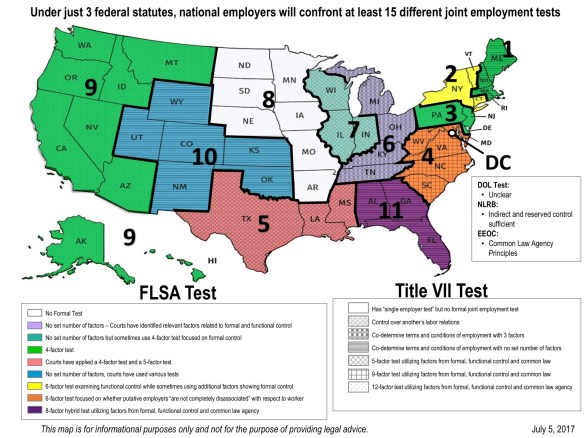
This could be a busy week for developments in the joint employment area.

1) Congressional Republicans have begun drafting legislation that could change the definition of joint employment, Bloomberg BNA reports. Presumably the goals of a new bill would be (a) to add clarity to the standards for deciding who is a joint employer, and (b) to make it more difficult for workers or unions to claim they are jointly employed.

Continue reading

The DOL Wants You to Know Its Opinions (Here’s Why That’s Good News!)

IMG_1087

Everybody has an opinion, so why not share?

This week, Labor Secretary Alex Acosta announced that the WHD will resume its prior practice of issuing opinion letters to advise on difficult wage and hour issues. This is good news for companies and employees because it increases predictability.

An opinion letter is an official, written opinion by the WHD of how a particular law applies to a specific set of circumstances presented by an employer or employee. The benefit to the general public is that opinion letters are published and may be relied upon.

Continue reading

Joint Employment Is Like Taking Steroids By Accident

athlete-joint employment - staffing agency - 1840437_1920It seems like every month another professional athlete is caught using a prohibited substance. The typical script (after getting caught) is to blame the maker of a supplement. “I should have more carefully checked the label,” or “I had no way of knowing what was in that synthetic elephant urine.”

Fair or unfair, every athlete knows that he/she is responsible for what goes into the athlete’s body, whether the juicing was intentional or not.

The same rule applies to companies who use staffing agencies.

Continue reading

Labor Dept Withdraws 2015-16 Joint Employment, Independent Contractor Guidance

IMG_1084

Did the new Labor Secretary of Labor finally throw employers a bone? I think so, but it’s too early to tell whether it’s delicious bacon-flavored or some generic processed meat flavor.

On June 7th, the Department of Labor (DOL) announced it was withdrawing the 2015 and 2016 informal guidance on joint employment and independent contractors.

Read the full post here, on BakerHostetler’s Employment Law Spotlight blog.

Court Rejects Mandatory Arbitration for Independent Contractor Truckers

truck independent contractor arbitrationArbitration agreements can be an effective way to manage disputes with independent contractors. The Federal Arbitration Act (FAA) and Supreme Court decisions support arbitration as an efficient way to resolve disputes outside of the courtroom.

But what happens when an independent contractor with an arbitration agreement claims to have been misclassified as an employee? Can these disputes be forced into arbitration?

Usually yes, but this blog post by my colleague, John Lewis, highlights the limitations of arbitration agreements when applied to transportation workers. Although federal public policy — as articulated in the FAA — generally favors arbitration as a way to resolve disputes, Section 1 of the FAA lists a few situations where the FAA does not apply. One type of excluded dispute is over “contracts of employment” with transportation workers.

Are independent contractor agreements with owner-operator truckers “contracts of employment” with transportation workers? Continue reading

The Myth of “Temporary Employees”

IMG_1067What is a “temporary employee”? I have practiced employment law for 20 years (Note to self: Keep practicing; someday you’ll get good at it.) and I can’t tell you. It’s a state secret. All lawyers have been sworn to secrecy forever.

Either that or, if you really want to know and say “pretty please” (with or without sugar on top, but no artificial sweetener please), that term has no legal significance. Usually the term is used to mean one of two things:

  1. your employee, hired on a trial basis with some sort of probationary period; or
  2. a staffing agency worker, retained to augment staff levels on a temporary basis.

Under option 1, the “temp” is a regular W-2 employee of yours, probably employed at will like your other employees, but whether you call that person “temp” or “permanent” or “regular” or “irregular” (?), none of it matters. A temp worker who is your employee, paid subject to deductions, is your employee.  Temp time counts toward FMLA eligibility. Continue reading

Can an Intern be an Independent Contractor? (Answers revealed in James Bond movies)

IMG_1068Among James Bond films, Rotten Tomatoes ranks Never Say Never Again 18th out of 26, with a mediocre 63% rating. (Bond movie quiz at the end of this post, for patient readers.)

It’s a cliche saying, I know, but my first reaction when asked this question was, “I’d never say never, but it’s hard to imagine a scenario where that would work.” (That was also my second reaction and my third. Let’s just say that’s my reaction.)

Let’s run this through the gauntlet. Remember, it’s not your choice whether an intern is an independent contractor or an employee. The law decides that for you, based on the nature of the relationship.

Test #1: Economic Realities Test. Under federal wage and hour laws, an independent Continue reading

What’s Up? Black Car Drivers Are Independent Contractors. Here’s Why.

balloons-1786430_1280At the end of Pixar’s Up, Carl and Russell sit on a curb pointing out cars: “Red one!” “Blue one!” Then Dug (the dog) calls out “Gray one!” which I find endlessly funny every time I watch it.

Whatever color the car, they sat there content, eating ice cream.

Black car companies in New York are celebrating too (hopefully with ice cream), after a recent decision preserving their drivers’ status as independent contractors. In Salem v. Corporate Transportation Group, the Second Circuit Court of Appeals ruled that drivers were not entitled to overtime pay, since they were not employees, but rather independent contractor franchisees.

We’ve written often in this blog about the different tests for determining Who Is My Employee? This case was brought under the Fair Labor Standards Act (FLSA) and comparable New York law, so the Court applied an Economic Realities Test. This test measures whether workers are economically dependent on one company to earn a living or are in business for themselves.

Relying on the Economic Realities factors, the Court ruled the drivers were economically independent and were in business for themselves. Here are the keys to victory:

  1. The drivers purchased franchises, choosing from a variety of options (rent, own);
  2. The drivers used their own cars and paid all their own expenses;
  3. The drivers could drive for competitors or for personal clients;
  4. The drivers were entrepreneurs, controlling many significant aspects of their personal driving business;
  5. The drivers were free to accept or reject jobs;
  6. The drivers chose when, where, and how often to work; and
  7. The franchisor company could not freely terminate the drivers’ franchise agreements.

While independent contractor relationships remain under fire, this decision shows that there’s still hope. Companies can win these cases when they carefully construct the facts, relinquish control, and allow contractors to run their own enterprises.

Although these drivers had considerable discretion over how to run their individual businesses, none (unfortunately) had the creativity to ditch the car and transport customers in a helium-balloon powered house.  Now back to the film.

film-158157_1280

© 2017 Todd Lebowitz, posted on WhoIsMyEmployee.com, Exploring Issues of Independent Contractor Misclassification and Joint Employment. All rights reserved.

Unpaid Internships: Six Tips For Avoiding Minimum Wage Requirements

student unpaid internship frog-1339892_1920It’s summer intern hiring season. Can your interns be unpaid? If you pay them something, can you pay a small stipend that amounts to less than minimum wage?

Wage and hour laws dictate when a summer intern must be paid like a regular employee, with a required minimum wage and eligibility for overtime. Seasonal amusement and recreational establishments (such as summer camps or some amusement parks) may qualify for a special exemption, but this post is focused on more conventional year-round businesses.

Here are six tips for maintaining unpaid internship status: Continue reading