

Are Santa’s Elves Employees or Independent Contractors?

elves independent contractors or employeesFor roughly 200 years, Santa has been retaining seasonal help at his Arctic Circle workshop. His undersized non-union workers toil in an icy land that sits beyond the jurisdiction of U.S. employment laws, a wise move by Mr. Claus and his attorneys.

While children around the world ask silly questions like, Can I visit the elves? and What do elves eat? and How do they work so fast?this blog asks the serious question that all adult businesspeople want to know: Are elves employees or independent contractors?

Spoiler alert for the children: The answers are No, Caribou, and Amphetamines.

The adult question takes some analysis. Let’s peek behind the wintry curtain.

Continue reading

Be Kind, Rewind: Here’s Why the Browning-Ferris Joint Employment Standard Is Going to Be Reversed

AF6DB19D-A636-4AB4-BFA8-7D592D57137FRemember when you used to go to the video store to rent VHS tapes and there was that little sticker on the tape cheerfully reminding you to “Be kind! Rewind!”  I know, half of you have no idea what I am talking about, but there used to be these things for watching movies before Netflix — no, not DVDs, before that — no, no, not cave drawings, after that.

Anyway, take my word for it. The point was, when you were done with your movie, you were supposed to rewind the tape so the next viewer could start over, back at the beginning of the film. It was the courteous thing to do.

Continue reading

Why I Can’t Give You a Template Independent Contractor Agreement

Independent contractor vs employee template independent contractor agreement - generic independent contractor agreement - IMG_1112I am often asked for a sample Independent Contractor Agreement. I do a lot of work in this area, so I should have plenty, right? Well, sure, I have drafted dozens, but they won’t do you much good.


A generic Independent Contractor Agreement that includes a few boilerplate recitals is of little value. A generic agreement probably says something like, “We all agree that you’re an independent contractor and not an employee. We won’t pay employment taxes for you. We’re not paying into your Social Security account or providing you workers’ comp or unemployment coverage. We’re not giving you benefits. You’re lucky if we let you breathe the air in our building. No, you know what, bring your own oxygen tank. You can’t use our air. You agree to all of this and you’ll like it. And Thank you sir, may I have another?

Continue reading

Court Serves Up Reminder that Contractors Can Be Properly Classified and Misclassified – At The Same Time.

elephant-reminder pennsylvania court joint employment joint empoyer construction workplace misclassification act

A recurring theme in this blog has been that when trying to determine Who Is My Employee?, there are different tests under different laws. Different tests can yield different results.

A recent court decision from Pennsylvania emphasizes this point. In the Keystone State (proud home of Dunder Mifflin and Hershey Park), contruction workers are considered employees for workers compensation purposes unless they (i) have a written contract, (ii) have a place of business separate from their general contractor’s site, and (iii) have liability insurance of at least $50,000. This strict test is courtesy of the Construction Workplace Misclassification Act (CWMA), an Act whose name shows a disappointing lack of creativity.

I might have gone with “Construction Occupation Workers’ Act Regarding Designations In Classifying Employees” (COWARDICE) or “Law About Misclassifying Employees” (LAME) or, if I was hungry for shellfish, then maybe “Construction Law About Misclassification for Builders And Keeping Employees Safe” (CLAMBAKES).

Continue reading

Consultants Can Take Steps to Avoid Joint Employer Liability

Joint employer ;liability management companiy consultant IMG_1097Companies in distress sometimes retain management consultants to try to turn them around. Sometimes the plan works, sometimes not. When the turnaround effort fails and the company shuts down, can the management company be held liable as a joint employer?

This issue arose recently in a WARN Act case. The federal WARN Act requires an employer, before ordering a plant shutdown or mass layoff, to provide 60 days’ notice and pay to its employees.

Here’s what happened. A nursing home with multiple Medicare and Medicaid violations retained a consulting firm to try to solve its many problems. The consulting firm Continue reading

Appeals Court Slams NLRB Joint Employer Finding in Landmark CNN Case, But Ruling May Prove Hollow

NLRB CNN joint employment Browning-Ferris overrule Second Circuit Court of Appeals IMG_1094A federal Court of Appeals has ruled that the NLRB cannot abruptly change its definition of joint employment without sufficient explanation. This decision (the CNN case) rebukes the NLRB for its initial attempt, in 2014, to expand the definition of joint employment.

This decision does not, however, address the Browning-Ferris case that followed in 2015, in which the Board similarly expanded the definition of joint employment but, that time, with an expansive explanation and justification for doing so. Browning-Ferris in on appeal too.

Here’s what happened.

Back in the good old days, when TV was pure and the world had not yet been exposed to Janet Jackson’s halftime nipple, CNN used to contract with an outside company who Continue reading

Joint Employment Legislation Needs to Be Expansive — If It’s to Be Effective

IMG_1093On Monday, we wrote about the Save Local Business Act — proposed legislation that, if passed, would create a new definition for joint employment under the NLRA and FLSA. But would that law go far enough?

No. Not at all.

On the bright side for businesses, the law would provide some predictability in that staffing agency workers would most likely be excluded from bargaining units. It would also remedy the current unfairness that results when a staffing agency makes payroll and overtime miscalculations but the company using the workers is held responsible as a joint employer.

But much more needs to be done to provide real clarity and predictability for business owners.

First, the law fails to address who is a joint employer under other federal employment Continue reading

Congress May Rewrite “Joint Employment” Definition

IMG_1092Congress may finally provide some clarity in determining who is a joint employer. In legislation introduced last week, the House proposed a bill that would rewrite the definition of “joint employer” under federal labor law (National Labor Relations Act) and federal wage and hour law (Fair Labor Standards Act).
The Save Local Business Act — despite lacking a fun-to-say acronym — would create a new standard for determining who is a joint employer under these two laws. The proposed new standard would allow a finding of joint employment “only if such person [business] directly, actually, and immediately, and not in a routine and limited manner, exercises significant control over the essential terms and conditions of employment….”

The definition provides examples of what are “essential terms and conditions,” including: Continue reading

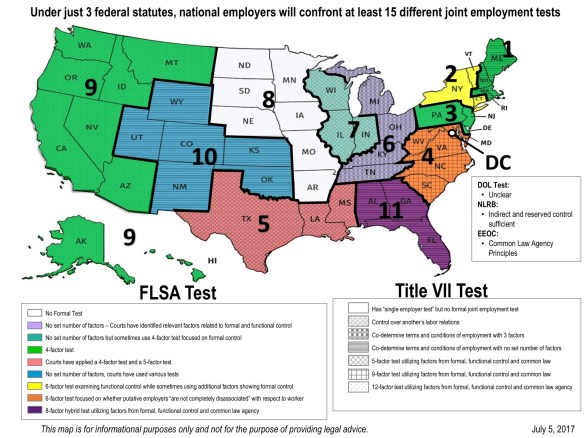
Map Shows Joint Employment Tests Are a Mess!

IMG_8284The tests for determining whether a business is a joint employer vary, depending on which law applies. That means there are different tests under federal labor law, wage and hour law, and employee benefits law, to name a few. There are also different tests under different states’ laws.

Further complicating the analysis, there are even different tests when applying the same law — depending on where you live.

Yes, you read that right. Even though the Fair Labor Standards Act (FLSA) is a federal wage and hour law that applies across the country, federal courts in different states use different methods for determining whether a business is a joint employer under that single law.

Continue reading

Two Key Developments in Joint Employment are Expected This Week

IMG_1091.JPG

This could be a busy week for developments in the joint employment area.

1) Congressional Republicans have begun drafting legislation that could change the definition of joint employment, Bloomberg BNA reports. Presumably the goals of a new bill would be (a) to add clarity to the standards for deciding who is a joint employer, and (b) to make it more difficult for workers or unions to claim they are jointly employed.

Continue reading