 At the end of Pixar’s Up, Carl and Russell sit on a curb pointing out cars: “Red one!” “Blue one!” Then Dug (the dog) calls out “Gray one!” which I find endlessly funny every time I watch it.
Whatever color the car, they sat there content, eating ice cream.
Black car companies in New York are celebrating too (hopefully with ice cream), after a recent decision preserving their drivers’ status as independent contractors. In Salem v. Corporate Transportation Group, the Second Circuit Court of Appeals ruled that drivers were not entitled to overtime pay, since they were not employees, but rather independent contractor franchisees.
We’ve written often in this blog about the different tests for determining Who Is My Employee? This case was brought under the Fair Labor Standards Act (FLSA) and comparable New York law, so the Court applied an Economic Realities Test. This test measures whether workers are economically dependent on one company to earn a living or are in business for themselves.
Relying on the Economic Realities factors, the Court ruled the drivers were economically independent and were in business for themselves. Here are the keys to victory:
- The drivers purchased franchises, choosing from a variety of options (rent, own);
- The drivers used their own cars and paid all their own expenses;
- The drivers could drive for competitors or for personal clients;
- The drivers were entrepreneurs, controlling many significant aspects of their personal driving business;
- The drivers were free to accept or reject jobs;
- The drivers chose when, where, and how often to work; and
- The franchisor company could not freely terminate the drivers’ franchise agreements.
While independent contractor relationships remain under fire, this decision shows that there’s still hope. Companies can win these cases when they carefully construct the facts, relinquish control, and allow contractors to run their own enterprises.
Although these drivers had considerable discretion over how to run their individual businesses, none (unfortunately) had the creativity to ditch the car and transport customers in a helium-balloon powered house. Now back to the film.

© 2017 Todd Lebowitz, posted on WhoIsMyEmployee.com, Exploring Issues of Independent Contractor Misclassification and Joint Employment. All rights reserved.

 I am often asked for a sample Independent Contractor Agreement. I do a lot of work in this area, so I should have plenty, right? Well, sure, I have drafted dozens, but they won’t do you much good.
 Companies in distress sometimes retain management consultants to try to turn them around. Sometimes the plan works, sometimes not. When the turnaround effort fails and the company shuts down, can the management company be held liable as a joint employer?
 A federal Court of Appeals has
  On Monday,
  Congress may finally provide some clarity in determining who is a joint employer. In legislation introduced last week, the House proposed a bill that would rewrite the definition of “joint employer” under federal labor law (National Labor Relations Act) and federal wage and hour law (Fair Labor Standards Act).
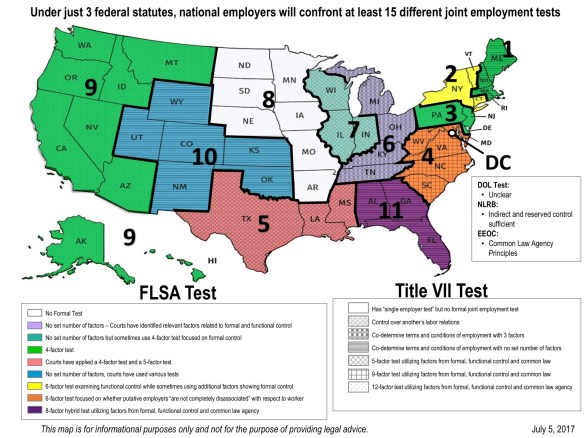 The tests for determining whether a business is a joint employer vary, depending on which law applies. That means there are different tests under federal labor law, wage and hour law, and employee benefits law, to name a few. There are also different tests under different states’ laws.
 Among James Bond films, Rotten Tomatoes ranks Never Say Never Again 18th out of 26, with a mediocre 63% rating. (Bond movie quiz at the end of this post, for patient readers.)
