

A recurring theme in this blog has been that when trying to determine Who Is My Employee?, there are different tests under different laws. Different tests can yield different results.
A recent court decision from Pennsylvania emphasizes this point. In the Keystone State (proud home of Dunder Mifflin and Hershey Park), contruction workers are considered employees for workers compensation purposes unless they (i) have a written contract, (ii) have a place of business separate from their general contractor’s site, and (iii) have liability insurance of at least $50,000. This strict test is courtesy of the Construction Workplace Misclassification Act (CWMA), an Act whose name shows a disappointing lack of creativity.
I might have gone with “Construction Occupation Workers’ Act Regarding Designations In Classifying Employees” (COWARDICE) or “Law About Misclassifying Employees” (LAME) or, if I was hungry for shellfish, then maybe “Construction Law About Misclassification for Builders And Keeping Employees Safe” (CLAMBAKES).
 A legal battle in Seattle (“The Battle of Seattle!”) may soon determine whether independent contractor drivers can form unions. In 2015, the city
  On Monday,
  Congress may finally provide some clarity in determining who is a joint employer. In legislation introduced last week, the House proposed a bill that would rewrite the definition of “joint employer” under federal labor law (National Labor Relations Act) and federal wage and hour law (Fair Labor Standards Act).
 If you retain freelancers in New York City, pay attention.
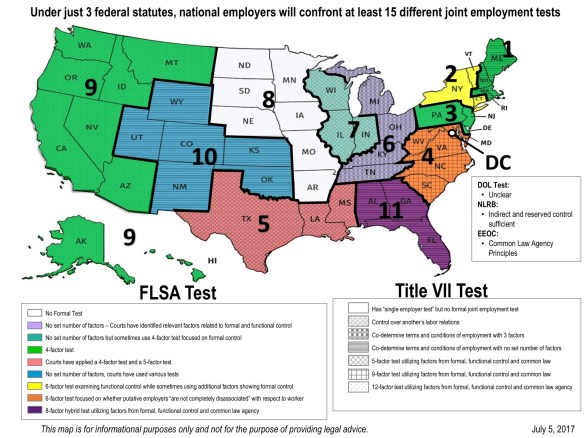 The tests for determining whether a business is a joint employer vary, depending on which law applies. That means there are different tests under federal labor law, wage and hour law, and employee benefits law, to name a few. There are also different tests under different states’ laws.
 Who Is My Employee?