

It’s There, Even If You Can’t See It: Court Reinstates Trump-Era Independent Contractor Test, and It’s Effective Now.

There’s an optical illusion known as a negative afterimage. If you stare at the red dot on this woman’s nose for about 15 seconds, then look at a blank wall, you’ll see the woman on your wall – but in full color and with dark hair. And yet, there is no woman on your wall. 

You see what isn’t there because the illusion tricks the photoreceptors in your retina.

Monday’s ruling by a federal judge in Texas also has us seeing what isn’t there – or what was there and then wasn’t there – or something like that, but with respect to the test for independent contractor classification. 

In early January 2021, the Trump DOL issued a new regulation that sought to provide clarity on how to determine whether someone is an employee or an independent contractor under the Fair Labor Standards Act (FLSA). Even though the FLSA is a federal law that is supposed to apply everywhere, different courts around the country used different versions of the FLSA’s Economic Realities Test to make that determination.

Under the new regulation, 29 CFR Part 795, there would be just one test. It was simple, and the same rule would apply all over the country. The regulation was scheduled to take effect March 8, 2021. But a few days before the effective date, the Biden Administration postponed implementation of the new rule. Then in May, they rescinded it. They replaced it with nothing. If you go to the Code of Federal Regulations, there is no 29 CFR Part 795. (Here, try it!)

But Monday’s ruling said to stare a little harder. It’s there.

The court ruled that the Biden Administration’s effort to delay and then withdraw Part 795 was unlawful and violated the Administrative Procedure Act. The delay provided too short a comment period, failing to offer the public a meaningful period to provide input. The withdrawal was improper because the DOL failed to consider alternatives and instead “left regulated parties without consistent guidance.” 

Because the delay and withdrawal of the Trump era rule were deemed unlawful, the court ruled that Part 795 did, in fact, go into effect March 8, 2021, and “remains in effect.”

Who knew?

So now you probably want to know what the rule is, since you cannot find it online in the Code of Federal Regulations – at least as of Tuesday night.

The test in Part 795 identifies two “core factors” for determining the independent contractor vs. employee question under the FLSA. If both factors point in the same direction, the issue is generally decided. If the core factors point in different directions, three “other factors” are considered.

The Two Core Factors

As we explained here, The core factors are:

• The nature and degree of the individual’s control over the work; and

• The individual’s opportunity for profit or loss.

The control factor supports independent contractor status if the worker “exercises substantial control over key aspects of the work,” including setting schedules, selecting projects, and being allowed to work for others.

The profit or loss factor weighs in favor of independent contractor status if the worker has the opportunity to earn profits or incur losses based on the exercise of initiative, managerial skill, business acumen or judgment, or based on management of his or her own investments or capital expenditures. Examples of investments may include hiring helpers or buying equipment. 

Other Factors

If the two core factors do not determine the issue, three other factors are to be considered:

• Amount of skill required for the work;

• Degree of permanence of the working relationship between the individual and the potential employer; and

• Whether the work is part of an integrated unit of production.

Amount of skill required. This factor weighs in favor of independent contractor status if the work requires specialized skill or training that the potential employer does not provide.

Degree of permanence. This factor weighs in favor of independent contractor status if the work is definite in duration or sporadic. This factor supports employee status if the work is indefinite. Work that is seasonal by nature does not weigh in favor of independent contractor status, even though it’s definite in duration.

Whether the work is part of an integrated unit of production. This factor is likely to receive the heaviest criticism from worker advocates. The “integrated unit of production” factor comes from a pair of 1947 U.S. Supreme Court cases. Over the years, this factor has morphed into the question of whether the work is “integral” to the potential employer’s business. Part 795 takes a firm stance here, saying that — based on the 1947 Supreme Court decisions — the relevant question is whether the work is “integrated,” not whether it is “integral.”

This factor weighs in favor of independent contractor status if the work is “segregable” from the potential employer’s processes for a good or service. For example, a production line is an integrated process for creating a good. A software development program may require an integrated process for creating a computer program. Work that is performed outside of an integrated unit of production is more likely performed by an independent contractor.

What Happens Now?

First, the DOL can appeal the decision to the Fifth Circuit. We expect that will happen. In the meantime, a stay might be issued or might not be issued.

Second, Part 795 is now in effect, unless a stay is issued. 

Third, it’s a fair question how much this really matters anyway. The test was not intended to change the outcome in most instances. It was instead intended to articulate more clearly how these determinations were already being made. The two “core factors” were already determinative in almost all cases, even if courts were not explicitly identifying two factors as being most important. Also, the Circuit Courts of Appeal do not have to adopt the DOL’s interpretation of the test. They can go on using their five-part and six-part tests, or they can apply the Part 795 analysis. 

The Part 795 should now be the applicable test. But we shall see.

If you stare hard enough at your handy copy of the Code of Federal Regulations, and then look at a blank wall, Part 795 just might appear.

Enter your email address to subscribe to this blog and receive notifications of new posts by email.

© 2022 Todd Lebowitz, posted on WhoIsMyEmployee.com, Exploring Issues of Independent Contractor Misclassification and Joint Employment. All rights reserved.

2018_Web100Badge
 

That’ll Cost You 96 Camels: Court Headlocks Staffing Agency with $7.2M Misclassification Judgment

Mom feeding a non-wrestling camel, May 2010

If you weren’t in Turkey last month, you missed the annual Selçuk Efes Camel Wrestling Festival, which featured 162 competitors in four categories.

The camels are paired by weight and skill, and their techniques include tripping their opponents with foot tricks or applying headlocks then sitting on their opponents. Some just push until the other camel gives up. A winner is declared when one camel scares away the other, making him scream or collapse. The camels are muzzled so there is no biting.

Among those missing the spectacle were the owners of Steadfast Medical Staffing, a Virginia-based firm that maintains a database of nurses and pairs them with healthcare facilities. That’s because they were in federal court, defending against a lawsuit by the Department of Labor. The DOL alleged that they had misclassified the nurses as independent contractors in violation of the Fair Labor Standards Act (FLSA).

After a bench trial, the judge agreed with the DOL and ruled that the nurses — which included CNAs, LPNs and RNs — were employees of the staffing agency. The Court applied the Economic Realities Test, which is the proper test for determining who is an employee under the FLSA.

The Court considered all relevant factors, then applied camel-style headlocks while sitting on the defendant, causing the staffing agency to either scream or collapse (unclear from the opinion). The Court ruled that the staffing agency failed to pay overtime and failed to comply with FLSA record keeping requirements. The agency will be liable for approximately $3.6M in back wages plus another $3.6M in liquidated damages.

Following the judgment, the DOL issued a statement with quotes from the Secretary of Labor, Marty Walsh, and the Solicitor of Labor, Seema Nanda, that the DOL was sending an “unequivocal message” to Steadfast and other staffing companies that the DOL is serious about pursing independent contractor misclassification.

Staffing agencies that treat workers as independent contractors are on notice that the DOL is serious about enforcement. Remember, the facts of the relationship determine whether a worker is an employee or an independent contractor, not how the parties choose to characterize the relationship.

More than 1,100 nurses will share in the award, with a healthy-but-to-be-determined amount of fees headed to the plaintiffs’ lawyers.

A prized wrestling camel can be sold for more than a million Turkish lira. That’s about $75,000. Large awards like this for systemic misclassification are not surprising. This one will cost the staffing firm about 96 wrestling camels.

Enter your email address to subscribe to this blog and receive notifications of new posts by email.

© 2022 Todd Lebowitz, posted on WhoIsMyEmployee.com, Exploring Issues of Independent Contractor Misclassification and Joint Employment. All rights reserved.
2018_Web100Badge
 

>

Low-Hanging Fruit? DOL and NLRB Join Forces to Fight Misclassification

Much has been written about the phrase low-hanging fruit. The metaphor’s origins are fairly obvious, referring to obtaining quick wins through minimal effort.

But how good is the metaphor? For harvesters, starting with the lowest hanging fruit is not the best strategy. Fruit near the top of a tree is generally riper and ready to eat, due to better sun exposure. Fruit can also be heavy, and harvesters who start at the top of the tree can work their way down as their bags grow heavier. Then there’s this insightful warning from one author’s mother, who cautioned that the blackberries near the bottom of the bush are the ones most likely to have been peed on by an animal.

Pee notwithstanding, the Department of Labor and the NLRB have seized on the low-hanging fruit strategy as a way to go after companies that misclassify independent contractors.

Last month the two agencies signed a Memorandum of Understanding, agreeing to share information and better coordinate investigations when they suspect there have been violations of the law.

While the DOL and NLRB apply different tests to determine Who Is My Employee?, it’s likely that a relationship failing one test also fails the other. Violators of one law are the low-hanging fruit.

What does that mean for businesses? It means that if the NLRB believes your company misclassified its independent contractors, they’ll share that information with the DOL, which would be pleased to piggyback on the NLRB’s finding and tag you with wage and hour violations as well. And vice versa.

The information sharing arrangement raises the stakes for alleged violators. Companies found to be in violation of one law are more likely to be found in violation of multiple laws. And that means more fines, more assessments, and more disruption to your business.

For the DOL and NLRB, the information-sharing arrangement means they’ll go after each other’s targets and seek to double up on penalties. For companies whose independent contractors may resemble employees, it means you’re the blackberry that’s about to get peed on.

Enter your email address to subscribe to this blog and receive notifications of new posts by email.

© 2022 Todd Lebowitz, posted on WhoIsMyEmployee.com, Exploring Issues of Independent Contractor Misclassification and Joint Employment. All rights reserved.

2018_Web100Badge
 

A Frog’s Eye View: What is Horizontal Joint Employment?

Suppose Kermit works 30 hours a week at The Muppet Show. He holds a non-exempt position as a research assistant, trying to determine why are there so many songs about rainbows.

Frog food is expensive these days, so he holds a second job too. Kermit works nights at Sesame Street, where he spends 20 hours a week investigating multi-colored arc-shaped atmospheric phenomena and what’s on the other side.

With 30 hours at one job and 20 hours at another, neither role pays Kermit overtime.

But is he being cheated out of time-and-a-half? Let’s hop in and take a deeper look.

Horizontal joint employment is when a person holds two jobs, but the businesses are under common control. They may have the same owners or officers, they may coordinate schedules among workers, or they may share a common pool of employees. When horizontal joint employment exists, the hours from both jobs are aggregated, and 30 hours at one job plus 20 hours at the other equals 50 total hours, 10 of which require overtime pay.

So what about our short-bodied, tailless amphibian friend? Does Kermie get overtime?

Kermit may seem like a free spirit, but whether he’s on The Muppet Show (30 hours) or Sesame Street (20 hours), his every move is controlled by Jim Henson. Literally.

Common control signals horizontal joint employment, which means Kermit’s been shortchanged 10 hours of overtime. It’s not easy being green.

You’ve probably read about recent changes to the joint employment tests, but those changes are for vertical joint employment, not horizontal joint employment. Vertical joint employment is when the employees of a primary employer perform services for the benefit of a secondary employer, like in a staffing agency relationship. When staffing agency employees work side-by-side with a company’s regular employees, the staffing agency and the other business may be joint employers.

The rules on horizontal joint employment are unchanged. So if sharing employees with a business under common control, be aware of the rules and look before you leap.

Enter your email address to subscribe to this blog and receive notifications of new posts by email.

© 2021 Todd Lebowitz, posted on WhoIsMyEmployee.com, Exploring Issues of Independent Contractor Misclassification and Joint Employment. All rights reserved.

2018_Web100Badge
 

He-Gassen! This Telecom Company Should Have Smelled a Misclassification Claim Coming

Fire away! Source: Waseda U. Library

The Waseda University Library in Tokyo maintains an online archive of drawings dedicated to epic Japanese fart battles of the 17th and 18th centuries. The depictions, called he-gassen (really!), show farts so powerful they penetrate walls and blow cats out of trees.

This mode of attack must have been intimidating, but approaching enemies should have smelled what was coming and taken evasive action.

The same can be said for a Nevada telecommunications company, which had engaged 1,400 call center workers but treated them all as independent contractors. In the immortal words of Daryl Hall, no can do.

Under federal wage and hour law, the Economic Realities Test is used to determine whether a worker is an employees, regardless of what the parties call the relationship. In this case, the telecom company failed virtually every part of the test. The workers were economically reliant on the telecom company, which controlled their work in just about every relevant way, making the workers employees.

The facts were so bad that the Department of Labor took the laboring oar on this one, filing its own lawsuit in federal court. The DOL won a $1.4 million award, and the Ninth Circuit Court of Appeals upheld the decision.

Remember, a worker’s status as an employee or independent contractor is determined using the legal test and the facts of the relationship, regardless of what the parties call themselves.

The moral of the story is that if it smells like an employment relationship, it probably is. Choose your battles wisely. He-gassen!

Enter your email address to subscribe to this blog and receive notifications of new posts by email.

© 2021 Todd Lebowitz, posted on WhoIsMyEmployee.com, Exploring Issues of Independent Contractor Misclassification and Joint Employment. All rights reserved.

2018_Web100Badge

Nowhere to Run: New Case Serves as Reminder That FLSA Misclassification Settlements are Very Public

I just got back from running in a 200-mile relay, Muskegon to Traverse City, with a group of college friends. I ran three legs of 4, 4, and 5 miles. I had the easiest set of three legs among the 12 runners, but I’m happy just to have finished. It was great to see everyone, and I was able to disconnect from work life for a few days.

So, what I’m saying here is, I had a better weekend than the guys I’m about to write about. And for them, there’s no running away from their problems.

In yet another exotic dancer case to hit the news, the performers at King’s Inn Premier Gentlemen’s Club in Massachusetts are about to score a $292,000 settlement in a claim that they were misclassified as independent contractors. A hearing to approve the settlement is scheduled for this week.

There seem to be a lot of exotic dancer cases in the annals of independent contractor misclassification, and the clubs seem to lose their fair share of these cases. This case, like most of the dancer cases, is a wage and hour case. The dancers claimed they were denied a minimum wage and overtime pay, in violation of the Fair Labor Standards Act (FLSA). The club claimed the dancers were independent contractors and therefore were not covered under the FLSA.

But why do you care about a strip club exotic dancers case? Two reasons:

  • First, the Economic Realities Test is alive and well, and it applies to all industries.
  • Second, any settlement of an FLSA lawsuit must be approved, and it becomes public record.

You can read more about the first point here, in a collection of posts about this test and how it is used to determine whether someone is an employee.

The second point deserves a bit more attention, though. Most types of litigation can be settled in a private settlement agreement. An FLSA case cannot be. The law requires the settlement of an FLSA case to be approved by a judge, and there is a public hearing at which the settlement terms are considered.

Once you get sued for an FLSA violation, it’s very hard to get out of it with anything resembling confidentiality. This is the kind of claim you want to avoid in the first place.

How do you avoid an FLSA claim when you have independent contractors?

  • Be proactive. Evaluate your relationships using the Economic Realities Test and see if they hold up.
  • Review your contracts and see if they can be adjusted to better memorialize the facts that support independent contractor status.
  • Consider obtaining representations from the contractors up front to determine whether they really do operate independently.

Don’t wait until its too late to take action. You can’t just run away from an FLSA case.

Enter your email address to subscribe to this blog and receive notifications of new posts by email.

© 2021 Todd Lebowitz, posted on WhoIsMyEmployee.com, Exploring Issues of Independent Contractor Misclassification and Joint Employment. All rights reserved.

2018_Web100Badge
 

Welcome to Turkmenistan: Joint Employment Rules Rescinded, Leaving Massive Crater in FLSA Regulations

Tormod Sandtorv – FlickrDarvasa gas crater panorama CC BY-SA 2.0

No visit to Turkmenistan would be complete without a visit to the Darvaza Crater, more commonly known as the Door to Hell. This massive crater formed decades ago after a Soviet drilling rig collapsed. Roughly 40 years ago, the Soviets lit the crater on fire to burn off the methane. But Turkmenistan has some of the largest gas reserves in the world, which meant you couldn’t just make the gas go away.

The fire still burns today, and the massive fiery hole is an impressive sight.

A massive hole can also describe what the Wage and Hour Division (“WHD”) just created.

On July 29, the WHD formally announced the rescission of all of the regulations that define when joint employment exists under the Fair Labor Standards Act (“FLSA”).

The regulations, which can be found in Part 791 of 29 C.F.R., have existed in some form since 1958, which is right around the tenth anniversary of a magnitude 7.3 earthquake that killed up to 10% of the entire population of Turkmenistan.

In 2020, the Trump Administration revised the regulations to provide more clarity about who is a joint employer and when. The 2020 regulations listed specific factors that should be applied. The new rule sought to create consistency in place of the patchwork of different factors used by different courts in different circuits. The 2020 regulations also included 11 helpful illustrations of how the new rules would be applied in various situations.

Pro-business groups liked the new rule because it provided clarity and made it harder to be a joint employer. Pro-employee groups hated the rule because it provided clarity and made it harder to be a joint employer.

In March 2021, the Biden Administration announced an intent to rescind the 2020 regulations. On July 29, the rescission was formally announced. The rescission takes effect September 28, 2021.

In the formal rescission notice, the WHD notes that few courts had followed the new test and that a federal district court in New York had ruled that the 2020 regulations were invalid. (That case is now on appeal to the Second Circuit.)

What does the rescission mean?

Welcome to Turkmenistan! The rescission doesn’t reinstitute the 1958 regulations. It doesn’t provide new regulations. Instead, it strikes all of Part 791 and leaves an empty hole.

The new guidance is that there is no guidance.

No kidding. Here’s what the notice says:

Effect of Rescission

Because this final rule adopts and finalizes the rescission of the Joint Employer Rule, part 791 is removed in its entirety and reserved. As stated in the NPRM, the Department will continue to consider legal and policy issues relating to FLSA joint employment before determining whether alternative regulatory or subregulatory guidance is appropriate.

The WHD notice reminds us that courts have set forth their own tests, and those tests can be followed.

So where does that leave us? What’s the rule? Well, it depends where you live. Really! Different courts apply different tests. But for the most part, they are similar.

In general, there are two types of joint employment – vertical and horizontal.

Vertical joint employment is when one employer, such as a staffing agency, provides workers for the benefit of a second entity. Joint employment under the FLSA means that both entities are legally responsible for ensuring that the workers are properly paid a minimum wage and overtime. Both are also jointly liable for any FLSA violations, even though the staffing agency likely has full control over payroll. 

Based on court decisions, vertical joint employment will follow an Economic Realities Test, and joint employment will exist when “the economic realities show that the employee is economically dependent on, and thus employed by the other employer.” Multiple factors go into this analysis. These typically include:

  • Right to direct, control and supervise work;
  • Right to control employment conditions;
  • Permanency and duration of relationship;
  • Repetitive or rote nature of the work;
  • Whether the work is integral to the business;
  • Whether the work is performed on premises; and
  • Which entity performs the administrative functions characteristic of an employer (payroll, workers compensation, etc.)

Different courts articulate the test in different ways, but that’s a reasonable summary of the factors most commonly applied.

Any new interpretive guidance from the Biden WHD is almost certainly going to be that joint employment should be widespread and easy to establish. 

Horizontal joint employment is when two businesses under common control employ the same individual. This issue arises when a worker spends 30 hours at Business 1 and 30 hours at Business 2. If the businesses are joint employers, then the worker is entitled to 20 hours of overtime for the combined 60 hours of work.

The 2020 regulations did not materially change the test for horizontal joint employment. The 1958 version of the regulations looked at whether the two entities were “completely disassociated” from each other. Courts typically look at common control and common management as evidence of horizontal joint employment. That is not likely to change, but that regulation’s gone too.

Will There Be New Regulations?

Maybe. It seems more likely to me that we’ll see a re-issuance of the 2016 Administrator’s Interpretation on Joint Employment. The 2016 AI adopted an expansive view of joint employment, finding that it’s fairly easy to establish. The 2016 AI was issued by David Weil, who ran the WHD under Obama.  President Biden has nominated Weil to head the WHD in the current administration, so it would not be a surprise to see the 2016 AI or something similar re-issued.

Businesses should expect an expansive definition of joint employment, with little guidance or help from the WHD. With all regulations gone, and with different courts applying different tests, the landscape on joint employment resembles a massive crater filled with burning methane. It’s not a hospitable climate.

What Should Businesses Do?

Businesses should review their arrangements with vendors who provide labor and revisit those contracts and relationships. Steps can be taken to provide contractual protection against joint employment, even where the law will find a joint employment relationship.

Enter your email address to subscribe to this blog and receive notifications of new posts by email.

© 2021 Todd Lebowitz, posted on WhoIsMyEmployee.com, Exploring Issues of Independent Contractor Misclassification and Joint Employment. All rights reserved.

2018_Web100Badge
 

Watch for New Joint Employer Rule This Week

Who’s the white robed fella? I ask because it looks here like Ric didnt know this guy would be in his video.

While cleaning out the garage Saturday, I heard the Cars’ song “Magic,” which contains this nifty lyric: “Summer, It’s like a merry go round.” I then went down the rabbit hole of looking for the video, which features a collection of bizzaro characters at Rik Ocasek’s freakish pool party, including this probable leader of a religious cult.

The lyric stood out, though, because this summer is like a merry go round for joint employment. The rules are about to change again to make it much easier to establish joint employment under the FLSA.

I’ll keep this post short for two reasons:

  1. It’s beautiful outside and so I should not be inside on my laptop, and
  2. The real news on joint employment is coming sometime this week, but it’s not out yet as of Sunday midday when I am writing this.

Here’s what we know:

In March 2021, the Biden Administration indicated it would be rescinding the Trump joint employer rule, which made it hard to establish joint employment.

Last week, the White House announced that it had concluded its review of the new joint employer rule, which will be published imminently.

After it’s released, I’ll write more about it, quite possibly with another screenshot from a Cars video. Or “You Might Think I’ll screenshot another video. Maybe not. Like you, I am on the edge of my seat. But unlike you, that’s because I’m getting up to go outside. I’ll post more when we see the final rule.

Enter your email address to subscribe to this blog and receive notifications of new posts by email.

© 2021 Todd Lebowitz, posted on WhoIsMyEmployee.com, Exploring Issues of Independent Contractor Misclassification and Joint Employment. All rights reserved.

2018_Web100Badge
 

Biden Plan: Independent Contractor Misclassification Will Be An Enforcement Priority

Money
Get away
You get a good job with good pay and you’re okay
Money
It’s a gas
Grab that cash with both hands and make a stash
New car, caviar, four star daydream
Think I’ll buy me a football team

Pink Floyd just gets it. When I was a young lawyer, someone described civil litigation to me as just moving piles of money from one party to another. But that cynical view tells only part of the story. It excludes the emotion, frustration, stress, and workload involved in defending disputes and in dealing with the consequences, which can include destroying an entire business model.

For businesses making widespread use of independent contractors, all of these concerns are about to get worse.

President Biden’s proposed FY2022 budget includes expanding resources to combat independent contractor misclassification. The Administration’s “commitment” to combatting misclassification is spelled out pretty unambiguously on page 15:

The Administration is also committed to ending the abusive practice of misclassifying employees as independent contractors, which deprives these workers of critical protections and benefits. In addition to including funding in the Budget for stronger enforcement, the Administration intends to work with the Congress to develop comprehensive legislation to strengthen and extend protections against misclassification across appropriate Federal statutes.

The President’s proposal includes $14.2 billion for DOL enforcement efforts, including to “address the misclassification of workers as independent contractors.” This represents a $1.7 billion increase from 2021.

Expect the Department of Labor to place much greater scrutiny on independent contractor relationships than during the Trump Administration. The nomination of David Weil to head up the Wage and Hour Division signals that the President is serious about this enforcement priority. Weil served in the same role under Obama, and he made independent contractor misclassification a focal point of his enforcement efforts.

If your independent contractor arrangements have not been closely examined recently, it’s time for a check up. $14.2 billion for enforcement efforts is a lot of money. I think I’d buy me a football team.

Enter your email address to subscribe to this blog and receive notifications of new posts by email.

© 2021 Todd Lebowitz, posted on WhoIsMyEmployee.com, Exploring Issues of Independent Contractor Misclassification and Joint Employment. All rights reserved.

2018_Web100Badge
 

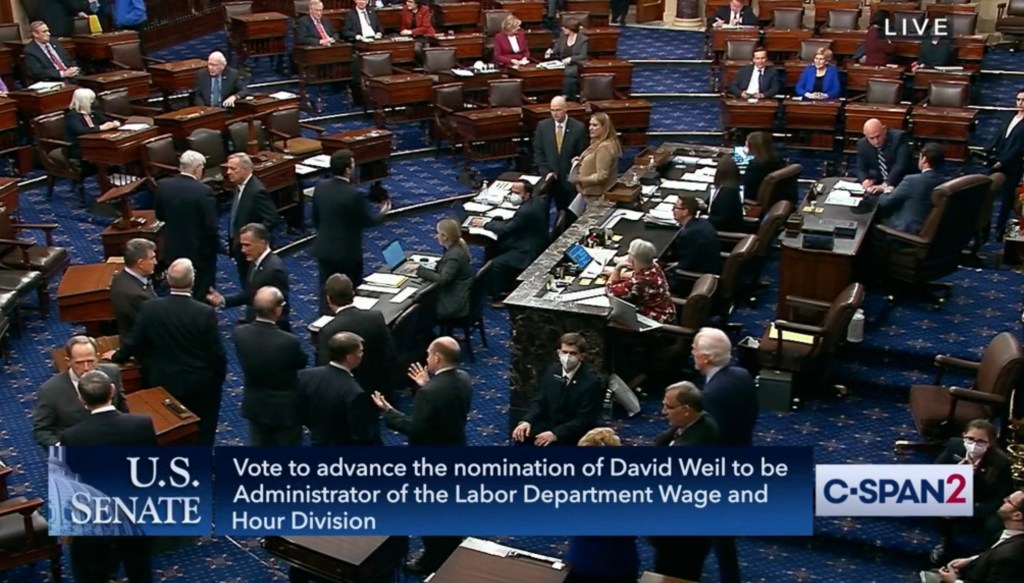
Independent Contractors May Have a Weil Problem On Their Hands

Crash Test Dummies is a band from Winnipeg that I really like — especially the 1993 album, God Shuffled His Feet. It’s full of thoughtful questions asked in a booming deep voice. The song In the Days of the Caveman takes a look back, with some keen observations added for good measure:

In the days of the caveman
And mammoths and glaciers
Bugs and trees were your food then
No pajamas or doctors

See, that’s all true and probably not something you had thought about before.

President Biden has given us another reason to look back and reconsider some things you hadn’t thought about in a while. Last week, Biden nominated David Weil to serve as Wage and Hour Administrator. Weil served in the same role under Obama, so we’ve seen that movie too.

Here are some highlights from Weil’s last stint as W&H Administrator:

  • Administrator’s Interpretation 2016-1: Joint Employment under the FLSA, which I wrote about here when it was issued. Weil embraces the broadest possible view of joint employment. The Trump Administration’s DOL rescinded this guidance in 2017.
  • Administrator’s Interpretation 2015-1: Applying the FLSA’s “Suffer or Permit” Standard to Independent Contractor Classification, which I wrote about here. Weil advocates an expansive view of employment, declaring that “most workers are employees under the FLSA’s board definitions.”

Here’s what we can expect from Weil 2.0:

  • Increased enforcement activity by the DOL against companies using independent contractors.

Right now, claims generally arise through lawsuits, and class/collective actions present the most danger. The risk of class claims can be limited with arbitration agreements and class waivers. But arbitration agreements provide no defense against a DOL action. Those agreements don’t bind the government. Expect the DOL to go after companies that make extensive use of independent contractors.

  • Increased enforcement activity by the DOL on joint employment claims.

Remember, unlike independent contractor misclassification, joint employment is not illegal. Joint employment is a problem when a primary employer (such as a staffing agency or vendor/subcontractor) fails to comply with some aspect of the FLSA and its wage payment rules. Under a broad theory of joint employment, the company benefitting from the services is going to be liable for the errors of the primary employer, even though the alleged joint employer had no control over the primary employer’s wage practices.

  • New regulations on independent contractor classification and joint employment.

The standards and test keep changing, depending on who holds the White House. One step the Wage and Hour Division can take to try to make its views more permanent is to adopt its views as formal regulations, not just Administrator’s Interpretations. This is what the Trump DOL tried to do for both independent contractor misclassification and joint employment. Expect a strong push by the DOL to adopt new regulations that make it harder to maintain independent contractor status and easier to find joint employment.

The bottom line is that we’re going back in time. Maybe not so far back that bugs and trees were your food then, but back to 2015 and 2016 interpretations of the FLSA. Expect no pajamas or doctors.

What to do about it? Businesses that rely on independent contractors should tighten their agreements now. Businesses that engage staffing agencies should review those contracts now.

These posts contain a few of my favorite tips:

Good luck out there, and beware of mammoths and glaciers.

Enter your email address to subscribe to this blog and receive notifications of new posts by email.

© 2021 Todd Lebowitz, posted on WhoIsMyEmployee.com, Exploring Issues of Independent Contractor Misclassification and Joint Employment. All rights reserved.

2018_Web100Badge