
 You’re supposed to learn something new every day, right? Here’s something that’s definitely new, unless you are a fungus aficionado — and, lucky reader, because this is a read-only post, you do not have to identify yourself if you are indeed a fungus aficionado, and if you are, TMI, and keep it to yourself.
Anyway, there’s a fungus that attacks certain kinds of ants, takes over their ant-body cells, turns them into zombies, causes them to take a final mad bite into a certain type of leaf, then causes a plant spore to sprout from their heads. Yes, really. It’s right here in this New York Times article, complete with pictures.
The Ophiocordyceps fungus is not a dinosaur, despite its suspiciously dinosaur-sounding name, but it sounds pretty ferocious and looks like it’s threatening to kill off segments of the ant population.
Another thing that is ferocious and threatening to kill something off is California’s recent Assembly Bill 5, which would convert many independent contractors into employees under state labor laws.
The latest attempt to eradicate that ferocious law comes in the form of a ballot initiative being sponsored by some of the large ride hailing and delivery app companies.
The Protect App-Based Drivers and Services Act, if passed, would preserve the independent contractor status of app-based drivers in California if the app companies provide the drivers with a number of financial considerations and benefits, along with allowing the drivers to maintain control over when and where they work. The law imposes substantial driver protections that app companies are currently hesitant to provide, out of fear that providing these benefits and protections might cause the drivers to be deemed employees.
The law would strike a much-need balance that enhances driver rights while creating certainty on drivers’ classification status.
The app companies would have to provide an earnings guarantee of at least 120% of the local minimum wage for time engaged, a 30-cents per mile stipend to cover vehicle expenses, a healthcare subsidy contribution, occupational accident insurance, and liability insurance.
App companies would be prohibited from engaging in discrimination. Companies would also be required to implement a sexual harassment policy, conduct background checks, implement safety training, and implement a zero tolerance policy prohibiting driving while impaired. Rest periods would also be required.
In exchange, the app companies would receive assurance that the drivers are properly classified as independent contractors so long as four conditions are met:
(a) The network company does not unilaterally prescribe specific dates, times of day, or a minimum number of hours during which the app-based driver must be logged into the network company’s online-enabled application or platform.
(b) The network company does not require the app-based driver to accept any specific rideshare service or delivery service request as a condition of maintaining access to the network company’s online-enabled application or platform.
(c) The network company does not restrict the app-based driver from performing rideshare services or delivery services through other network companies except during engaged time.
(d) The network company does not restrict the app-based driver from working in any other lawful occupation or business.
The proposed law is supported by multiple prominent ride share and delivery app companies. Their hope is to gather enough signatures to place the issue on the November 2020 ballot in California.
This is worth watching. You can read more about it here. If passed, this can serve as model legislation to be applied elsewhere around the country.
In the meantime, if you see fungal spores starting to grow out of app drivers’ heads, you’ll know that Assembly Bill 5 got to them first. We can only hope.

© 2019 Todd Lebowitz, posted on WhoIsMyEmployee.com, Exploring Issues of Independent Contractor Misclassification and Joint Employment. All rights reserved.
Need training on avoiding independent contractor misclassification claims? Hey, I do that!
 California continues to be a hotbed of activity, which got me wondering: what is a hotbed? So I
  I took a picture of this goat right before it tried to eat a small paper cup. The paper cup had food in it, but the paper cup was not the food. This confusion is understandable because, well, it’s a goat. The bar is set low for a goat.
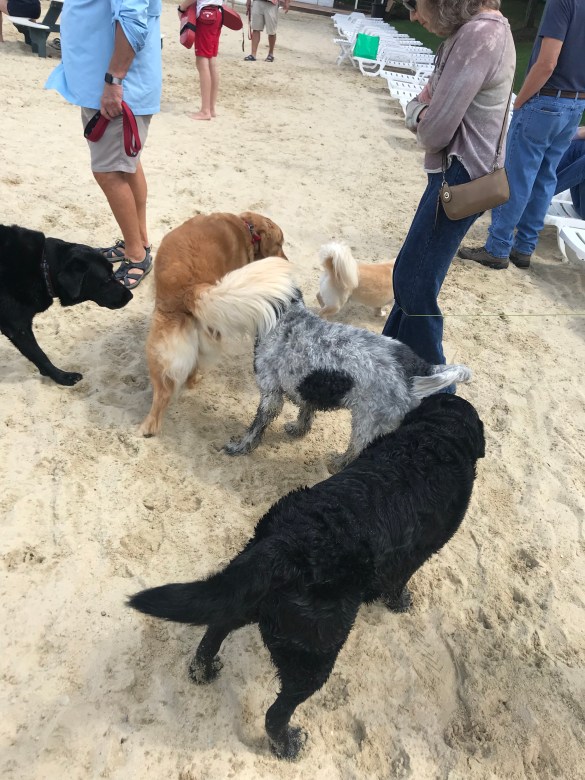 Where I play tennis, there’s a lake with a beach that is open all summer. Like most places in the Midwest, it closes for the season on Labor Day. The weekend after Labor Day, they open it up for everyone to bring their dogs to run around, jump off the high dive (I wish!), and sniff each other’s butts. Because dogs are not typically allowed at the lake, these dogs are unfamiliar with each other, so there’s even more butt-sniffing than you might normally see at a canine networking event.
 Sometime I forget where I park, so when I went to the airport recently, I told Siri where I left the car.

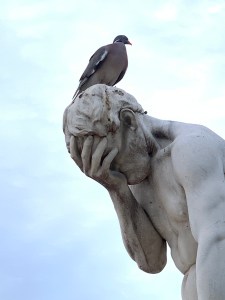 I took this picture last week in Paris, walking through the Jardin des Tuileries with my family, just outside the Louvre.
 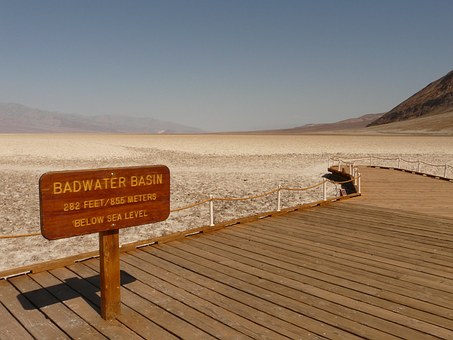 California is the home of both the highest and the lowest points in the continental U.S. — Mt. Whitney at 14,495 feet and Death Valley at -282 feet. As far apart as these two sites are on the altimeter, they’re less than 100 miles apart on the odometer.
 Everyone loves a fun funeral story, right? Apparently so. AARP.com posted
  Who Is My Employee?