
How Does the New Tax Plan Affect Independent Contractors?

In 1985, Simple Minds released the song, Dont You (Forget About Me). Despite the most ridiculous looking dancing you can imagine (under a chandelier, in front of TV screens, adding to the mood ???), the video was nominated for two MTV Video Music Awards.

The preposterous dance moves are pretty simple, though, which seems fitting for a band named Simple Minds.

Simplicity is the overriding theme here. Despite the overall complexity of the newly enacted tax plan, one thing is simple: The tax plan is good news for independent contractors.

Continue reading

Is Independent Contractor Misclassification, By Itself, an Unfair Labor Practice? (2018 update)

Clock independent contractor misclassificationAs Bob Dylan would say, The times they are a-changin’.  Upon being sworn in as new General Counsel of the NLRB, Peter Robb issued a Memorandum indicating his intent to reconsider a broad range of controversial positions taken by the Board and by his predecessor, Richard Griffin.

Among these positions is an issue we wrote about here, just a couple of months ago. The issue is whether the act of misclassifying a worker as an independent contractor could, by itself, be deemed an unfair labor practice. As explained in that blog post, an Administrative Law Judge had ruled that misclassification alone could be considered an unfair labor practice. The ALJ’s explanation went like this:

Continue reading

Free Bird! Dep’t of Labor Rewrites Test for Unpaid Internships

chicks-2965846_1920Lots of things are free in the world of music. There’s Free Bird (Lynyrd Skynyrd), Free Money (Patti Smith), and according to Dire Straits, you can get your money for nothin’ and your chicks for free.
For the most part, though, you’ve got to pay for your interns. Or do you?

On Friday, the DOL announced it was reversing its 2010 guidance on Internship Programs under the Fair Labor Standards Act. Since 2010, the DOL had been taking the position that unpaid interns are employees and must be paid unless each of six factors were present. Here’s the old DOL fact sheet and six-factor test.

The DOL has now changed course, after four U.S. Court of Appeals decisions rejected the DOL’s test as too strict. The DOL now opted for a balancing test. The balancing test asks whether the intern or the business is the “primary beneficiary” of the internship.

The DOL’s new guidance adopts the same balancing test recently favored by the courts.

Continue reading

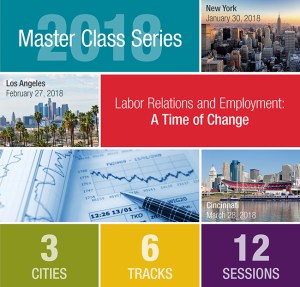
Join Me: 2018 Master Class Dates & Locations. Free Attendance.

ShowImage.ashxPlease join me and my BakerHostetler colleagues for the 2018 Master Class on Labor Relations and Employment: A Time for Change. I will be presenting on Labor Law Issues in the Gig Economy. Choose 6 of 12 courses in a full-day session. There is no charge for attendance.

Event dates and locations are:
Jan. 30 – New York
Feb. 27 – Los Angeles
Mar. 28 – Cincinnati

Register here. List my name under referring attorney so that I know to look for you.

Sessions include: Continue reading

School’s Back in Session: How Much Training Can You Give to Independent Contractors?

“We don’t need no education / We don’t need no thought control,” are the opening lines to Pink Floyd’s Another Brick in the Wall (Part II). “Teachers, leave them kids alone!”

The same advice can be given when retaining independent contractors. Contractors are supposed to be in business for themselves. They are expected to be competent in performing the types of activities they are being retained to perform. In several of the Independent Contractor vs. Employee tests applied to federal and state laws, the amount and type of training is a factor that can tilt the scales toward a finding of misclassification.

But sometimes, some training is needed. The key questions to ask yourself are, What type? And How much?

Continue reading

N. Carolina Strengthens Independent Contractor Enforcement Plan

North carolina independent contractor misclassification

With apologies to James Taylor, In my mind I’m gone to Carolina. That’s not because of Tarheels or Panthers or Hurricanes. It’s because North Carolina just enacted a law to make it easier for the state to identify instances of independent contractor misclassification.

Not only does the law help the state identify business that may be misclassifying workers, it also coordinates the state’s enforcement efforts. The law creates a process for state agencies to share suspected incidents of misclassification, so those businesses unlucky enough to take a hit on an unemployment claim can expect to hear from the Department of Labor and Department of Revenue as well. How sweet it is to be loved by you (and you, and you, and you).

The Employee Fair Classification Act creates an Employment Classification Section within the Department of Industrial Relations. Its role is to receive complaints from workers who suspect they have been misclassified, investigate them, and make it easier for the other state agencies to investigate them as well. Most of the law’s provisions go into effect December 31, 2017. Continue reading

EU Court Expands Penalties for Independent Contractor Misclassification

UK england independent contractor misclassification

Crikey! Across the pond, worker misclassification is a hot topic, and the European Court of Justice (ECJ) has turned up the heat on companies using independent contractors.

In a closely watched case, the ECJ ruled that a commission-only sales contractor who was  misclassified was entitled to receive payment for four weeks of annual holiday pay for the entirety of his engagement, 13 years, covering 1999 to 2012.  The case is King v Sash Window Workshop Ltd., decided 29/11/2017 (US translation: 11/29/2017).

In the US, back pay in misclassification cases is often limited to two or three years. Statutes of limitation generally limit how far back a worker can go when seeking a recovery. But what about Europe?

Continue reading

Ding-Dong, the Witch is Dead! NLRB Overrules Browning-Ferris

1168499F-959C-46D6-91E6-B5B695418DEF.jpeg

Remember the good old days, way back in 2014? You recall the time — back when David Letterman was still on the air and it was not yet illegal in New York to take a selfie with a tiger.

Yes, that was life before 2015, when the NLRB waved its magic wand, rewrote the definition of joint employment, and forced several of the planets to spin out of orbit. The Board’s decision in Browning-Ferris erased decades of precedent and caused bloggers everywhere to vomit profuse amounts of text and doomsday predictions.

For those of you who missed the news in 2015 (understandable if you spent the year focused on following the saga of Winston, the Aussie python who swallowed salad tongs), allow me to offer this quick refresher: The 2015 Browning-Ferris decision declared that, under federal labor law, a business would be considered a joint employer if it retained the right to exercise even a teeny tiny bit of control, and even if it never actually exercised that control.

Good news, citizens of earth! The planets realigned on Thursday, when the Board reversed its 2015 decision and reverted back to the old standard. The new standard is the old standard. (Got it?)

Continue reading

Reminder: Jan. 31 Deadline for Filing Independent Contractor Forms

new year 2018Businesses that retain independent contractors need to remember to file their tax forms. The 1099-MISC forms used for reporting payments made to independent contractors are due to the IRS on January 31st. The payments are to be reported in Box 7. Click here for more helpful filing tips from your friends at the Internal Revenue Service.

Generally, the IRS requires a Form 1099-MISC to be issued for any independent contractor who is paid $600 or more in any year.

How do you know whether you have to file a Form 1099-MISC? The IRS advises that if the following four conditions are met, businesses (or individuals) must report a payment as nonemployee compensation:

  • You made the payment to someone who is not your employee;
  • You made the payment for services in the course of your trade or business (including government agencies and nonprofit organizations);
  • You made the payment to an individual, partnership, estate, or in some cases, a corporation; and
  • You made payments to the payee of at least $600 during the year.

Continue reading

Did You Know You Can Be Cited for OSHA Violations for Non-Employee Workers?

osha violations joint employment

Can OSHA cite your business for conditions that affect another company’s employees? Maybe.

OSHA’s Multi-Employer Citation Policy addresses who gets cited for violations that occur on a multi-employer worksite. If your company hosts staffing agency workers, that may include you.

The policy has been subjected to several legal challenges, though, based on an argument that OSHA obligations extend only to an employer’s own employees. One of these challenges is currently pending in the Fifth Circuit Court of Appeals, based on a dispute over an Austin, Texas, construction site.

While we wait for a decision, though, here’s what OSHA has to say about its authority to issue citations on multi-employer worksites: Continue reading