Those who have seen me present on independent contractor issues know that I like to incorporate song references by The Who. There are so many song titles and lyrics that help the presentation flow.
On Tuesday, it’s my turn to co-present at the annual BakerHostetler Master Class on Labor Relations and Employment Law. The session is called Answering Tough Questions About Independent Contractors, Joint Employment and the Contingent Workforce, Using Songs by The Who. The session is free, 2-3p ET on April 5. Register here.
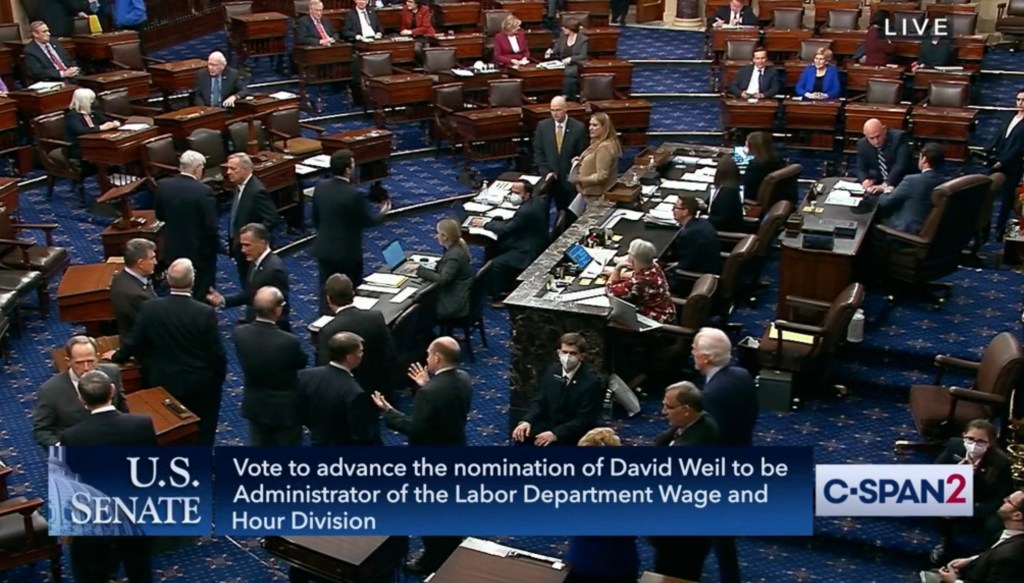
If you join me, you’ll get gems like this when we update you on 2022 developments, such as David Weil’s nomination to serve as Wage and Hour Administrator of the DOL:
Democrats: Meet the new boss, same as the old boss.
Republicans: We won’t get fooled again.
David Weil was the Wage and Hour Administrator in the DOL during the Obama Administration. He published two Administrator’s Interpretations expressing the view that most independent contractors were misclassified and that joint employment should be much easier to establish. He wrote about the problems with the “fissured workforce,” meaning the expansion of non-traditional, non-employee labor. He was not a friend of the business community and especially disliked by the franchising community.
In 2021, Biden nominated him to reclaim that post.
Last week, the Senate voted 53-47 to block the nomination.
In the independent contractor space, it’s been a busy few months for the DOL, and I would imagine the administration would like to fill this role as quickly as possible.
Last month, a federal court took issue with the Biden DOL changing its tune on the Trump DOL’s test for independent contractor misclassification. The court declaredThe Song Is Over and rejected the Biden DOL’s change, reinstating the Trump-era test for worker classification under the Fair Labor Standards Act (FLSA). More details here.
In January, the DOL and the NLRB signed a Memorandum of Understanding in which they agreed to share information to combat independent contractor misclassification.
Join me and my colleagues Margaret Rosenthal and Vartan Madoyan on Tuesday for more updates, tips, previews, and Who-themed lyrics. There’s no charge to attend. I’m Free.
I just got back from Miami, where this happened. According to The Miami Herald, a very badass bobcat was caught on video taunting a 120-lb python by swatting at it and eating its eggs. Despite giving up 100 lbs to the python, the bobcat reigned supreme. Unbeknownst to our friends in the animal kingdom, there are easier ways to get an omelet.
This week’s post is also about fighting over who reigns supreme. But this battle is between the FTC Franchise Rule and the ABC Test for determining independent contractor vs employee status. Sounds exciting? (I know!)
In Massachusetts, there is a strict ABC Test for determining employee status. This is the hardest ABC Test to meet in the US. It is the same as California‘s test but lacks the exceptions found in California law.
ABC Tests have been viewed in the business community as a threat to the franchising model of doing business. On one hard, franchisors must exert control over their franchisees to ensure brand consistency. On the other hand, exerting control is a sign of employment and could turn a franchisee into the franchisor’s employee.
In Patel v. 7-Eleven, the Massachusetts Supreme Judicial Court was asked whether the ABC Test can be used to determine employment status in a dispute between a franchisor and franchisee. The franchisor, 7-Eleven, argued that the state law test is incompatible with the FTC Franchise Rule and should therefore be disregarded in the franchise context.
The Court ruled that the ABC Test still applies, reversing the earlier decision I wrote about here, in this super fun but now outdated Electric Grandma-themed post.
The Court explained that the FTC Franchise Rule deals with control over the “method of operations,” not control over the method of “performing service”:
“[C]ontrol over the franchisee’s method of operation” does not require a franchisor to exercise “control and direction” in connection with the franchisee’s “performing any service” for the franchisor — the relevant inquiry under the first prong of the ABC test. That the election under the FTC Franchise Rule and the first prong of the ABC test employ the same word — control — does not create an inherent conflict. Indeed, “significant control” over a franchisee’s “method of operation” and “control and direction” of an individual’s “performance of services” are not necessarily coextensive.
I dissent. (Can I do that?)
The lines get awfully blurry awfully fast. The differences the Court relies on are subtle differences. In many respects, control over the operation seems to requires control over how services are performed. Your burger at one franchise looks and tastes the same as your burger at another franchise because the method for making that burger has to be essentially the same. It’s true that the franchisor doesn’t control a franchisee’s schedule or hiring process. But how well will a jury understand that the franchisor’s control is over the “operation,” but not over the “services”?
The Court’s ruling does not mean franchisees in Massachusetts are going to be considered employees now, but it does make it more challenging for a defendant/franchisor to explain the subtle distinctions in types of control.
I don’t know who in this scenario is the bobcat and who is the python, and I certainly don’t know who would be the one eating the eggs. But like the python vs. bobcat confrontation, there’s a definite clash here, and it’s an uncomfortable and confusing situation for everyone. The Massachusetts Supreme Court certainly didn’t do anything to make it easier to apply the ABC Test, and independent contractor misclassification remains a serious risk for franchisors who comply with franchising requirements.
There’s an optical illusion known as a negative afterimage. If you stare at the red dot on this woman’s nose for about 15 seconds, then look at a blank wall, you’ll see the woman on your wall – but in full color and with dark hair. And yet, there is no woman on your wall.
You see what isn’t there because the illusion tricks the photoreceptors in your retina.
Monday’s ruling by a federal judge in Texas also has us seeing what isn’t there – or what was there and then wasn’t there – or something like that, but with respect to the test for independent contractor classification.
In early January 2021, the Trump DOL issued a new regulation that sought to provide clarity on how to determine whether someone is an employee or an independent contractor under the Fair Labor Standards Act (FLSA). Even though the FLSA is a federal law that is supposed to apply everywhere, different courts around the country used different versions of the FLSA’s Economic Realities Test to make that determination.
Under the new regulation, 29 CFR Part 795, there would be just one test. It was simple, and the same rule would apply all over the country. The regulation was scheduled to take effect March 8, 2021. But a few days before the effective date, the Biden Administration postponed implementation of the new rule. Then in May, they rescinded it. They replaced it with nothing. If you go to the Code of Federal Regulations, there is no 29 CFR Part 795. (Here, try it!)
But Monday’s ruling said to stare a little harder. It’s there.
The court ruled that the Biden Administration’s effort to delay and then withdraw Part 795 was unlawful and violated the Administrative Procedure Act. The delay provided too short a comment period, failing to offer the public a meaningful period to provide input. The withdrawal was improper because the DOL failed to consider alternatives and instead “left regulated parties without consistent guidance.”
Because the delay and withdrawal of the Trump era rule were deemed unlawful, the court ruled that Part 795 did, in fact, go into effect March 8, 2021, and “remains in effect.”
Who knew?
So now you probably want to know what the rule is, since you cannot find it online in the Code of Federal Regulations – at least as of Tuesday night.
The test in Part 795 identifies two “core factors” for determining the independent contractor vs. employee question under the FLSA. If both factors point in the same direction, the issue is generally decided. If the core factors point in different directions, three “other factors” are considered.
• The nature and degree of the individual’s control over the work; and
• The individual’s opportunity for profit or loss.
The control factor supports independent contractor status if the worker “exercises substantial control over key aspects of the work,” including setting schedules, selecting projects, and being allowed to work for others.
The profit or loss factor weighs in favor of independent contractor status if the worker has the opportunity to earn profits or incur losses based on the exercise of initiative, managerial skill, business acumen or judgment, or based on management of his or her own investments or capital expenditures. Examples of investments may include hiring helpers or buying equipment.
Other Factors
If the two core factors do not determine the issue, three other factors are to be considered:
• Amount of skill required for the work;
• Degree of permanence of the working relationship between the individual and the potential employer; and
• Whether the work is part of an integrated unit of production.
Amount of skill required. This factor weighs in favor of independent contractor status if the work requires specialized skill or training that the potential employer does not provide.
Degree of permanence. This factor weighs in favor of independent contractor status if the work is definite in duration or sporadic. This factor supports employee status if the work is indefinite. Work that is seasonal by nature does not weigh in favor of independent contractor status, even though it’s definite in duration.
Whether the work is part of an integrated unit of production. This factor is likely to receive the heaviest criticism from worker advocates. The “integrated unit of production” factor comes from a pair of 1947 U.S. Supreme Court cases. Over the years, this factor has morphed into the question of whether the work is “integral” to the potential employer’s business. Part 795 takes a firm stance here, saying that — based on the 1947 Supreme Court decisions — the relevant question is whether the work is “integrated,” not whether it is “integral.”
This factor weighs in favor of independent contractor status if the work is “segregable” from the potential employer’s processes for a good or service. For example, a production line is an integrated process for creating a good. A software development program may require an integrated process for creating a computer program. Work that is performed outside of an integrated unit of production is more likely performed by an independent contractor.
What Happens Now?
First, the DOL can appeal the decision to the Fifth Circuit. We expect that will happen. In the meantime, a stay might be issued or might not be issued.
Second, Part 795 is now in effect, unless a stay is issued.
Third, it’s a fair question how much this really matters anyway. The test was not intended to change the outcome in most instances. It was instead intended to articulate more clearly how these determinations were already being made. The two “core factors” were already determinative in almost all cases, even if courts were not explicitly identifying two factors as being most important. Also, the Circuit Courts of Appeal do not have to adopt the DOL’s interpretation of the test. They can go on using their five-part and six-part tests, or they can apply the Part 795 analysis.
The Part 795 should now be the applicable test. But we shall see.
If you stare hard enough at your handy copy of the Code of Federal Regulations, and then look at a blank wall, Part 795 just might appear.
In this post, we’ll set the bar low. Today’s theme is “Don’t say stupid [stuff].”
Those of you living outside Northeast Ohio may have missed this recent gem. During a city council meeting on whether to allow ice fishing at Hudson Springs Park, Hudson’s mayor opposed the proposal — on the grounds that ice fishing shanties might be used for prostitution.
“If you open this up to ice fishing, while on the surface it sounds good, then what happens next year? Does somebody come back and say, ‘I want an ice shanty in Hudson Springs Park for ‘X’ amount of time?’ And if you then allow ice fishing with shanties, then that leads to another problem. Prostitution.”
Don’t say stupid stuff. After being widely mocked, the mayor resigned a week later.
A similar rule of thumb applies when evaluating your independent contractor relationships.
It’s a great idea to look carefully at those relationships and to examine whether misclassification might exist. But be careful what you put in writing. Don’t write stupid stuff. Emails are a plaintiff’s lawyer’s best friend.
If you think your business might be misclassifying its contractors, you get a gold star for being proactive. (Congratulations! It will look great on your chart on the refrigerator.) But don’t express that opinion in an internal company email. Pick up the phone and call someone. Or better yet, get your legal counsel involved. Not only can you have privileged, non-discoverable email communications with counsel, you can also get helpful legal advice.
Email, IMs, DMs, texts, Slack, and Team chats are all discoverable in litigation. If your business gets sued for misclassifying contractors, you do not want a trove of emails from HR to the CFO saying, “I think we may be misclassifying our contractors” or “I saw Lebowitz’s blog, and I think our contractors are probably employees under the Right to Control test,” or “That California ABC test is a real killer. There’s no way we meet part B.”
Those are helpful thoughts — and you all know I always recommend being proactive about these things — but please, please, pick up the phone instead. Call your CFO. Call your company president. Call your lawyer. Don’t write it in a discoverable email or text or IM or chat. Don’t create evidence that will allow a plaintiff’s lawyer to say, “Not only was this business misclassifying its contractors, but they knew they were doing it. Just look at this email.”
Your good intentions in identifying a possible issue can be used against you. But be careful how you communicate that concern. Say it, don’t write it.
I like long songs. For the last several weeks, I have been starting my workday with the Pink Floyd album Atom Heart Mother on my headphones. The opening track is 23 minutes, and the album ends with “Alan’s Psychedelic Breakfast,” a 13-minute journey that includes lines like “um, flakes” and “marmalade, I like marmalade.”
Long litigation, on the other hand – I’m not a fan. When I was an associate, I worked on a healthcare fraud case that lasted about 8 years. Not fun.
The legal team at Sleepy’s LLC probably doesn’t like long litigation either. Hargrove v. Sleepy’sLLC is an independent contractor misclassification case that was filed in 2010. The case has been to the Third Circuit twice already and went to the New Jersey Supreme Court on the certified question of what test should be used to determine employee status under New Jersey wage and hour law. I wrote about that 2015 ruling here in a post that also takes an admiring look at one menu option at an ice cream parlor in Dania Beach, Florida. (Partial spoiler: ABC Test. But you’ll have to read the post to see about the menu option.)
This case is back in the news after a new set of rulings.
After 12 years, the court issued a decision last week to grant class certification and to deny the defendant’s motions to dismiss. These are issues that are typically resolved in the first several months of a case.
The point here is to show you how long and complicated an independent contractor misclassification case can become. This is not straightforward litigation, and there are so many legal issues that can dominate the underlying dispute — questions, for example, about class certification, class size, jurisdiction, standing, and which legal test to use for deciding whether misclassification exists.
This case is a good reminder of the importance of getting your independent contractor arrangements reviewed and your contracts revised. Preventive steps taken now can help avoid lengthy litigation later. Lengthy litigation is no fun for anyone.
But I do like long songs, and if you pay close attention, you can appreciate the careful and elaborate construction of a track. Put on your headphones if you want to catch every subtle sound.
There’s no reason our maps are oriented the way they are, with Australia at the bottom and Canada near the top. There’s no right side up in space, and we could just as easily think of the world with Australia on top, in the middle.
Same with our way of deciding Who Is My Employee? The process for determining whether someone is an employee or an independent contractor doesn’t have to be the way Americans conduct that analysis.
Two High Court decisions this month in Australia highlight a key difference between the American approach and what is now the new Australian approach.
In the U.S., courts look past the written contract and analyze a worker’s status based on the actual facts of the relationship.
The Australian High Court says the U.S. approach is upside down.
In two highly publicized decisions, the Australian court ruled that the contract establishes the rules of the relationship and therefore also determines the worker’s status. In one case, the agreement said the work would be controlled by the hiring party. By contractually reserving the right to control the work, the hiring party inadvertently made the worker an employee. The court still looked past the fact that the parties called the worker an independent contractor, but the court said the contractual requirements of the relationship — the terms and conditions — controlled the outcome.
The other High Court case involved two truck drivers. Their contracts exhaustively set forth terms preserving their flexibility to work for others and to control how their work was performed. Their contracts also called for the drivers to use their own equipment, which involved a significant investment by the drivers. The court overruled a lower court decision that deemed the workers to be employees. The lower court focused on actual control exerted by the hiring party. But the High Court said the contract controls and, in this case, the contract established requirements consistent with independent contractor status. It is up to the parties to follow the contract, but the contract establishes the independent contractor relationship.
There are lessons for American companies here too.
While under U.S. law, the actual facts of the relationship control whether the worker is an employee, the independent contractor agreement is an opportunity to memorialize the helpful facts. That’s why off-the-shelf templates in the U.S. are of no value. (Hot tip: Google & Bing is not a law firm.) See related posts here and here, including how to discomfit a bear.
An independent contractor agreement in the U.S. should be drafted with the particular facts of the relationship in mind. Does the worker get to decide when and where the work is done? If so, put that in the contract. The worker controls when and where the work is performed, and the hiring party has no right to control when and where.
If the worker’s status is challenged, you want the contract to be a helpful piece of evidence. You want to be able to say to a court: Not only does the worker get to decide when and where the work is done (or insert other factor), but the contract forbids us from controlling that.
In the U.S., contract terms like that will be persuasive evidence, but only if the actual facts align. In Australia, the contract sets the rules, and the parties are in breach if they fail to follow the rules established in the contract.
But no matter where you sit, and no matter which way your map is aligned, companies should view independent contractor agreements as an opportunity to build the case that an independent contractor is properly classified.
By planning ahead and drafting carefully, you can maximize your chances of coming out on top.
The term cold shoulder originated with Scottish novelist and poet Walter Scott in the early 19th century. A commonly repeated but incorrect origin story says that welcome houseguests were given a hot meal, but those who were not welcome would get a cold shoulder of mutton. But Scott’s use of the phrase had nothing to do with food. He described “shewing o’ the cauld shouther” as a physical gesture, turning the shoulder away from someone in a cold or indifferent manner.
No matter the origin, a federal judge in California recently showed some seriously cold shoulder to an independent contractor seeking ERISA benefits. The case shows the importance of a well drafted complaint in a misclassification lawsuit and highlights an important defense.
Tim Alders worked for YUM! Brands and Taco Bell for 25 years as an independent contractor. He then filed a lawsuit claiming he was misclassified.
He sued under ERISA, alleging that he should have been treated as an employee. He claimed that if he had been treated as an employee, he would have been a “participant” in YUM’s retirement plans, incentive plans, 401(k) plan, and executive income deferral program. Had he been a participant, he would have received financial benefits that he did not receive as a contractor.
Under ERISA, however, civil actions may only be brought by plan participants, beneficiaries, or the Secretary of Labor. ERISA defines a “participant” as “any employee or former employee of an employer . . . who is or may become eligible to receive a benefit of any type from an employee benefit plan which covers employees of such employer . . . or whose beneficiaries may be eligible to receive any such benefit.”
As YUM argued in its motion to dismiss, Alder could not sue under ERISA because he was not a “participant.” Judge Phillip Gutierrez, with a wink and a nod to Joseph Heller, agreed and dismissed the case. The plaintiff never got to argue whether he was misclassified or not.
The decision relied on past rulings, including this synopsis of ERISA law by a different California federal judge: “[U]nder Ninth Circuit authority, a claim that a former employee plaintiff should have been included in a plan, but actually was not included in a plan, does not give [the] plaintiff a ‘colorable claim to vested benefits’ for ERISA standing purposes.”
That’s some serious cauld shouther.
This case is a reminder that there are a lot of ways to defend a misclassification case. The “not a participant” defense is a valuable tool and should be used when appropriate.
But don’t be fooled. This ruling does not mean that a misclassified contractor can never sue for employee benefits. Remember too that this is unpublished case by one district court. Let’s not give it too much weight as precedent. There have been many class actions, some highly publicized, in which in which misclassified contractors took home lots of cash (many millions of dollars) as a result of being denied employee benefits.
One more thing before you go. There’s one easy step that companies should take now, before facing a misclassification lawsuit. Companies should check their plans to make sure the plan eligibility language protects specifically against misclassification claims. This post, featuring a reggae cucumber, provides the magic language you should be including in your plan documents.
If you plan properly, you too can give the cauld shouther.
Raise your hand if you remember the 1982 song “Twilight Zone”? Seeing several hands raised, I will continue. The tune is catchy, but the lyrics are hard to understand. I heard the song this weekend and decided to finally check the lyrics. “There’s a storm on the loose, zarmines in my head” couldn’t be right, could it?
Raise your hand if you knew the chorus was this:
Help I’m steppin’ into the twilight zone The place is a madhouse, Feels like being cloned My beacon’s been moved under moon and star Where am I to go, now that I’ve gone too far?
Seeing no hands raised, I will continue.
It’s all very confusing to me, but it made sense once I read through it more carefully.
I had the same reaction after seeing an amicus brief that the AFL-CIO recently filed with the NLRB. The brief was filed in a case that may — yet again — change the test for independent contractor status.
In Atlanta Opera, the Regional Director for Region 10 ruled that a proposed unit of makeup artists and hairstylists were employees, not independent contractors, and that an election could proceed.
The NLRB then issued a notice asking the parties and the public for briefs addressing whether the Board should reconsider the test for determining whether workers are independent contractors or employees. It seems inevitable that the Board will rewrite the test to make it harder for a worker to be deemed a contractor. But is Atlanta Opera the right case to use for rewriting the test?
The AFL-CIO, somewhat surprisingly, said no. Like the lyrics to “Twilight Zone,” that was confusing to me at first, but it makes sense when I read through it more carefully.
Undoubtedly the unions want a rewrite of the test to make it as hard as possible for someone to maintain contractor status. But the AFL-CIO urged the NLRB to wait, arguing this isn’t the right set of facts to make a sweeping change.
The AFL-CIO’s brief argued that, even under the existing test, it was pretty clear the makeup artists and stylists were employees. It would be more impactful to wait for a closer case to rewrite the test. Ah, so that’s their angle — wait til later then really shake things up.
Eventually, the NLRB is going to change the test. The current test, explained in SuperShuttle DFW (discussed here), examines ten Right to Control factors.
At a minimum, it seems clear that the Board would like to go back to the FedEx Home Delivery test. The FedEx test asked whether the worker was “in fact, rendering services as part of an independent business” and essentially adopted an Economic Realities Test, rather than the Right to Control Test that had always been applied.
When the Board revises the test, it could go back to FedEx or it could try to adopt a new, more stringent test, like an ABC Test. (The courts probably would not allow the Board to adopt an ABC Test without Congressional action, but that’s for another day.)
And the Board will revise the test. It’s just a question of when and to what. The Board will make it harder to be an independent contractor under federal labor law. That means it will become easier for unions to file election petitions and try to organize groups of workers that might now be operating as independent contractors.
Yeah there’s a storm on the loose, sirens in my head.
When the temperature in Florida drops into the 30s, the iguanas freeze. Unable to regulate their body temperature, they drop out of trees, landing on sidewalks and in yards like solid rubber toy animals.
The freeze doesn’t kill them though. It just stuns them for a while, then they eventually warm up, reanimate, and go about their daily iguana business.
Getting stunned like this can’t be avoided for the iguanas. Amazon is not yet selling iguana jackets, and online delivery to lizards is notoriously complicated. (Note to self: Business opportunity?)
But unlike iguanas, businesses can reduce their chances at getting stunned — at least when it comes to avoiding lawsuits from staffing agency workers.
When staffing agency workers file wage and hour lawsuits, they often sue both the staffing agency and the business where they worked. The workers allege that both are joint employers, often bringing class claims or a collective action.
Businesses that carefully draft their staffing agency agreements will have some natural defenses against these claims. I’ve written about that here. I call this strategy The Monster with Three Eyes.
But there’s a fourth strategy too. Force individual staffing agency workers to arbitrate these claims instead of pursuing them in court, and include class action waivers with the agreement to arbitrate.
There are two ways to introduce arbitration agreements with class waivers in your staffing agency agreements.
First, you can mandate that staffing agencies sign arbitration agreements with their own employees. Some courts have found that arbitration agreements between a staffing agency and its employee protect the third party business too, even if the third party hasn’t signed the agreement.
But that approach carries risk. The agency’s arbitration agreement might be poorly written, or it might include terms that make it unenforceable. Your protection is only as good as whatever form agreement the agency presents to their workers.
There’s a second approach I like better. It goes like this:
Draft your own individual arbitration agreement (with class waiver) for staffing agency workers to sign, requiring them to arbitrate any claims against you. Make it mutual, of course.
Append it to the staffing agency agreement as an exhibit.
Include a clause in the staffing agency agreement requiring the agency not to assign anyone to your business unless they’ve first signed this agreement.
The agreement will be short. No more than two pages. It can also include an agreement by the agency worker to protect your confidential information and assign inventions.
If the document is properly characterized as an offer by your business, accepted by the worker, you have offer plus acceptance equals contract — even if your business doesn’t sign it. There is specific language you can include that can make that work.
So if you use staffing agency workers, don’t assume you won’t get sued as a joint employer. You particularly want to avoid class and collective actions, and this type of arbitration agreement will do the trick.
Plan for bad weather in advance. Include this layer of protection with your staffing agency agreements. Consider it your own little iguana jacket.
If you weren’t in Turkey last month, you missed the annual Selçuk Efes Camel Wrestling Festival, which featured 162 competitors in four categories.
The camels are paired by weight and skill, and their techniques include tripping their opponents with foot tricks or applying headlocks then sitting on their opponents. Some just push until the other camel gives up. A winner is declared when one camel scares away the other, making him scream or collapse. The camels are muzzled so there is no biting.
Among those missing the spectacle were the owners of Steadfast Medical Staffing, a Virginia-based firm that maintains a database of nurses and pairs them with healthcare facilities. That’s because they were in federal court, defending against a lawsuit by the Department of Labor. The DOL alleged that they had misclassified the nurses as independent contractors in violation of the Fair Labor Standards Act (FLSA).
After a bench trial, the judge agreed with the DOL and ruled that the nurses — which included CNAs, LPNs and RNs — were employees of the staffing agency. The Court applied the Economic Realities Test, which is the proper test for determining who is an employee under the FLSA.
The Court considered all relevant factors, then applied camel-style headlocks while sitting on the defendant, causing the staffing agency to either scream or collapse (unclear from the opinion). The Court ruled that the staffing agency failed to pay overtime and failed to comply with FLSA record keeping requirements. The agency will be liable for approximately $3.6M in back wages plus another $3.6M in liquidated damages.
Following the judgment, the DOL issued a statement with quotes from the Secretary of Labor, Marty Walsh, and the Solicitor of Labor, Seema Nanda, that the DOL was sending an “unequivocal message” to Steadfast and other staffing companies that the DOL is serious about pursing independent contractor misclassification.
Staffing agencies that treat workers as independent contractors are on notice that the DOL is serious about enforcement. Remember, the facts of the relationship determine whether a worker is an employee or an independent contractor, not how the parties choose to characterize the relationship.
More than 1,100 nurses will share in the award, with a healthy-but-to-be-determined amount of fees headed to the plaintiffs’ lawyers.
A prized wrestling camel can be sold for more than a million Turkish lira. That’s about $75,000. Large awards like this for systemic misclassification are not surprising. This one will cost the staffing firm about 96 wrestling camels.