

Garbage Bird? Don’t Get Poisoned By A Double Hit of Misclassification and Joint Employment

Photo: Benjamin Freeman/Wikimedia Commons (CC BY 4.0)

The natives of Papua New Guinea call the hooded pitohui a “garbage bird,” and they don’t eat it or touch it. As Westerners learned more recently, there’s a good reason for the islanders’ hostility.

The hooded pitohui is the first bird confirmed to be poisonous. The bird‘s feathers emit batrachotoxins, which causes numbness and burning in low concentrations. A heavier does can cause paralysis, cardiac arrest and death. In other words, there’s good reason for keeping the hooded pitohui off the menu.

Numbness and burning may also describe the impact of a recent DOL enforcement action on two contractors in Louisiana. They were dealt a double hit—the DOL found independent contractor misclassification and joint employment.

After an investigation, the DOL’s Wage and Hour Division found that hundreds of painters and drywall workers had been misclassified as independent contractors. The company that retained the workers, PL Construction, failed to pay overtime and failed to maintain accurate time records, both violations of the Fair Labor Standards Act (FLSA).

Adding to the pain, the DOL found that a higher tier contractor, Lanehart, was the workers’ joint employer. That meant Lanehart was jointly liable for the violations—even though it had no control over PL Construction’s pay practices.

The DOL recovered more than $240,000 in overtime back wages for 306 workers.

There are several lessons here, both for companies that retain independent contractors directly and for higher tier contractors that engage subcontractors that use ICs.

1. The DOL considers independent contractor misclassification an enforcement priority. The agency is actively looking for violations.

2. The DOL publishes its wins. That means you can expect a press release naming and shaming your company if the DOL finds that there’s a practice of misclassifying workers. Have you heard the old adage that there’s no such thing as bad publicity? It’s not true.

3. Higher tier contractors are taking a risk if they put their head in the sand and disregard misclassification by their lower tier subs—especially if they plan to direct the work of the lower tier sub’s workers.

Here, the DOL found that Lanehart, the higher tier contractor, supervised PL’s workers and maintained records of who worked when. Lanehart’s supervision and direction made it a joint employer of PL’s workers. Under the FLSA, a joint employer is fully liable for wage and hour violations, even where it had no control over how the lower tier sub paid its workers.

4. A lawsuit is not the only way misclassification claims arise. Federal and state agencies can initiate investigations too. And while arbitration agreements with class action waivers can prevent class action litigation, they can’t stop a federal agency from pursuing claims on its own.

The DOL made its position pretty clear in its press release: “Our investigation shows the costly consequences employers face when they or their subcontractors fail to comply with the law. When we determine a joint employment relationship exists, the Wage and Hour Division will hold all responsible employers accountable for the violations.”

Misclassification hurts. Joint employment doubles the pain. The DOL can inflict an uncomfortable burning sensation, even without sending a a hooded pitohui your way.

Enter your email address to subscribe to this blog and receive notifications of new posts by email.

© 2022 Todd Lebowitz, posted on WhoIsMyEmployee.com, Exploring Issues of Independent Contractor Misclassification and Joint Employment. All rights reserved.

2018_Web100Badge
 

Yes, This Applies to You: Why Non-Union Employers Should Be Concerned with the NLRB’s View On Worker Misclassification

Good news for old passengers traveling to New York!

The caption above may be too small to read, but it’s from a recent New York Times article about updates to the airport. The caption says, “An old passenger walkway in the process of being demolished at La Guardia Airport.”

You might not think this applies to you, but I say it’s about time! The idea of a walkway for old passengers doesn’t seem right, and old passengers should be allowed to use the same walkway as everyone else.

Another area where I sometimes hear “this doesn’t apply to me” is when we talk about the National Labor Relations Board’s views on independent contractor misclassification. But even if your business is union-free (meaning no union, not that the union is complimentary), the NLRB’s position on independent contractor misclassification matters. (Also, how is it that we intuitively know caffeine free means there’s no caffeine, rather than there’s lots of it and there’s no extra charge?)

The NLRB wants to make it harder to maintain independent contractor status under the National Labor Relations Act (NLRA).

Here are four reasons your non-union business should care about the NLRB’s views on independent contractor misclassification:

  1. The NLRB’s General Counsel has issued a policy memo indicated that she intends to have independent contractor misclassification declared to be an automatic unfair labor practice (ULP). This spring, the Board issued a complaint in a case that may help it achieve this policy goal. If misclassification becomes an automatic ULP, that would overturn the Board’s 2019 decision in Velox Express, when the Board said it was reasonable for a company to express its opinion that a worker was a contractor, not an employee, even if the company turned out to be wrong.
  2. If the NLRB rules that your contractors are employees, you can hang up a welcome shingle for your favorite union. (Aside: I don’t think anyone would welcome shingles, but you can buy welcome shingles on amazon.) Such a ruling would empower the unions to try to organize your newly-declared employees. If some independent contractors were already feeling mistreated enough to seek employee status, they’ll likely welcome union representation to help them fight back against The Man.
  3. The protections granted to employees under the NLRA apply to non-union employees too. But the NLRA doesn’t apply to independent contractors. Non-union employees have the right to engage in protected, concerted activity without fear of retaliation or reprisal. Contractors don’t. Protected, concerted activity can include more than you might think. Any time two employees get together to object to a business practice, that’s potentially protected, concerted activity. If two contractors jointly complain, the NLRA doesn’t apply.
  4. The NLRB has an information sharing agreement with the Department of Labor (DOL). If the NLRB thinks your contractors are misclassified, they’re probably gonna tell on you. The DOL may then starts its own investigation, viewing your company as an easy target for misclassification, even though the tests for employee status are different under the NLRA and the federal wage and hour laws administered by the DOL.

Like La Guardia, the NLRB is trying to do a little remodeling, but the NLRB’s remodeling is not for the benefit of old passengers. Instead, the Board is trying to make it harder to classify a worker as an independent contractor. The Board also wants to declare worker misclassification to be an automatic ULP.

Whether your workforce is union or non-union, businesses should pay attention. This is a rebuild that’s worth watching.

Enter your email address to subscribe to this blog and receive notifications of new posts by email.

© 2022 Todd Lebowitz, posted on WhoIsMyEmployee.com, Exploring Issues of Independent Contractor Misclassification and Joint Employment. All rights reserved.
2018_Web100Badge
 

No Laughing Matter: Here’s Why States Think Your Independent Contractors Are Misclassified

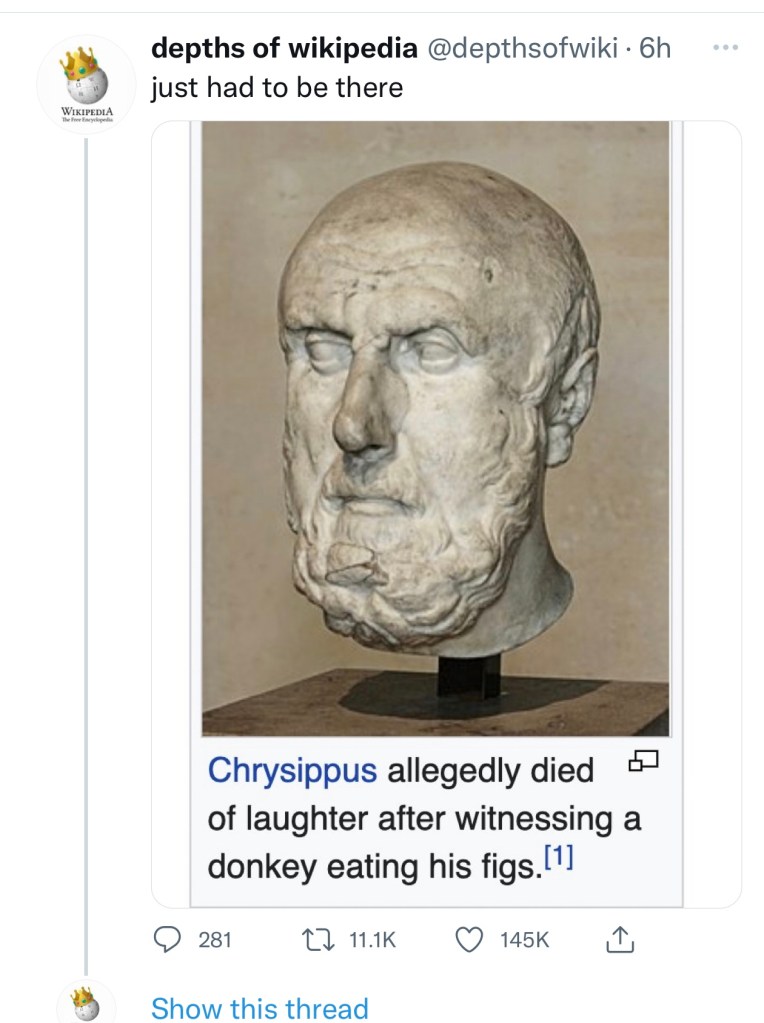
The best twitter account you’re not yet following is Depths of Wikipedia @depthsofwiki, which finds all the crazy fascinating stuff on Wikipedia that you wish you had time to look for.

Such as this gem from last week:

I didn’t know who Chrysippus was, but this is top shelf information. He died of laughter after witnessing a donkey eat his figs?!

That would make for one f***d-up game of Clue.

Here’s something that’s not a laughing matter.

Ever wondered why states seem so aggressive in fighting against companies that classify workers as independent contractors? Ok, yeah, there’s the crowd-pleasing pitch that they’re looking out for the little guy, and workers are being denied benefits, and companies are cheating the systems, etc.

But also comes down to money. State governments claim they are losing hundreds of millions of dollars a year in unpaid taxes and unpaid contributions to unemployment and workers compensation funds. This policy brief by the National Employment Law Project cites to 30 state law studies with varying estimates of losses to state coffers.

Are these studies accurate, or are they merely self-serving reports designed to justify misclassification audits? Probably some of both, but the point is that it doesn’t matter. Whether motivated by workers’ rights or bolstering state coffers, states are doing two things to make it harder to classify workers as independent contractors.

First, several pending state bills would make it harder to classify workers as independent contractors.

Second, states are taking enforcement seriously. Through audits and lawsuits, the states are going after companies directly.

For companies, defending against state action can be a lot harder than defending against private lawsuits. State prosecutors and agencies claim to be fighting for the little guy, and they tend to get dug in with their positions. State prosecutors and agency enforcers get paid the same salary, win or lose, and it can be harder to persuade them that your company’s classifications are legitimate and that they should be spending their limited time and resources elsewhere.

Plaintiffs’ lawyers, on the other hand, are business people and are generally more open to business solutions that are driven by a cost-benefit analysis of how best to use their limited time and resources. A strong set of facts supporting independent contractor classification can lead to a victory in court or can create leverage for a favorable settlement with private litigants. Private settlements can also be reached with no admission of wrongdoing.

The lesson here is that enforcement efforts by state governments are no laughing matter. While a donkey trying to eat your figs may be drop-dead hilarious, an enforcement action by the state isn’t so funny. But it can still kill your business.

Enter your email address to subscribe to this blog and receive notifications of new posts by email.

© 2022 Todd Lebowitz, posted on WhoIsMyEmployee.com, Exploring Issues of Independent Contractor Misclassification and Joint Employment. All rights reserved.

2018_Web100Badge
 

Beware of Snakes: Court of Appeals to Decide Whether Student-Athletes Are Employees under FLSA

Snakes have been in the news lately. A Maryland man was recently found dead in his home, killed by a venomous snake bite. This might seem surprising, until you learn that the same man kept 124 pet snakes in his house, including rattlesnakes, cobras, black mambas and a 14-foot-long Burmese python.

I also learned this week of a horrifying tourist attraction in Manitoba called the Snakes of Narcisse, where you can view “tens of thousands of red-sided garter snakes as they slither to the surface from their winter dens.” Tourists can view the dens and the snakes’ “mating balls,” in which “one [unlucky] female is surrounded by up to one hundred males.” Brackets are mine, since this can’t be fun for the snakestress, no matter how many cocktails are involved.

According to Quizlet, six colleges and universities have snakes for mascots. I won’t spoil the surprise. You can click here for the big reveal.

For student-athletes at these six schools, plus those at every other non-snake-themed college, there’s a Third Circuit case that’s worth watching.

The Third Circuit has agreed to hear a case that poses the following question: “Whether NCAA Division I student athletes can be employees of the colleges and universities they attend for purposes of the Fair Labor Standards Act solely by virtue of their participation in interscholastic athletics.

If the Third Circuit says yes, student-athletes may be entitled to millions of dollars in back wages under the FLSA. A ‘yes’ ruling would be deadly venom to just about every non-major sports program, since schools have no budget to pay wages to student-athletes. Very few programs in very few sports actually make money.

For those who brought this suit and think they are advocating for the student, be careful what you wish for. If the Third Circuit rules that student-athletes are entitled to be paid, college sports are largely dead. Women’s sports would take the biggest hit, as would every other program that isn’t a top-tier college football or basketball program raking in the cash.

This is a case to watch closely. If student-athletes are entitled to be paid, there would no longer be any distinction between amateurs and professionals. The whole concept of the student-athlete — and almost all of college sports — would go the way of the Round Island Burrowing Boa. That’s an extinct snake that used to live in Mauritius, says wikipedia.

Enter your email address to subscribe to this blog and receive notifications of new posts by email.

© 2022 Todd Lebowitz, posted on WhoIsMyEmployee.com, Exploring Issues of Independent Contractor Misclassification and Joint Employment. All rights reserved.

2018_Web100Badge
 

Giving the Cold Shoulder: Court Denies ERISA Misclassification Claim Because Contractor Was “Not a Participant”

Mutton: Not the origin of the term.

The term cold shoulder originated with Scottish novelist and poet Walter Scott in the early 19th century. A commonly repeated but incorrect origin story says that welcome houseguests were given a hot meal, but those who were not welcome would get a cold shoulder of mutton. But Scott’s use of the phrase had nothing to do with food. He described “shewing o’ the cauld shouther” as a physical gesture, turning the shoulder away from someone in a cold or indifferent manner.

No matter the origin, a federal judge in California recently showed some seriously cold shoulder to an independent contractor seeking ERISA benefits. The case shows the importance of a well drafted complaint in a misclassification lawsuit and highlights an important defense.

Tim Alders worked for YUM! Brands and Taco Bell for 25 years as an independent contractor. He then filed a lawsuit claiming he was misclassified.

He sued under ERISA, alleging that he should have been treated as an employee. He claimed that if he had been treated as an employee, he would have been a “participant” in YUM’s retirement plans, incentive plans, 401(k) plan, and executive income deferral program. Had he been a participant, he would have received financial benefits that he did not receive as a contractor.

Under ERISA, however, civil actions may only be brought by plan participants, beneficiaries, or the Secretary of Labor. ERISA defines a “participant” as “any employee or former employee of an employer . . . who is or may become eligible to receive a benefit of any type from an employee benefit plan which covers employees of such employer . . . or whose beneficiaries may be eligible to receive any such benefit.”

As YUM argued in its motion to dismiss, Alder could not sue under ERISA because he was not a “participant.” Judge Phillip Gutierrez, with a wink and a nod to Joseph Heller, agreed and dismissed the case. The plaintiff never got to argue whether he was misclassified or not.

The decision relied on past rulings, including this synopsis of ERISA law by a different California federal judge: “[U]nder Ninth Circuit authority, a claim that a former employee plaintiff should have been included in a plan, but actually was not included in a plan, does not give [the] plaintiff a ‘colorable claim to vested benefits’ for ERISA standing purposes.”

That’s some serious cauld shouther.

This case is a reminder that there are a lot of ways to defend a misclassification case. The “not a participant” defense is a valuable tool and should be used when appropriate.

But don’t be fooled. This ruling does not mean that a misclassified contractor can never sue for employee benefits. Remember too that this is unpublished case by one district court. Let’s not give it too much weight as precedent. There have been many class actions, some highly publicized, in which in which misclassified contractors took home lots of cash (many millions of dollars) as a result of being denied employee benefits.

One more thing before you go. There’s one easy step that companies should take now, before facing a misclassification lawsuit. Companies should check their plans to make sure the plan eligibility language protects specifically against misclassification claims. This post, featuring a reggae cucumber, provides the magic language you should be including in your plan documents.

If you plan properly, you too can give the cauld shouther.

Enter your email address to subscribe to this blog and receive notifications of new posts by email.

© 2022 Todd Lebowitz, posted on WhoIsMyEmployee.com, Exploring Issues of Independent Contractor Misclassification and Joint Employment. All rights reserved.

2018_Web100Badge
 

Twilight Zone? AFL-CIO Says “Not Now,” as NLRB Considers Redo of Independent Contractor Test

Raise your hand if you remember the 1982 song “Twilight Zone”? Seeing several hands raised, I will continue. The tune is catchy, but the lyrics are hard to understand. I heard the song this weekend and decided to finally check the lyrics. “There’s a storm on the loose, zarmines in my head” couldn’t be right, could it?

Raise your hand if you knew the chorus was this:

Help I’m steppin’ into the twilight zone
The place is a madhouse,
Feels like being cloned
My beacon’s been moved under moon and star
Where am I to go, now that I’ve gone too far?

Seeing no hands raised, I will continue.

It’s all very confusing to me, but it made sense once I read through it more carefully.

I had the same reaction after seeing an amicus brief that the AFL-CIO recently filed with the NLRB. The brief was filed in a case that may — yet again — change the test for independent contractor status.

In Atlanta Opera, the Regional Director for Region 10 ruled that a proposed unit of makeup artists and hairstylists were employees, not independent contractors, and that an election could proceed.

The NLRB then issued a notice asking the parties and the public for briefs addressing whether the Board should reconsider the test for determining whether workers are independent contractors or employees. It seems inevitable that the Board will rewrite the test to make it harder for a worker to be deemed a contractor. But is Atlanta Opera the right case to use for rewriting the test?

The AFL-CIO, somewhat surprisingly, said no. Like the lyrics to “Twilight Zone,” that was confusing to me at first, but it makes sense when I read through it more carefully.

Undoubtedly the unions want a rewrite of the test to make it as hard as possible for someone to maintain contractor status. But the AFL-CIO urged the NLRB to wait, arguing this isn’t the right set of facts to make a sweeping change.

The AFL-CIO’s brief argued that, even under the existing test, it was pretty clear the makeup artists and stylists were employees. It would be more impactful to wait for a closer case to rewrite the test. Ah, so that’s their angle — wait til later then really shake things up.

Eventually, the NLRB is going to change the test. The current test, explained in SuperShuttle DFW (discussed here), examines ten Right to Control factors.

At a minimum, it seems clear that the Board would like to go back to the FedEx Home Delivery test. The FedEx test asked whether the worker was “in fact, rendering services as part of an independent business” and essentially adopted an Economic Realities Test, rather than the Right to Control Test that had always been applied.

When the Board revises the test, it could go back to FedEx or it could try to adopt a new, more stringent test, like an ABC Test. (The courts probably would not allow the Board to adopt an ABC Test without Congressional action, but that’s for another day.)

And the Board will revise the test. It’s just a question of when and to what. The Board will make it harder to be an independent contractor under federal labor law. That means it will become easier for unions to file election petitions and try to organize groups of workers that might now be operating as independent contractors.

Yeah there’s a storm on the loose, sirens in my head.

Oh. That makes more sense.

Enter your email address to subscribe to this blog and receive notifications of new posts by email.

© 2022 Todd Lebowitz, posted on WhoIsMyEmployee.com, Exploring Issues of Independent Contractor Misclassification and Joint Employment. All rights reserved.

2018_Web100Badge
 

That’ll Cost You 96 Camels: Court Headlocks Staffing Agency with $7.2M Misclassification Judgment

Mom feeding a non-wrestling camel, May 2010

If you weren’t in Turkey last month, you missed the annual Selçuk Efes Camel Wrestling Festival, which featured 162 competitors in four categories.

The camels are paired by weight and skill, and their techniques include tripping their opponents with foot tricks or applying headlocks then sitting on their opponents. Some just push until the other camel gives up. A winner is declared when one camel scares away the other, making him scream or collapse. The camels are muzzled so there is no biting.

Among those missing the spectacle were the owners of Steadfast Medical Staffing, a Virginia-based firm that maintains a database of nurses and pairs them with healthcare facilities. That’s because they were in federal court, defending against a lawsuit by the Department of Labor. The DOL alleged that they had misclassified the nurses as independent contractors in violation of the Fair Labor Standards Act (FLSA).

After a bench trial, the judge agreed with the DOL and ruled that the nurses — which included CNAs, LPNs and RNs — were employees of the staffing agency. The Court applied the Economic Realities Test, which is the proper test for determining who is an employee under the FLSA.

The Court considered all relevant factors, then applied camel-style headlocks while sitting on the defendant, causing the staffing agency to either scream or collapse (unclear from the opinion). The Court ruled that the staffing agency failed to pay overtime and failed to comply with FLSA record keeping requirements. The agency will be liable for approximately $3.6M in back wages plus another $3.6M in liquidated damages.

Following the judgment, the DOL issued a statement with quotes from the Secretary of Labor, Marty Walsh, and the Solicitor of Labor, Seema Nanda, that the DOL was sending an “unequivocal message” to Steadfast and other staffing companies that the DOL is serious about pursing independent contractor misclassification.

Staffing agencies that treat workers as independent contractors are on notice that the DOL is serious about enforcement. Remember, the facts of the relationship determine whether a worker is an employee or an independent contractor, not how the parties choose to characterize the relationship.

More than 1,100 nurses will share in the award, with a healthy-but-to-be-determined amount of fees headed to the plaintiffs’ lawyers.

A prized wrestling camel can be sold for more than a million Turkish lira. That’s about $75,000. Large awards like this for systemic misclassification are not surprising. This one will cost the staffing firm about 96 wrestling camels.

Enter your email address to subscribe to this blog and receive notifications of new posts by email.

© 2022 Todd Lebowitz, posted on WhoIsMyEmployee.com, Exploring Issues of Independent Contractor Misclassification and Joint Employment. All rights reserved.

2018_Web100Badge
 

>

More Than One Iota: Supreme Court Agrees to Decide Scope of Arbitration Law; Outcome Will Affect Independent Contractor Agreements

Last week I read that Sirhan Sirhan had been denied parole again. No surprise there. But what captured my attention was his attorney’s comment that there was not “one iota” of evidence he would be a threat to society if released.

Not even one iota? Why are there never any iotas? And what is the plural of iota anyway? And how do you even respond to that? Well, actually, we had a few iotas. Let me check my notes here. Yes, three iotas.

“Iota” means an infinitesimal amount. Synonyms include bupkus and diddly-squat. But if you search for “iota” online, no one ever has any iotas. The word is always used in the negative.

Well here are a few iotas for you. The Supreme Court has agreed to hear two cases that will affect when arbitration agreements with independent contractors can be enforced. The Supreme Court generally gets involved when there are at least a few iotas of good arguments on both sides.

Both cases address the scope of the Federal Arbitration Act (FAA), which creates a presumption that arbitration agreements should be enforced, but includes a few iotas of carveouts.

In the first case, Viking River Cruises v. Moriana, the Supreme Court will determine whether cases brought under California’s Private Attorneys General Act (PAGA) are subject to arbitration. California courts have said they are not.

In the second case, Southwest Airlines Co. v. Saxon, the Court will address the scope of the Section 1 exemption, which makes the FAA inapplicable to certain types of transportation workers in interstate commerce. The Saxon decision is likely to clear up the mass confusion (and circuit split) over whether last mile delivery drivers and local rideshare fall within the exemption.

In the political arena, arbitration agreements have come under fire, and there is a movement among Democrats to abolish mandatory pre-dispute arbitration agreements. The Supreme Court, on the other hand, appears more likely to enforce the contracts as written, deferring to the contractual intent of the parties and interpreting any exemptions to the FAA narrowly.

There is more than one iota of evidence to support both sides of these disputes. But expect some 6-3s.

If I am pulling out my crystal ball, I expect the Supreme Court will uphold the arbitration agreements, at least in Saxon. Moriana is tougher to predict since PAGA is a state law creation in which the individual bringing the claim acts as a private attorney general, bringing the claim on behalf of the state. On one hand, the state never agreed to arbitrate. But on the other hand, the individual bringing the PAGA claim did agree to arbitrate any disputes, not to bring them in court under the guise of PAGA.

Whenever the Court rules, we’ll see arbitration agreements back in the news. More visibility on this issue will mean louder and more urgent calls from politicians to abolish pre-dispute arbitration agreements.

We can expect many iotas of news on arbitration agreements later in 2022.

Enter your email address to subscribe to this blog and receive notifications of new posts by email.

© 2022 Todd Lebowitz, posted on WhoIsMyEmployee.com, Exploring Issues of Independent Contractor Misclassification and Joint Employment. All rights reserved.

2018_Web100Badge
 

New Year’s Resolutions: 5 Tips for Avoiding Trouble in 2022

Last spring in Poland, a menacing brown object appeared in a tree. Locals grew concerned about the mysterious beast and closed their windows. After a few days it was still there, and a call was placed to the local animal welfare society.

The authorities responded to the call and arrived on the scene to investigate. The citizens were relieved to learn it was not a bird of prey, a dangerous rabies-infested rodent, or a trapped pet. It was a croissant.

Somebody probably threw it into the tree while trying to feed birds.

The locals were likely embarrassed, but better safe than sorry. When in doubt, take steps to avoid problems. Be proactive.

Here are five tips to start off the new year the right way, with or without arboreal baked goods:

1. Review and revise your agreements with staffing agencies. Make sure you include The Monster with Three Eyes and these other clauses. Consider requiring all individual workers to sign arbitration agreements, and don’t forget the impact a choice of law clause may have.

3. Self-audit your use of independent contractors to determine whether these relationships are defensible. Here’s a tip for quickly identifying the riskiest relationships.

2. Review and revise your agreements with independent contractors. Add safe harbor clauses if you do business in WV or LA. Remember these rules, akin to discomfitting a bear.

4. Create a gatekeeper system so that managers and procurement team members cannot retain non-employee labor without first going through a designated individual. You can’t guard against the risks you don’t even know about.

5. Check your website for references to independent contractor relationships. Don’t refer to your contractors as “our whatevers” or “our team of whatevers.”

Remember, to those who say they haven’t been sued for misclassification, I say you haven’t been sued yet.

Wishing you all a happy and healthy 2022!

Enter your email address to subscribe to this blog and receive notifications of new posts by email.

© 2022 Todd Lebowitz, posted on WhoIsMyEmployee.com, Exploring Issues of Independent Contractor Misclassification and Joint Employment. All rights reserved.

2018_Web100Badge
 

Don’t Get Stuck Naked: Tips for Enforceable Arbitration Agreements When Using Staffing Agency Workers

He was in here. Really. Source: Syracuse Fire Dept Facebook

A Syracuse man was rescued from inside the walls of a historic theater last month after spending two days trapped, naked. The man apparently had entered the building’s crawlspace (why?) and fell from the ceiling into a gap between walls in the men’s restroom. No word on why he was au naturale.

But I’m sure he was glad to be freed from this unexpected situation. He should have planned better — like by not hiding in a crawlspace or, if he had a really, really good reason to hide there, by at least wearing clothes.

You can protect your business from unexpected situations (different ones), such as by making sure your staffing agency agreements include valid arbitration clauses with the staffing agency’s workers. The goal here is to avoid being left naked and stuck, if faced with a joint employment claim.

In a recent Oklahoma case, two staffing agency workers sued the staffing agency and the company where they provided services, alleging a failure to pay overtime.

The company where they worked filed a motion to compel arbitration, arguing that the arbitration agreement the workers signed with the staffing agency should cover all claims against both defendants. The district court initially ruled that the arbitration agreement was only between the worker and the staffing agency, and so it could not be relied upon by the other company. Motion denied.

But the Tenth Circuit disagreed, finding that the non-signatory company could enforce the agreement because the plaintiffs’ claims “allege substantially interdependent and concerted misconduct” against the two defendants. The plaintiffs were therefore “estopped from avoiding their duty to arbitrate their claims arising out of their employment relationship.”

That was good news in this case, but I wouldn’t count on that result every time. This case turned on Oklahoma estoppel law. But with proper planning, you can achieve the same result.

Here’s how:

First, in your agreement with staffing agencies, require the agencies to have all individuals assigned to perform services at your company sign an individual arbitration agreement.

Second, make sure it’s not just any old arbitration agreement, but one that includes customized terms. For example:

  • Require the worker to acknowledge that signing is a condition to being placed at your company.
  • Make sure the scope of covered claims is broad enough to include claims that are not just against the staffing agency.
  • List your company as a third party beneficiary with authority to enforce the agreement.
  • Make the obligation to arbitrate bilateral and binding on your company, even though your company will not sign the agreement. In other words, if you agree to perform services at the company, the company will agree to arbitrate any claims against you.

There are a few more tricks of the trade, but these are some of the key items. Keep the agreement short, and use simple language.

With some careful advance planning, you can avoid being left naked and stuck if faced with a joint employment lawsuit filed by staffing agency workers.

Enter your email address to subscribe to this blog and receive notifications of new posts by email.

© 2021 Todd Lebowitz, posted on WhoIsMyEmployee.com, Exploring Issues of Independent Contractor Misclassification and Joint Employment. All rights reserved.

2018_Web100Badge