
G-L-O-R-I-A! California Court says to use different tests for different IC misclassification claims

California independent contractor misclassification tests

If someone were to ask whether you like the song, “Gloria,” you’d be right to ask, “Which version?”

There’s the version written by Van Morrison and recorded by his band Them, later covered by Patti Smith, The Doors, and a gaggle of others. That’s the version that goes, “G-L-O-R-I-A, Gloooooria!” (I’m gonna shout it out every day.)

Then there’s the version recorded by Laura Branigan in 1982, originally written in Italian by Umberto Tozzi. (Fun fact!) You know that one — “You’re always on the run now. Running after somebody, you gotta get him somehow.”

Of course the right answer is that you prefer the first version, but my point is that there are multiple versions of “Gloria.” Same name, different song.

This is the same approach California courts seem to be taking with the state’s test for Independent Contractor vs. Employee. Same question, different tests. Many of you will recall the April 2018 Dynamex decision, in which the California Supreme Court adopted a strict ABC Test for determining whether a worker is an employee under California’s Industrial Wage Orders.

But the Dynamex decision did not address whether the new ABC Test would be used to determine whether someone is a contractor or an employee under California’s other state labor laws. Now we know.

The answer, according to a California Court of Appeal decision last week, is that there’s room for both “G-L-O-R-I-A” and “You’re always on the run now.” (You’re welcome, Laura Branigan.)

In last week’s case, called Garcia v. Border Transportation Group, the court considered an eight-count complaint brought by a taxicab driver who had been treated as an independent contractor. The driver claimed he should have been treated as an employee and that various state laws, which apply only to employees, were not followed. The court ruled that different tests apply to different claims.

The Court ruled that the claims brought under California’s Industrial Wage Orders had to be evaluated under the Dynamex ABC Test and, for these claims, the driver had to be considered an employee. The claims subject to the Dynamex test were the claims alleging unpaid wages, failure to pay minimum wage, failure to provide meal and rest periods, failure to furnish itemized wage statements, and the unfair competition (UCL) claims arising out of the wage order violations.

On the other hand, the driver’s claims for wrongful termination in violation of public policy, waiting time penalties, and the UCL claims stemming from these allegations had to be evaluated under the more traditional S.G. Borello balancing test, which includes elements of a Right to Control Test but incorporates other factors too, making it a hybrid test. Under the S.G. Borello standard, the Court ruled that the driver was properly classified as an independent contractor.  (The plaintiff alleged failure to pay overtime too. Typically, overtime claims are governed by the Industrial Wage Orders, but the overtime rules do not apply to taxicab drivers.)

For those who like score cards, here is a list showing (a) the claims that were filed, and (b) which test must be used to determine Independent Contractor vs. Employee under each claim, according to the Garcia case. I have color-coded the claims because it looks pretty:

1. Wrongful termination in violation of public policy. (Lab. Code, §§ 923 [employees may organize], 6310 [retaliation for an OSHA complaint], 6400 [duty to provide a safe work environment], 1102.5 [whistleblower protection].)  S.G. Borello balancing test

2. Unpaid wages under the wage order. (Cal. Code Regs, tit. 8, § 11090.)  Dynamex ABC Test

3. Failure to pay minimum wage. (Lab. Code, §§ 1182.12 [minimum wage], 1194 [right of action], 1194.2 [liquidated damages], 1197 [duty to pay minimum wage].)  Dynamex ABC Test

4. Failure to pay overtime. (Lab. Code, §§ 510 [overtime], 1194 [right of action].) – Not applicable

5. Failure to provide meal and rest breaks. (Lab. Code, §§ 226.7 [rest periods], 512 [meal breaks].) Dynamex ABC Test

6. Failure to furnish accurate wage statements. (Lab. Code, §§ 226 [wage statements], 226.3 [civil penalties], 2699 [PAGA penalties].) Dynamex ABC Test

7. Waiting time penalties. (Lab. Code, §§ 201−202 [wages and leave due upon departure], 203 [penalties].) S.G. Borello balancing test

8. Unfair competition (UCL), based on the foregoing violations. (Bus. & Prof. Code, § 17200 et seq.; Lab. Code, § 2699 [PAGA penalties].) Dynamex ABC Test for the alleged violations of the wage order; S.G. Borello balancing test for the other claims


That’s the state of the law at this moment, but of course the California Supreme Court could weigh in again later as to whether S.G. Borello should still be used at all.

The explanation given in the Garcia case, though, for why the different tests should be used for different claims makes perfect sense. The definition of employee in Dynamex is broader than in the other statutes, as the California Supreme Court explained in the Dynamex decision.

So there you have it. Different definition of employee, different tests.

Shout it out all night!

Shout it out every day!

© 2018 Todd Lebowitz, posted on WhoIsMyEmployee.com, Exploring Issues of Independent Contractor Misclassification and Joint Employment. All rights reserved.

Enter your email address to subscribe to this blog and receive notifications of new posts by email.

New Rule May Clear Up ‘Employee vs Contractor’ Test under FLSA, But Not Quite Yet

DOL joint employment

New regulations may soon be proposed to redefine “employee” under federal wage and hour law. In a recent interview with Bloomberg BNA, Secretary of Labor Alex Acosta hinted that the DOL is working on a new regulation that would more definitively speak to who is an employee and who is an independent contractor.

The Fair Labor Standards Act (FLSA), the federal law governing minimum wage and overtime for employees, does not apply to independent contractors. That’s one of the reasons it matters whether someone is classified as an employee of a contractor. Contractors are not entitled to a minimum wage or overtime under federal law.

The FLSA was passed in the 1930s and does not fit the modern gig economy. Secretary Acosta appears committed to modernizing the regulations, which would bring much needed clarity to the question of who is an employee and who is an independent contractor.

In terms of priorities, the DOL appears likely to address the definition of “joint employment” first.

The National Labor Relations Board (NLRB) has initiated formal rulemaking procedures that would result in a new regulation defining joint employment more narrowly under federal labor law.  The DOL has indicated it has plans to follow suit, using rulemaking procedures to seek a new regulation redefining “joint employment” under the FLSA. We can probably expect to see a new proposed FLSA regulation redefining “joint employment” by early 2019.

Based on Secretary Acosta’s comments to Bloomberg BNA, it seems likely that the DOL will turn it’s attention to the Independent Contractor vs Employee conundrum next.

© 2018 Todd Lebowitz, posted on WhoIsMyEmployee.com, Exploring Issues of Independent Contractor Misclassification and Joint Employment. All rights reserved.

Enter your email address to subscribe to this blog and receive notifications of new posts by email.


Is this weird trick the key to defeating independent contractor claims? (Hahahahahaha. No.)

Weird trick to defeat independent contractor claims Jani-King

As everyone with an internet connection now knows, articles promising “one weird trick” to solve some real-world problem are everywhere. These articles are annoying. (It’s called clickbait.) You open up the article, and the “weird trick” is usually something you already knew anyway. Or the weird trick just doesn’t work.

So what’s the “weird trick” here?

Requiring independent contractors to form corporate entities. Then you have a business-to-business contract, not employment. Right?

Ok, it’s not weird at all. Lots of companies use this approach.

But does it work? Not necessarily.

Let’s consider the issue under the Fair Labor Standards Act (FLSA). The FLSA requires employees to be paid a minimum wage and overtime (unless there’s an exemption) and requires employers to keep certain kinds of pay records.

The test for determining whether someone is an employee under the FLSA is Ye Olde Economic Realities Test. 

Dear Reader, hold onto your seat, because we’re about to see this test in action!

Can you defeat independent contractor misclassification claims by requiring workers to form legal entities? Let’s see…

A federal appeals court recently considered a dispute involving Jani-King and its franchise model for providing janitorial services. Under Jani-King’s business model, the individuals who provide cleaning services are not treated by Jani-King as its employees. Rather, Jani-King requires that anyone who wants to provide janitorial services under the Jani-King name must form a legal entity, like an LLC. Then Jani-King enters into a franchise agreement with the LLC, and the LLC/franchisee provides the cleaning services. There is no job offer or employment agreement between Jani-King and the individuals performing the services. It’s all treated like a business-to-business, franchisor-franchisee relationship.

The Department of Labor (DOL) is questioning the legitimacy of this model.  The DOL began an investigation and then filed a lawsuit, claiming that Jani-King’s franchisees are really Jani-King’s employees under the FLSA, and Jani-King therefore had to comply with FLSA record-keeping requirements, as well as its overtime and minimum wage rules.

The reason Jani-King’s “one weird trick” doesn’t necessarily work is because to determine whether someone is an employee under the FLSA, it doesn’t matter what you call the worker. You can call the worker a contractor or a franchisee, but using that tag doesn’t mean the worker is not an employee under the FLSA. That’s a legal determination made using the Economic Realities Test.

In this case, the trial court judge in Oklahoma had dismissed the DOL’s case, ruling that Jani-King’s contracts were with entities, not individuals, so there could not be an employment relationship. The Tenth Circuit Court of Appeals, however, said that’s not true. 

The Court of Appeals ruled that a six-part Economic Realities Test must be used to determine whether the individual franchisees who performed the janitorial work should be considered employees under the FLSA. Under the Economic Realities Test, a court must examine the economic realities of the relationship, not merely rely on the parties’ labels. 

In the Tenth Circuit (which covers Oklahoma, New Mexico, Kansas, Colorado, Utah, and Wyoming), here are the factors to consider under the Economic Realities Test:

1) The degree of control exerted by the alleged employer over the worker; 

2) The worker’s opportunity for profit or loss; 

3) The worker’s investment in the business; 

4) The permanence of the working relationship; 

5) The degree of skill required to perform the work; and 

6) The extent to which the work is an integral part of the alleged employer’s business.

The not-so-weird trick of requiring workers to set up a legal entity does not necessarily work. It can be helpful, but only if the facts show that the entity is not economically reliant on the other party. The facts matter, not the labels.

This case is headed back to the trial court for some fact-finding to determine how these six factors play out.

In the meantime, remember that “one weird trick” to solve some real-world problem is probably not weird at all, and it may or may not work. But it may arouse your curiosity and cause you read the article. Here, Jani-King’s one weird trick aroused the DOL’s curiosity, which is not something a business should want to do.

© 2018 Todd Lebowitz, posted on WhoIsMyEmployee.com, Exploring Issues of Independent Contractor Misclassification and Joint Employment. All rights reserved.

Enter your email address to subscribe to this blog and receive notifications of new posts by email.


What does the NLRB’s Proposed New ‘Joint Employment’ Rule Mean for Businesses?

360 degrees joint employment NLRB new rule

True story. Late 1980s. Early days of fantasy baseball. One of my high school buddies — we’ll call him The Beast — finishes last but decides he’s ready to turn things around. The Beast stands up at the next year’s draft and announces his new team name, intending to show us that he’s about to reverse last year’s standings: 360 degrees.

No one had the guts to say it. Only later did someone tell him he probably meant 180 degrees. He finishes last again. The Beast no longer plays fantasy baseball but lives a comfortable life as a tax lawyer in Florida.

A complete turnaround may now be in the works when it comes to defining “joint employment.” Recent actions by the National Labor Relations Board signal an upcoming 180-degree shift.

Click here to read the rest of the story, recently published in Westlaw’s Journal Employment and Practitioner Insights.

© 2018 Todd Lebowitz, posted on WhoIsMyEmployee.com, Exploring Issues of Independent Contractor Misclassification and Joint Employment. All rights reserved.

Enter your email address to subscribe to this blog and receive notifications of new posts by email.


New Definition of Joint Employment Still Appears Likely, Despite Efforts to Smack NLRB Chair in Face with an Octopus

octopus kayaker seal joint employment NLRB nature-3262715_1920

When this kayaker was slapped in the face by an octopus wielded by a seal, he just laughed it off. It didn’t seem to hurt, and I guess that’s just a thing that seals sometimes do.

Q. Now, Lebowitz, how are you going to work that intro back into something related to joint employment?

A. Watch this!

Similarly, it didn’t take long after the NLRB proposed a new regulation that would redefine joint employment (see this post) for two prominent Democrats to try to octo-seal-slap the NLRB’s Chair into backing off. Not gonna happen. The Board will not abandon its kayak.

Last week, Senator Patty Murray and Representative Bobby Scott sent a letter to Board Chair John Ring, arguing that there is “scant research or analysis” to support the Board’s call for a new joint employment standard. Um, so everything in the joint employment world has been peaches and cream? Heck, there’s so much uncertainty in the joint employment world right now that someone could devote a whole blog just to that topic!

In an effort to stall the rulemaking process, Murray and Scott asked the Board to extend the comment period on the proposed new rule by another 60 days (because no one saw this coming?) and demanded that the Board produce of all sorts of records relating to joint employment cases filed over the past several years. They also tried to re-raise concerns that there might be a conflict of interest affecting two of the three Republican Board members. The letter demanded the production of 21 categories of documents within 12 days, including asking for the name and case number of every joint employment case during the past six years fitting into various categories.

Let’s be realistic. This letter is basically outreach by Sen. Murray and Rep. Scott to labor unions, showing that they’ve got their back on the joint employment issue (to the detriment of businesses). I expect the letter will have no real effect on the process for rulemaking or on the timetable for adoption.

While few people may read that letter, the Go-Pro video of the seal smacking the kayaker in the face with an octopus has received a boatload of hits. I highly recommend watching. It is far more entertaining than this blog.

© 2018 Todd Lebowitz, posted on WhoIsMyEmployee.com, Exploring Issues of Independent Contractor Misclassification and Joint Employment. All rights reserved.

Enter your email address to subscribe to this blog and receive notifications of new posts by email.

Extra Pepperoni! Domino’s Fends Off Joint Employment Claims

Pizza Food Slice Cheese Mushroom Veggies V

Domino’s Pizza in Russia recently had to cancel a promotion offering free pizza for life to anyone who got a tattoo of the Domino’s logo after too many people tatted up. The Russian franchisee that offered the promotion was overwhelmed by the response. It canceled the scheduled two-month promotion after just four days.

Franchise owners have to adhere to brand standards, but they have flexibility on other things, such as how vigorously to encourage their customers to ink. It can be confusing to the public, however, which decisions are made by franchisors and which decisions are made by franchisees. Not surprisingly, this confusion extends to employment situations, where claims of joint employment are frequently asserted against franchisors, even though individual employment decisions are made by franchisees.

In a delicious decision for franchisors, a New York federal court has ruled that Domino’s Pizza’s corporate entities are not joint employers of the employees who work at individually owned Domino’s franchises – at least under federal and New York State wage and hour law. (Click here for Five Things You Should Know About Joint Employment.)

Joint employment claims are a constant threat in the franchise space. Major restaurant and fast food franchisors are frequently alleged to be joint employers when plaintiffs bring employment lawsuits against individual franchisees. The franchisors (like Domino’s) are viewed as the deep pockets and, by targeting the franchisor’s corporate office, plaintiffs can try to build class actions that include groups of employees across multiple franchises. Or, by tagging a franchisee as a joint employer, plaintiffs can feel more confident that enough dollars will be available to pay any judgment.

The court’s ruling, which granted summary judgment to Domino’s corporate entities, evaluated the plaintiffs’ joint employment claims under the Fair Labor Standards Act (FLSA) and New York Labor Law (NYLL) using a two-part Economic Realities Test.

Following guidance from the Second Circuit Court of Appeals, the court looked at two sets of factors: one set to assess formal control exercised by the franchisor, and the second set to assess functional control by the franchisor. (That’s not the test used everywhere.)

As is typical in franchisor-franchisee relationships, the franchisee (store owner) signed a franchise agreement, agreeing that it – not the franchisor – “shall be solely responsible for recruiting, hiring, training, scheduling for work, supervising and paying the persons who work in the Store and those persons shall be [franchisee’s] employees, and not [franchisor’s] agents or employees.”  The agreement required the franchisee to adhere to brand standards to ensure consistency in product, but individual employment decisions were to be made at the store level, not by the franchisor.

Based on this framework, the court analyzed the facts using the formal control factors and the functional control factors.

The formal control factors included whether the franchisor:

  1. had the power to hire and fire the employees,
  2. supervised and controlled employee work schedules or conditions of employment,
  3. determined the rate and method of payment, and
  4. maintained employment records.

The functional control factors for determining joint employment, some of which do not even make sense in the context of a franchise relationship, are:

  1. whether the alleged employers’ premises and equipment were used for the plaintiffs’ work;
  2. whether the subcontractors had a business that could or did shift as a unit from one putative joint employer to another;
  3. the extent to which [the] plaintiffs performed a discrete line job that was integral to the alleged employers’ process of production;
  4. whether responsibility under the contracts could pass from one subcontractor to another without material changes;
  5. the degree to which the alleged employers or their agents supervised [the] plaintiffs’ work; and
  6. whether [the] plaintiffs worked exclusively or predominantly for the alleged employers.

After evaluating the facts using these factors, the court ruled that the Domino’s corporate franchisor entities were not joint employers. The franchisor entities were therefore dismissed from the lawsuit, but the court allowed the case to continue against the individual franchise owners.

The decision is refreshing for franchisors, but not too refreshing.  As noted here, other Courts of Appeal – mainly the Fourth Circuit – apply different tests for determining whether a company is a joint employer under the FLSA, even though the FLSA is a federal law that you would think would be interpreted the same way all across the country.

The test for joint employment under the National Labor Relations Act is different too – and is likely to change again.  It is possible for a company to be a joint employer under one law or test but not under other laws or tests. There is no uniformity or consistency.

For now, franchisors should rejoice in this small victory, but the fight to protect franchisors against joint employment claims is far from over — unlike the Russian tattoo promotion, which is entirely kaput.

© 2018 Todd Lebowitz, posted on WhoIsMyEmployee.com, Exploring Issues of Independent Contractor Misclassification and Joint Employment. All rights reserved.
Enter your email address to subscribe to this blog and receive notifications of new posts by email.

Five Things You Should Know About Joint Employment

Everyone knows that two’s company but three’s a crowd. Except, of course, for Three’s Company with Jack, Janet, and Chrissy (or Cindy or Terri). But how many of you recall that one is the loneliest number that you’ll ever do? Two can be as bad as one. It’s the loneliest number since the number one. I know this because of Three Dog Night.

For musical tastes, the number four can mean Tops, Seasons, or Non Blondes.

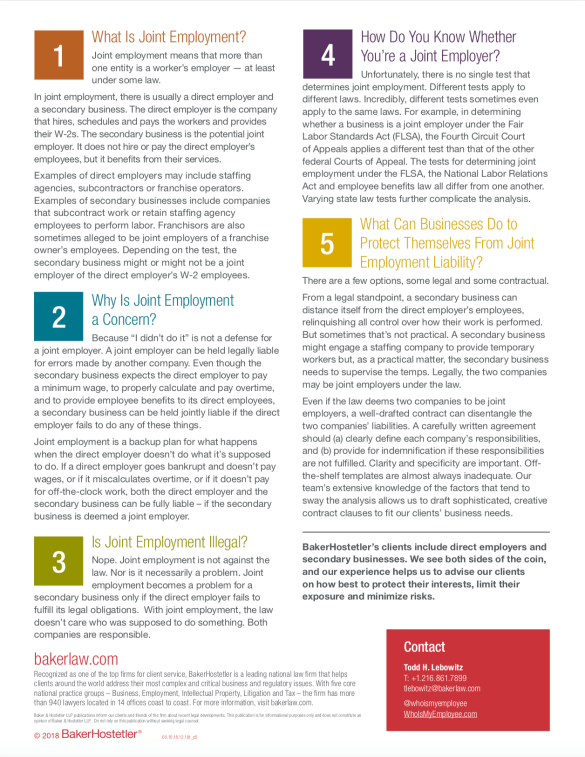
But today’s number is FIVE.  Here are Five Things You Should Know About Joint Employment.  (click here to download the PDF.)

Five things You Should Know About Joint employment - page 1 screenshot

Five things You Should Know About Joint employment - page 1 screenshot

© 2018 Todd Lebowitz, posted on WhoIsMyEmployee.com, Exploring Issues of Independent Contractor Misclassification and Joint Employment. All rights reserved.

Enter your email address to subscribe to this blog and receive notifications of new posts by email.

Truckers Fight to Preserve Independent Contractor Status, But Appellate Rulings Create Uncertainty

independent contractor driver trucking faaaa

Big Mutha Truckers was a 2002 video racing game in which four sibling truckers compete to make deliveries in fictional Hick County, with the most successful driver inheriting the family business. I had never heard of the game until now, but apparently it  was not very successful and is panned thoroughly by whoever spent precious life-minutes writing a comprehensive Wikipedia entry about this game, time that the author sadly will never be able to recover.

The real life trucking industry has its own problems, and they extend far beyond Hick County. The independent contractor owner-operator model, which has been common in the transportation industry for decades, is under attack. The situation is most critical on the West Coast, and owner-operator drivers are taking action to protect their livelihood — and their independent contractor status.

The Coalition for Independent Truckers announced the formation of a new Independent Contractor Ambassador program. The program’s mission is to protect the independent contractor/owner-operator model in the trucking industry. It aims to educate policymakers, the media, and the general public on the value of the independent  contractor model.

Three recent court decisions will it more difficult for these drivers to preserve their independent contractor status.

Last week, the Third Circuit Court of Appeals ruled that Illinois* state wage laws may be applied to professional motor carrier drivers, even though federal law is supposed to override state laws that are “related to” motor carrier prices, routes, or services.

Earlier this month, The Ninth Circuit Court of Appeals ruled that California’s meal and rest break laws may be applied in the motor carrier industry, despite federal law that seems to pre-empt state law in that field.

The Federal Aviation Administration Authorization Act (FAAAA) prevents states from enacting laws that are “related to” motor carrier prices, routes, or services. It seems hard to imagine that California’s mandatory meal and rest breaks (at issue in the 9th Circuit case) would not affect services and routes. Illinois wage law (at issue in the Third Circuit case) seems like a closer call.

Other federal courts have ruled that states cannot apply their wage and hour rules to motor carrier drivers because of FAAAA preemption. For example, a the First Circuit Court of Appeals previously ruled that Massachusetts’ ABC Test could not be applied to owner-operator drivers, since the state law test was preempted by the FAAAA.

But these new decisions from the Third and Ninth Circuits go the other way, saying that the state laws at issue do not sufficiently “relate” and therefore are not preempted by the FAAAA. These rulings create uncertainty and inconsistency across the industry, with different rules applying to interstate drivers in different locations. That’s what the FAAAA and other federal transportation laws aim to prevent.

This is an issue to watch. The Supreme Court may soon be called upon to resolve the circuit split. The national transportation industry relies heavily on the use of independent contractor owner-operators. These two appellate decisions make it increasingly difficult for legitimate independent contractor owner-operators to maintain their independent contractor status. Instead, these professional drivers may be subjected to reclassification as employees under some state laws, despite working in an industry that federal law tries to pre-empt,

Keep an eye on this one. Unlike Big Mutha Truckers, this saga will not be derailed by “repetitive gameplay, dated graphics, and lackluster sound.”

*Not an error. Yes, the case was decided in the Third Circuit, even though it relates to Illinois law.

© 2018 Todd Lebowitz, posted on WhoIsMyEmployee.com, Exploring Issues of Independent Contractor Misclassification and Joint Employment. All rights reserved.

Enter your email address to subscribe to this blog and receive notifications of new posts by email.


What is the Test for Joint Employment? It Depends.

Joint employment together

There are lots of ways to be together. Some are good, some less good.

Let’s compare:

  • By the end of the movie Grease, the graduates of Rydell High have decided that they “go together like rama lama lama ka dinga da dinga dong.” That, I think, is supposed to mean good.
  • In The Fox and Hound 2, a direct-to-video DisneyToon generally rated as “not terrible,” our four-legged heroes sing that they “go together like wet dog and smelly peanut butter jelly fleas on my belly.” That sounds less good.

In employment law, being together can be good or bad, depending on your perspective.

When a company retains someone else’s employees to perform work, it sometimes becomes necessary to decide whether the first company is a “joint employer” of the second company’s employees. Being a joint employer is not illegal, but it means that if the primary employer violates employment laws, a “joint employer” is liable too — even if it wasn’t primarily responisble for the unlawful act.

The test for joint employment varies depending on which law was violated and depending on the state you’re in. (Here’s a map that illustrates the madness.) For example…

In this post we discussed how you determine if someone is a joint employer under federal wage and hour law (the Fair Labor Standards Act) (FLSA).

In these posts, we discussed how you currently determine whether someone is a joint employer under federal labor law (the National Labor Relations Act) (NLRA). In this post, we discuss how and when that test is likely to change.

In today’s post, we’ll examine how you determine whether someone is a joint employer under federal employment discrimination and breach of contract law. For these laws, the test for joint employment looks to the common law of agency.

A recent decision by the federal Court of Appeals for the 11th Circuit reminds us that different tests apply to different laws. Applying the joint employment test for FLSA claims, the trial court had ruled that a citrus grower was the joint employer of migrant workers after the primary employer who hired them did not properly pay them.  (The farm-labor contractor who hired them allegedly demanded kickbacks from the migrant workers’ wages under threat of deportation. Today’s Tip: Don’t do that.)

The migrant workers had another claim too. They alleged breach of contract under federal law (the contract was part of the federal visa process), and it tried to sue both the farm-labor contractor who was demanding the kickbacks and the citrus grower at whose fields they picked delicious fruit.

For the breach of contract claim, the Court of Appeals ruled that the proper way to determine whether someone is a joint employer is to use a Right to Control Test.

There are different versions of Right to Control Tests, but they all try to determine whether a hiring party retains the right to control how the work is performed. If the answer is “yes they do,” then the hiring party is a joint employer under that law. If the answer is “no they don’t, they care about the achieving the result but not how the work is performed,” then the hiring party is not a joint employer.

This Court of Appeals decided that there are 7 factors that should be used to determine whether someone is a joint employer under federal breach of contract law. (The same test would generally apply to federal employment discrimination claims.) State laws may differ. Here are the 7 factors that this court used to determine whether someone is a joint employer under federal breach of contract law:

1. Does the alleged joint employer have the right to control how the work is performed?
2. Does the alleged joint employer provides the tools?
3. Is the work being performed at the worksite of the alleged joint employer?
4. Does the alleged joint employer provide employee benefits?
5. Does the alleged joint employer have the right to assign additional work?
6. Does the alleged joint employer have discretion over when and how long the workers work?
7. Is the work being performed a part of the alleged joint employer’s regular business?

In this case, applying the 7 factors, the Court of Appeals ruled that the citrus grower did not exert much control and therefore was not a joint employer for the breach of contract claim — even though it was a joint employer for the FLSA claim. (The FLSA uses an Economic Realities Test, not a Right to Control Test, to determine whether someone is an employer.) That’s right — different tests, different results.

The citrus grower did not want to be a joint employer because it was not part of the alleged kickback scheme and did not want to be held jointly responsible. Nonetheless, it was found to be a joint employer under the FLSA but not under the breach of contract claim. Confusing stuff.

When making music, being together seems so much simpler, although much more prone to nonsense words. Just ask the Turtles, who in 1969 were “so happy together Ba-ba-ba-ba ba-ba-ba-ba ba-ba-ba ba-ba-ba-ba.”

© 2018 Todd Lebowitz, posted on WhoIsMyEmployee.com, Exploring Issues of Independent Contractor Misclassification and Joint Employment. All rights reserved.

Enter your email address to subscribe to this blog and receive notifications of new posts by email.

Arbitration Agreements Save Uber From Massive Class Action

uber victory arbitration agreements 2018

Two themes are often repeated in this blog: (1) Independent contractor relationships are under attack, and (2) there are a lot of things companies can do to protect themselves, but they need to be proactive, not wait until they get sued. I’ve also tried themes relating to song titles – like here (Led Zeppelin) and here (Tom Petty) – but that’s kind of not the point I’m trying to make right now.

These two themes came together nicely this week in a major ruling by the Ninth Circuit Court of Appeals. Uber earned a big win, thanks to its arbitration agreements and a May 2018 U.S. Supreme Court decision confirming that mandatory arbitration agreements should be enforced.

Uber has been a favorite target of the plaintiffs’ bar in independent contractor misclassification lawsuits. Uber has been trying to defeat class claims by asking courts to enforce the mandatory arbitration agreements signed by most of its drivers.

That fight has been going on since 2013, when a federal court in California rejected Uber’s bid to enforce its arbitration agreements. The California judge certified a class of 160,000 drivers, then certified another subclass of drivers, creating a massive class action that Uber tried to settle for $100 million. The judge in that case rejected the settlement as too small, but Uber’s long game in court appears to have paid off.

After the judge rejected the proposed settlement, the case was to proceed; but, remember, the judge had also rejected Uber’s attempt to enforce the arbitration agreements, which would have kept the matter out of court entirely. If the arbitration agreements were enforced, the drivers would have to litigate their claims individually, one-by-one, with no individual driver’s claim worth all that much money. The attractiveness of these claims for plaintiffs’ lawyers is in the massive dollars generated by consolidating tens of thousands of individual claims into class actions. Individual arbitrations do not have much lure.

In this week’s Court of Appeals decision, the arbitration agreements were upheld as valid and enforceable. Uber will not have to face this class action of 160,000+ California drivers. The jackpot settlement of $100 million is gone, and the drivers who wish to go forward will now have to pursue their claims drip-drip-drip, one-by-one, with only small amounts of money at issue in each case.

This ruling became inevitable after the U.S. Supreme Court’s Epic Systems decision in May 2018, which held that individual employee arbitration agreements are generally enforceable and do not violate workers’ rights under the National Labor Relations Act.

Based on the Supreme Court’s ruling, the Ninth Circuit Court of Appeals had no choice but to rule that Uber’s arbitration agreements were indeed enforceable, overturning the district court judge’s 2013 decision that said they were not.

The plaintiffs tried to argue that since one of the lead plaintiffs opted out of arbitration, the entire potential class should be viewed as if everyone opted out of arbitration. But the Court was having none of that. A single class representative plaintiff doesn’t have the authority to cancel thousands of other contracts that he wasn’t a part of.

The lesson here is that arbitration agreements work. They are a potent weapon in defending against and preventing massive class action risks, especially for companies that rely heavily on independent contractors for their business model.

© 2018 Todd Lebowitz, posted on WhoIsMyEmployee.com, Exploring Issues of Independent Contractor Misclassification and Joint Employment. All rights reserved.

Enter your email address to subscribe to this blog and receive notifications of new posts by email.