Two Key Developments in Joint Employment are Expected This Week

IMG_1091.JPG

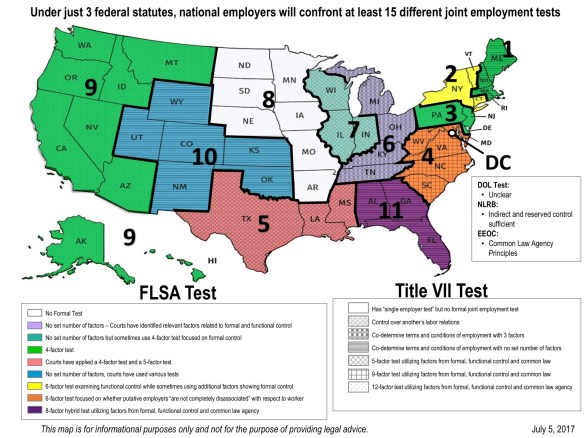
This could be a busy week for developments in the joint employment area.

1) Congressional Republicans have begun drafting legislation that could change the definition of joint employment, Bloomberg BNA reports. Presumably the goals of a new bill would be (a) to add clarity to the standards for deciding who is a joint employer, and (b) to make it more difficult for workers or unions to claim they are jointly employed.

Continue reading

New NLRB Nominations May Lead to New Joint Employment Test (or to my misuse of Lynyrd Skynyrd song lyrics)

IMG_1088In the Lynyrd Skynyrd song, “Gimme Three Steps,” we find our hero cutting a rug down at a place called The Jug with a girl named Linda Lou. This catchy song has nothing to do with labor law but does deal with someone who finds himself in a bad situation (shakin’ like a leaf on a tree!) and needs three steps to get out the back door.

Same thing here (in a sense). [C’mon, work with me here, I’m trying to make NLRB appointments interesting!]. When not posting tweets of himself pummeling a photoshopped CNN logo outside a WWE ring, President Trump found the time to make two important nominations to fill vacancies on the National Labor Relations Board (NLRB), giving companies two of the three steps needed to undo a long list of anti-business decisions from the past eight years.

The two new appointmnents, once confirmed, will shift the Board back to a 3-2 Republican majority, which should spell relief for businesses in several areas — including joint employment. (Two appointments = two steps. There’s a third step coming.  Wait for it….)

Continue reading

Franchises Continue to Fight Joint Employment Claims

IMG_1074.JPGAre franchisors responsible for the wage and hour violations of their individually owned franchisees?

This question continues to vex the courts. (Vex! Great Scrabble word!) Despite the promise of more pro-business policies from the current administration, lawsuits filed by employees against franchisors show no signs of slowing down. Here’s why.

When employees allege wage and hour violations against individually owned franchisees (your local store), such as a failure to properly pay overtime, the employees usually try to convert that lawsuit into a class action.

Continue reading

The Myth of “Temporary Employees”

IMG_1067What is a “temporary employee”? I have practiced employment law for 20 years (Note to self: Keep practicing; someday you’ll get good at it.) and I can’t tell you. It’s a state secret. All lawyers have been sworn to secrecy forever.

Either that or, if you really want to know and say “pretty please” (with or without sugar on top, but no artificial sweetener please), that term has no legal significance. Usually the term is used to mean one of two things:

  1. your employee, hired on a trial basis with some sort of probationary period; or
  2. a staffing agency worker, retained to augment staff levels on a temporary basis.

Under option 1, the “temp” is a regular W-2 employee of yours, probably employed at will like your other employees, but whether you call that person “temp” or “permanent” or “regular” or “irregular” (?), none of it matters. A temp worker who is your employee, paid subject to deductions, is your employee.  Temp time counts toward FMLA eligibility. Continue reading

Can an Intern be an Independent Contractor? (Answers revealed in James Bond movies)

IMG_1068Among James Bond films, Rotten Tomatoes ranks Never Say Never Again 18th out of 26, with a mediocre 63% rating. (Bond movie quiz at the end of this post, for patient readers.)

It’s a cliche saying, I know, but my first reaction when asked this question was, “I’d never say never, but it’s hard to imagine a scenario where that would work.” (That was also my second reaction and my third. Let’s just say that’s my reaction.)

Let’s run this through the gauntlet. Remember, it’s not your choice whether an intern is an independent contractor or an employee. The law decides that for you, based on the nature of the relationship.

Test #1: Economic Realities Test. Under federal wage and hour laws, an independent Continue reading

Maximum Badass Trucker Fight Fails to Break Up Independent Contractor Status

boxing-independent contractor or employee - independent contractor misclassification 0 100733_1920

In 2012, Mens Fitness Magazine ranked the “12 Most Badass Fight Scenes of the Millennium.” An obscure Ohio rest stop battle between two truckers didn’t make the list, but one attacked another viciously with a metal bar, breaking his leg and causing permanent injuries after being cut off in traffic.

But that’s not why I mention the Rest Stop Rumble (a/k/a Herndon v. Torres). The victim trucker sued both the trucker and the trucking company whose load the wannabe Maximus Decimus Meridius was hauling.

The trucking company avoided liability, however, by proving to the court that its relationship with Maximus was that of an independent contractor. While an employer can be held vicariously liable for the badass acts of its employees, there is generally no vicarious liability for independent contractors.

The court evaluated the relationship between Mad Max and the trucking company using a Right to Control Test, which is used to determine Who Is My Employee? under Ohio tort law.

The following factors helped establish that Max Zorin, while still the story’s villain, was not an employee of the trucking firm: Continue reading

What’s Up? Black Car Drivers Are Independent Contractors. Here’s Why.

balloons-1786430_1280At the end of Pixar’s Up, Carl and Russell sit on a curb pointing out cars: “Red one!” “Blue one!” Then Dug (the dog) calls out “Gray one!” which I find endlessly funny every time I watch it.

Whatever color the car, they sat there content, eating ice cream.

Black car companies in New York are celebrating too (hopefully with ice cream), after a recent decision preserving their drivers’ status as independent contractors. In Salem v. Corporate Transportation Group, the Second Circuit Court of Appeals ruled that drivers were not entitled to overtime pay, since they were not employees, but rather independent contractor franchisees.

We’ve written often in this blog about the different tests for determining Who Is My Employee? This case was brought under the Fair Labor Standards Act (FLSA) and comparable New York law, so the Court applied an Economic Realities Test. This test measures whether workers are economically dependent on one company to earn a living or are in business for themselves.

Relying on the Economic Realities factors, the Court ruled the drivers were economically independent and were in business for themselves. Here are the keys to victory:

  1. The drivers purchased franchises, choosing from a variety of options (rent, own);
  2. The drivers used their own cars and paid all their own expenses;
  3. The drivers could drive for competitors or for personal clients;
  4. The drivers were entrepreneurs, controlling many significant aspects of their personal driving business;
  5. The drivers were free to accept or reject jobs;
  6. The drivers chose when, where, and how often to work; and
  7. The franchisor company could not freely terminate the drivers’ franchise agreements.

While independent contractor relationships remain under fire, this decision shows that there’s still hope. Companies can win these cases when they carefully construct the facts, relinquish control, and allow contractors to run their own enterprises.

Although these drivers had considerable discretion over how to run their individual businesses, none (unfortunately) had the creativity to ditch the car and transport customers in a helium-balloon powered house.  Now back to the film.

film-158157_1280

© 2017 Todd Lebowitz, posted on WhoIsMyEmployee.com, Exploring Issues of Independent Contractor Misclassification and Joint Employment. All rights reserved.

Are Independent Contractors Exempt from the FLSA?

hurry-FLSA-independent contractor -2119711_1920Sort of. The Fair Labor Standards Act (FLSA) covers only employees, not independent contractors. The FLSA’s requirements on minimum wage and overtime, therefore, do not apply to independent contractors.

But wait, dear reader, don’t click away quite yet! There’s more! The real question is whether your independent contractor is really an independent contractor.

The question of Independent Contractor vs. Employee is determined under the FLSA by applying an Economic Realities Test to the facts of the relationship, not by deferring to how the parties have characterized they relationship.

The Economic Realities Test evaluates whether the worker is economically reliant on the company for which services are being provided, as opposed to in business for himself/herself.

I have written about the Economic Realities Test here, walking the reader through the various factors that courts and the DOL use to determine Who Is My Employee? under the FLSA.

The bottom line: A true independent contractor is not covered by the FLSA, but an Economic Realities analysis must be applied to determine whether a worker is truly an independent contractor.

© 2017 Todd Lebowitz, posted on WhoIsMyEmployee.com, Exploring Issues of Independent Contractor Misclassification and Joint Employment. All rights reserved.

What is an ABC Test? (and why these tests are a problem)

abc

As we know, there are a variety of tests used to determine Independent Contractor vs. Employee, and the proper test varies depending of the law being applied.

Most of these tests are balancing tests. A variety of factors are considered, and no single factor is determinative.

ABC tests, however, are different. ABC tests start with a presumption that a contractor is an employee, then requires a company to prove each of three factors to protect a contractor’s status as a contractor.

ABC tests tend to apply only to state unemployment coverage laws and, less commonly, to
state workers’ compensation laws. Continue reading

Four Ways to Give Up Control and Protect Independent Contractor Status

run

Retaining control over how independent contractors do their work can sink an otherwise legitimate independent contractor relationship.

Fortunately, steps can almost always be taken to give up aspects of control that do not hurt the business case for using a contractor instead of an employee. Companies need to be thoughtful and proactive, though, in evaluating and modifying these relationships — before they are challenged in a misclassification claim.

Here are four aspects of control you may be able to relinquish in your relationships with independent contractors: Continue reading