
Another Thing to Worry About?: Can Individuals Be Joint Employers under the FLSA?

This gem recently popped up on my twitter feed. Causes of death in London, 1632. Seems to me that cancer would be bad enough, but 10 deaths were attributable to the deadly combination of “cancer and wolf.” Sounds to me like 17th century cancer wards needed a moat.

Other notable causes of death include “Consumption” (1797) and its equally deadly opposite, “Dead in the street and starved” (6). “King’s evil” fell 38 unappreciated subjects of the Crown, and 98 died from “Rising of the lights,” which is a fate perhaps narrowly avoided by Clark in Christmas Vacation.

There were lots of things in 1630s London that could bring a person down, but happily “joint employment” is not among the recorded causes of death. Which raises this question as we head into 2023:

Can individuals be liable as joint employers?

The answer, of course, is sometimes.

The Supreme Court of Virginia recently ruled that individuals could not be joint employers under that state’s law on unpaid wages. The decision, was based on a strict reading of a state statute, which permitted only “entities” to be joint employers. The Virginia court explained that this definition was narrower than the understood meaning of joint employer under the Fair Labor Standards Act (FLSA).

And, indeed, the FLSA does recognize that individuals may be joint employers. This nugget from the First Circuit Court of Appeals answers that question with little room for doubt: “The overwhelming weight of authority is that a corporate officer with operational control of a corporation’s covered enterprise is an employer along with the corporation, jointly and severally liable under the FLSA for unpaid wages.” Donovan v. Agnew, 712 F.2d 1509, 1511 (1st Cir.1983).

The difference is definitional. The FLSA looks to whether one or more “persons” is the employer. Persons can be individuals or entities. The Virginia statute considered only “entities.”

Individual corporate officers can, therefore, face liability as joint employers, particularly in smaller organizations where corporate formalities might not be followed as closely as they should be. For example, in the Agnew case, the court determined that “corporate officers with a significant ownership interest who had operational control of significant aspects of the corporation’s day to day functions, including compensation of employees, and who personally made decisions to continue operations despite financial adversity during the period of non-payment” were employers under the FLSA.

The bottom line here is that, yes, individuals can — at least under some circumstances — be joint employers under the FLSA. But not necessarily under every state’s law.

So that’s one more thing that individuals need to be wary of, in addition to the king’s evil and the dreaded combination of “cancer and wolf.”

Enter your email address to subscribe to this blog and receive notifications of new posts by email.

© 2022 Todd Lebowitz, posted on WhoIsMyEmployee.com, Exploring Issues of Independent Contractor Misclassification and Joint Employment. All rights reserved.


2018_Web100Badge
 

Rick Springfield & Joint Employment: L.A. County Liable in FLSA Overtime Suit, Despite No Control Over Payroll

Rick jams!

If I ask you to name a song by Rick Springfield, you’ll say “Jessie’s Girl.” If I ask you to name another, you’ll look at me with a blank stare. But there’s another song you probably know. I forgot all about it too until I heard it on the 80s channel last week.

“Don’t Talk to Strangers” was released in 1982 and, around May of that year, spent four weeks at #2 on the Billboard charts. (Bonus Trivia Question: Can you name the #1 song in May 1982? The answer is below.)

Springfield had a couple of other hits too. Remember “Love Somebody” and “I’ve Done Everything for You”? Good times.

Anyway, the State of California and County of Los Angeles are hardly strangers, and they not only talk, but they collaborate on social services programs. That collaboration led to a lawsuit raising joint employer questions under the Fair Labor Standards Act (FLSA).

The State of California and the County of Los Angeles administer an In-Home Supportive Services (IHSS) program, which allows low-income elderly, blind, or disabled residents of the county to hire a provider to help them with daily living activities. The State of California runs the program at a state level, through state regulations, but the counties play a role in administering the program too.

Under a 2013 DOL regulation covering domestic workers, these workers were entitled to overtime pay under the FLSA. Until late 2015, however, the regulation was vacated while a court reviewed it. The state began paying overtime in 2016.

In this lawsuit, one of the IHSS providers filed suit against Los Angeles County, seeking FLSA overtime wages for 2015, while the rule was vacated and under review.

The county responded that the state, not the county, was the employer; and therefore the county could not be liable for the state’s failure to pay overtime in 2015. The district court agreed and ruled that the state, not the county, was the employer. The county would not be liable for the unpaid overtime. Or so it thought.

In a recent decision, however, the Ninth Circuit Court of Appeals reversed that conclusion. Applying the FLSA joint employer test, the Court held that the county was a joint employer, even though it did not control payroll.

Seems a little unfair, but that’s how joint employment works.

According to the Ninth Circuit, here’s the joint employer test under the FLSA: To determine whether an entity is a joint employer, the court must consider “whether the alleged employer (1) had the power to hire and fire the employees, (2) supervised and controlled employee work schedules or conditions of employment, (3) determined the rate and method of payment, and (4) maintained employment records.”

The test derives from a Ninth Circuit case called Bonette. Other circuits use slightly different tests.

Even though the state controls payroll, the Ninth Circuit ruled that the county had enough involvement, based on the four factors, to make it a joint employer. The county therefore would be jointly liable for the shortfall in overtime pay.

The case is a good reminder of the dangers of joint employment. Even if your business has no control over payroll, a joint employer is liable for the failure to pay overtime.

The idea of two different things coming together is also the answer to today’s trivia question from above: What was the #1 song on the Billboard charts in May 1982?

[scroll down for the answer]

.

.

.

.

.

.

The #1 song in May 1982 was Ebony and Ivory.

Also, random fun facts about Rick Springfield:

  • His real name is Richard Springthorpe.
  • He was born in Guilford, New Sales Wales, Australia.
  • He played Dr. Noah Drake on General Hospital.
  • Before making it big on his own, he played in bands called Wickedy Wak and Zoot.

Enter your email address to subscribe to this blog and receive notifications of new posts by email.

© 2022 Todd Lebowitz, posted on WhoIsMyEmployee.com, Exploring Issues of Independent Contractor Misclassification and Joint Employment. All rights reserved.

2018_Web100Badge
 

But the Onions! DOL’s Contractor Rule May Cause Companies Heartburn

Have you ever gone to a new restaurant that took over the space where one of your favorite restaurants used to be?
 
You’ve been wanting to try the new restaurant. You get there and the menu looks similar, so you order the fettucine with shrimp because that dish was always really good at the old place. It arrives and it looks the same but you’re not sure that it tastes quite the same.
 
Maybe the sauce tastes a little different but it’s hard to tell for sure. Then, you get home later that night and you feel a little queasy. You realize that the new restaurant must have put onions in the sauce. You probably didn’t notice because when the dish was served it looked just like it did at the old restaurant.
 
But you’re not supposed to eat onions, and now you have to wait and see if you’re going to start cramping up from eating the onions or if you’re going to be just fine. You really just don’t know. It could just as easily go either way, and now all you can do is wait.
 
That’s kind of how I feel after reading the Department of Labor’s proposed new independent contractor rule, released earlier this week.

Click here to read the rest of the story, originally published in Law360 on 10/13/2022.

Enter your email address to subscribe to this blog and receive notifications of new posts by email.

© 2022 Todd Lebowitz, posted on WhoIsMyEmployee.com, Exploring Issues of Independent Contractor Misclassification and Joint Employment. All rights reserved.

2018_Web100Badge
 

Garbage Bird? Don’t Get Poisoned By A Double Hit of Misclassification and Joint Employment

Photo: Benjamin Freeman/Wikimedia Commons (CC BY 4.0)

The natives of Papua New Guinea call the hooded pitohui a “garbage bird,” and they don’t eat it or touch it. As Westerners learned more recently, there’s a good reason for the islanders’ hostility.

The hooded pitohui is the first bird confirmed to be poisonous. The bird‘s feathers emit batrachotoxins, which causes numbness and burning in low concentrations. A heavier does can cause paralysis, cardiac arrest and death. In other words, there’s good reason for keeping the hooded pitohui off the menu.

Numbness and burning may also describe the impact of a recent DOL enforcement action on two contractors in Louisiana. They were dealt a double hit—the DOL found independent contractor misclassification and joint employment.

After an investigation, the DOL’s Wage and Hour Division found that hundreds of painters and drywall workers had been misclassified as independent contractors. The company that retained the workers, PL Construction, failed to pay overtime and failed to maintain accurate time records, both violations of the Fair Labor Standards Act (FLSA).

Adding to the pain, the DOL found that a higher tier contractor, Lanehart, was the workers’ joint employer. That meant Lanehart was jointly liable for the violations—even though it had no control over PL Construction’s pay practices.

The DOL recovered more than $240,000 in overtime back wages for 306 workers.

There are several lessons here, both for companies that retain independent contractors directly and for higher tier contractors that engage subcontractors that use ICs.

1. The DOL considers independent contractor misclassification an enforcement priority. The agency is actively looking for violations.

2. The DOL publishes its wins. That means you can expect a press release naming and shaming your company if the DOL finds that there’s a practice of misclassifying workers. Have you heard the old adage that there’s no such thing as bad publicity? It’s not true.

3. Higher tier contractors are taking a risk if they put their head in the sand and disregard misclassification by their lower tier subs—especially if they plan to direct the work of the lower tier sub’s workers.

Here, the DOL found that Lanehart, the higher tier contractor, supervised PL’s workers and maintained records of who worked when. Lanehart’s supervision and direction made it a joint employer of PL’s workers. Under the FLSA, a joint employer is fully liable for wage and hour violations, even where it had no control over how the lower tier sub paid its workers.

4. A lawsuit is not the only way misclassification claims arise. Federal and state agencies can initiate investigations too. And while arbitration agreements with class action waivers can prevent class action litigation, they can’t stop a federal agency from pursuing claims on its own.

The DOL made its position pretty clear in its press release: “Our investigation shows the costly consequences employers face when they or their subcontractors fail to comply with the law. When we determine a joint employment relationship exists, the Wage and Hour Division will hold all responsible employers accountable for the violations.”

Misclassification hurts. Joint employment doubles the pain. The DOL can inflict an uncomfortable burning sensation, even without sending a a hooded pitohui your way.

Enter your email address to subscribe to this blog and receive notifications of new posts by email.

© 2022 Todd Lebowitz, posted on WhoIsMyEmployee.com, Exploring Issues of Independent Contractor Misclassification and Joint Employment. All rights reserved.

2018_Web100Badge
 

Inedible Food: DOL Starts New Rulemaking Process to Toughen FLSA Independent Contractor Test

I saw this truck while driving home last week from my daughter’s college graduation. Now I’m no livestock dietician (I failed that course in law school), but this seems like the worst possible thing to feed your animals.

Whoever’s behind the labeling also needs some help with marketing. I know I wouldn’t buy that.

I’m also not buying the DOL’s recent announcement that it’s holding two public forums to help it decide what to do about a new independent contractor misclassification test. I think we all know what the DOL is going to do already.

The DOL will hold an Employer Forum on June 24, then a Worker Forum on June 29. Anyone can attend. RSVP links are here (6/24) and here (6/29).

After this charade open-minded exchange of viewpoints, the DOL will get to work preparing a new rule for determining who is an employee under the Fair Labor Standards Act (FLSA). The current regulation, issued by the Trump DOL, refocuses the traditional Economic Realities Test inquiry on two core factors: (1) the nature and degree of the individual’s control over the work, and (2) the individual’s opportunity for profit or loss. The Biden DOL tried (unsuccessfully) to prevent the Trump rule from going into effect, but a federal court ruled that the Biden DOL’s attempt to dismantle the rule was flawed, and the Trump rule therefore went into effect.

Now, let’s not kid ourselves. Just because a court told the Biden DOL that it’s stuck with this Trump-made rule doesn’t mean anyone at the DOL is actually applying it. The Biden DOL has said it plans to rewrite the rule, pronto. The new rule will make it harder to classify workers as independent contractors under the FLSA. We already know that’s going to happen, even if we don’t know the precise language to be used.

In late 2022, the DOL will issue its new rule, which will be like the old rule that we had before the Trump DOL’s new rule. Meet the new boss, same as the old boss. And with each new administration, it will become harder then easier then harder to be classified as a contractor under the FLSA.

So I will not be wasting my time listening in on these forums. I expect they’ll be as useful as inedible food. Which cannot be good for the GI tract.

Enter your email address to subscribe to this blog and receive notifications of new posts by email.

© 2022 Todd Lebowitz, posted on WhoIsMyEmployee.com, Exploring Issues of Independent Contractor Misclassification and Joint Employment. All rights reserved.

2018_Web100Badge
 

Not Dead Yet: Arbitration Agreements May Sit Dormant, But They Can Still Save You From a Class/Collective Action

Not dead yet. @SCMPNews

This spring has been a bad time for injured civilians who prefer not to be buried alive.

In Peru last month, a funeral procession was interrupted when the 36-year old car accident victim was heard banging on the lid of her coffin, trying to get out. Days earlier the woman had been pronounced dead, in what turned out to be an unfortunate mispronunciation.

In Shanghai, a nursing home mourned the passing of an elderly resident, who was placed in a body bag and sent to the mortuary. As seen in this video taken by a bystander, the mortuary workers unzipped the bag and found the man still moving. He was transferred to a hospital, which seems to me like a more appropriate place for someone still alive.

People may go quiet, but that doesn’t mean they should be treated as dead. The same holds true for individual arbitration agreements. They may exist quietly in the background, but courts can’t just ignore them, as a recent Fifth Circuit Court of Appeals decision made clear.

A plaintiff alleged violations of the Fair Labor Standards Act (FLSA), claiming she was misclassified as an independent contractor and therefore was denied overtime pay. She asked the court to treat her lawsuit as a collective action, claiming that other contractors were also misclassified and were also denied overtime pay. In FLSA cases, plaintiffs have to opt in to join the class. The district court approved the distribution of opt-in notices to similarly situated contractors, letting them know about the lawsuit and their right to participate.

The defendant opposed the notices, pointing out that the contractors had all signed individual arbitration agreements that included class action waivers. They couldn’t opt in, the defendant argued, so they should not get the notice. When the court approved the notices anyway, the defendant filed a writ of mandamus with the Fifth Circuit Court of Appeals, asking the appeals court to intervene and stop the notices from going out.

The Fifth Circuit granted the writ and stopped the notices from going out. The Court of Appeals ruled that the arbitration agreements required all disputes to be resolved through individual arbitration, and therefore the contractors could not opt in to the lawsuit. Since they could not opt in, they could not be sent notices inviting them to opt in.

It’s unusual for a Court of Appeals to grant a writ of mandamus. But here, the Court of Appeals recognized that the arbitration agreements were very much alive, even if the contractors who signed them were silent in the background.

This case is a good reminder of the value of individual arbitration agreements with class action waivers. A well-drafted arbitration agreement will require all claims to be resolved on an individual basis and will include a waiver of the right to participate in any class or collective action. The agreement should also deprive the arbitrator of jurisdiction to preside over a class or collective action.

Businesses that rely on independent contractors should check their agreements and consider adding robust, carefully-drafted arbitration clauses.

Arbitration agreements can sit silently in the background for years, but that doesn’t mean they are dead.

Enter your email address to subscribe to this blog and receive notifications of new posts by email.

© 2022 Todd Lebowitz, posted on WhoIsMyEmployee.com, Exploring Issues of Independent Contractor Misclassification and Joint Employment. All rights reserved.

2018_Web100Badge
 

Beware of Snakes: Court of Appeals to Decide Whether Student-Athletes Are Employees under FLSA

Snakes have been in the news lately. A Maryland man was recently found dead in his home, killed by a venomous snake bite. This might seem surprising, until you learn that the same man kept 124 pet snakes in his house, including rattlesnakes, cobras, black mambas and a 14-foot-long Burmese python.

I also learned this week of a horrifying tourist attraction in Manitoba called the Snakes of Narcisse, where you can view “tens of thousands of red-sided garter snakes as they slither to the surface from their winter dens.” Tourists can view the dens and the snakes’ “mating balls,” in which “one [unlucky] female is surrounded by up to one hundred males.” Brackets are mine, since this can’t be fun for the snakestress, no matter how many cocktails are involved.

According to Quizlet, six colleges and universities have snakes for mascots. I won’t spoil the surprise. You can click here for the big reveal.

For student-athletes at these six schools, plus those at every other non-snake-themed college, there’s a Third Circuit case that’s worth watching.

The Third Circuit has agreed to hear a case that poses the following question: “Whether NCAA Division I student athletes can be employees of the colleges and universities they attend for purposes of the Fair Labor Standards Act solely by virtue of their participation in interscholastic athletics.

If the Third Circuit says yes, student-athletes may be entitled to millions of dollars in back wages under the FLSA. A ‘yes’ ruling would be deadly venom to just about every non-major sports program, since schools have no budget to pay wages to student-athletes. Very few programs in very few sports actually make money.

For those who brought this suit and think they are advocating for the student, be careful what you wish for. If the Third Circuit rules that student-athletes are entitled to be paid, college sports are largely dead. Women’s sports would take the biggest hit, as would every other program that isn’t a top-tier college football or basketball program raking in the cash.

This is a case to watch closely. If student-athletes are entitled to be paid, there would no longer be any distinction between amateurs and professionals. The whole concept of the student-athlete — and almost all of college sports — would go the way of the Round Island Burrowing Boa. That’s an extinct snake that used to live in Mauritius, says wikipedia.

Enter your email address to subscribe to this blog and receive notifications of new posts by email.

© 2022 Todd Lebowitz, posted on WhoIsMyEmployee.com, Exploring Issues of Independent Contractor Misclassification and Joint Employment. All rights reserved.

2018_Web100Badge
 

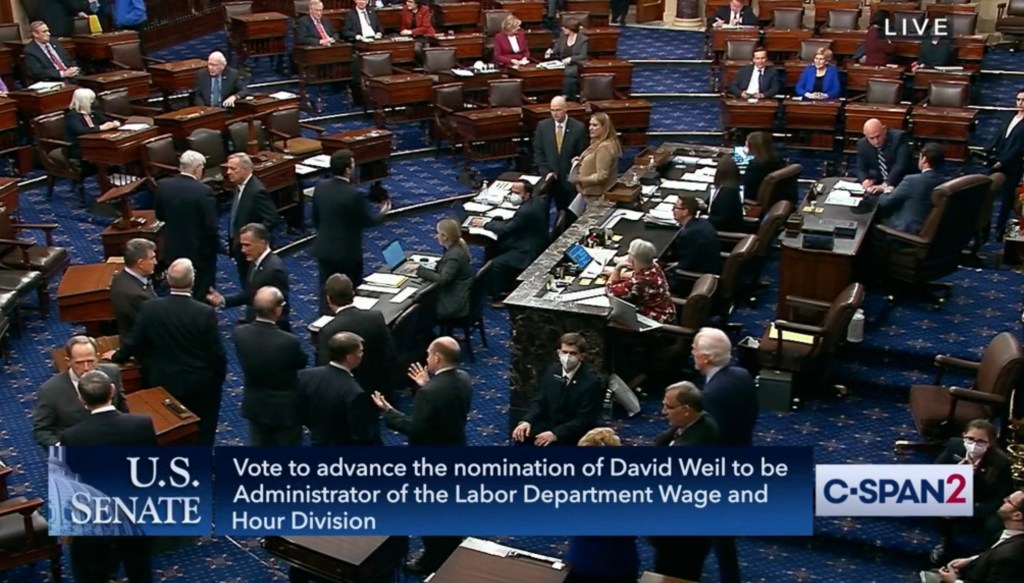
“We Won’t Get Fooled Again”: Senate Rejects Weil (& Join Me Tuesday for a Free Webinar)

(Action shot from the Senate floor!)

Those who have seen me present on independent contractor issues know that I like to incorporate song references by The Who. There are so many song titles and lyrics that help the presentation flow.

On Tuesday, it’s my turn to co-present at the annual BakerHostetler Master Class on Labor Relations and Employment Law. The session is called Answering Tough Questions About Independent Contractors, Joint Employment and the Contingent Workforce, Using Songs by The Who. The session is free, 2-3p ET on April 5. Register here.

If you join me, you’ll get gems like this when we update you on 2022 developments, such as David Weil’s nomination to serve as Wage and Hour Administrator of the DOL:

Democrats: Meet the new boss, same as the old boss.

Republicans: We won’t get fooled again.

David Weil was the Wage and Hour Administrator in the DOL during the Obama Administration. He published two Administrator’s Interpretations expressing the view that most independent contractors were misclassified and that joint employment should be much easier to establish. He wrote about the problems with the “fissured workforce,” meaning the expansion of non-traditional, non-employee labor. He was not a friend of the business community and especially disliked by the franchising community.

In 2021, Biden nominated him to reclaim that post.

Last week, the Senate voted 53-47 to block the nomination.

In the independent contractor space, it’s been a busy few months for the DOL, and I would imagine the administration would like to fill this role as quickly as possible.

Last month, a federal court took issue with the Biden DOL changing its tune on the Trump DOL’s test for independent contractor misclassification. The court declared The Song Is Over and rejected the Biden DOL’s change, reinstating the Trump-era test for worker classification under the Fair Labor Standards Act (FLSA). More details here.

In January, the DOL and the NLRB signed a Memorandum of Understanding in which they agreed to share information to combat independent contractor misclassification.

Join me and my colleagues Margaret Rosenthal and Vartan Madoyan on Tuesday for more updates, tips, previews, and Who-themed lyrics. There’s no charge to attend. I’m Free.

Enter your email address to subscribe to this blog and receive notifications of new posts by email.

© 2022 Todd Lebowitz, posted on WhoIsMyEmployee.com, Exploring Issues of Independent Contractor Misclassification and Joint Employment. All rights reserved.

2018_Web100Badge
 

It’s There, Even If You Can’t See It: Court Reinstates Trump-Era Independent Contractor Test, and It’s Effective Now.

There’s an optical illusion known as a negative afterimage. If you stare at the red dot on this woman’s nose for about 15 seconds, then look at a blank wall, you’ll see the woman on your wall – but in full color and with dark hair. And yet, there is no woman on your wall. 

You see what isn’t there because the illusion tricks the photoreceptors in your retina.

Monday’s ruling by a federal judge in Texas also has us seeing what isn’t there – or what was there and then wasn’t there – or something like that, but with respect to the test for independent contractor classification. 

In early January 2021, the Trump DOL issued a new regulation that sought to provide clarity on how to determine whether someone is an employee or an independent contractor under the Fair Labor Standards Act (FLSA). Even though the FLSA is a federal law that is supposed to apply everywhere, different courts around the country used different versions of the FLSA’s Economic Realities Test to make that determination.

Under the new regulation, 29 CFR Part 795, there would be just one test. It was simple, and the same rule would apply all over the country. The regulation was scheduled to take effect March 8, 2021. But a few days before the effective date, the Biden Administration postponed implementation of the new rule. Then in May, they rescinded it. They replaced it with nothing. If you go to the Code of Federal Regulations, there is no 29 CFR Part 795. (Here, try it!)

But Monday’s ruling said to stare a little harder. It’s there.

The court ruled that the Biden Administration’s effort to delay and then withdraw Part 795 was unlawful and violated the Administrative Procedure Act. The delay provided too short a comment period, failing to offer the public a meaningful period to provide input. The withdrawal was improper because the DOL failed to consider alternatives and instead “left regulated parties without consistent guidance.” 

Because the delay and withdrawal of the Trump era rule were deemed unlawful, the court ruled that Part 795 did, in fact, go into effect March 8, 2021, and “remains in effect.”

Who knew?

So now you probably want to know what the rule is, since you cannot find it online in the Code of Federal Regulations – at least as of Tuesday night.

The test in Part 795 identifies two “core factors” for determining the independent contractor vs. employee question under the FLSA. If both factors point in the same direction, the issue is generally decided. If the core factors point in different directions, three “other factors” are considered.

The Two Core Factors

As we explained here, The core factors are:

• The nature and degree of the individual’s control over the work; and

• The individual’s opportunity for profit or loss.

The control factor supports independent contractor status if the worker “exercises substantial control over key aspects of the work,” including setting schedules, selecting projects, and being allowed to work for others.

The profit or loss factor weighs in favor of independent contractor status if the worker has the opportunity to earn profits or incur losses based on the exercise of initiative, managerial skill, business acumen or judgment, or based on management of his or her own investments or capital expenditures. Examples of investments may include hiring helpers or buying equipment. 

Other Factors

If the two core factors do not determine the issue, three other factors are to be considered:

• Amount of skill required for the work;

• Degree of permanence of the working relationship between the individual and the potential employer; and

• Whether the work is part of an integrated unit of production.

Amount of skill required. This factor weighs in favor of independent contractor status if the work requires specialized skill or training that the potential employer does not provide.

Degree of permanence. This factor weighs in favor of independent contractor status if the work is definite in duration or sporadic. This factor supports employee status if the work is indefinite. Work that is seasonal by nature does not weigh in favor of independent contractor status, even though it’s definite in duration.

Whether the work is part of an integrated unit of production. This factor is likely to receive the heaviest criticism from worker advocates. The “integrated unit of production” factor comes from a pair of 1947 U.S. Supreme Court cases. Over the years, this factor has morphed into the question of whether the work is “integral” to the potential employer’s business. Part 795 takes a firm stance here, saying that — based on the 1947 Supreme Court decisions — the relevant question is whether the work is “integrated,” not whether it is “integral.”

This factor weighs in favor of independent contractor status if the work is “segregable” from the potential employer’s processes for a good or service. For example, a production line is an integrated process for creating a good. A software development program may require an integrated process for creating a computer program. Work that is performed outside of an integrated unit of production is more likely performed by an independent contractor.

What Happens Now?

First, the DOL can appeal the decision to the Fifth Circuit. We expect that will happen. In the meantime, a stay might be issued or might not be issued.

Second, Part 795 is now in effect, unless a stay is issued. 

Third, it’s a fair question how much this really matters anyway. The test was not intended to change the outcome in most instances. It was instead intended to articulate more clearly how these determinations were already being made. The two “core factors” were already determinative in almost all cases, even if courts were not explicitly identifying two factors as being most important. Also, the Circuit Courts of Appeal do not have to adopt the DOL’s interpretation of the test. They can go on using their five-part and six-part tests, or they can apply the Part 795 analysis. 

The Part 795 should now be the applicable test. But we shall see.

If you stare hard enough at your handy copy of the Code of Federal Regulations, and then look at a blank wall, Part 795 just might appear.

Enter your email address to subscribe to this blog and receive notifications of new posts by email.

© 2022 Todd Lebowitz, posted on WhoIsMyEmployee.com, Exploring Issues of Independent Contractor Misclassification and Joint Employment. All rights reserved.
2018_Web100Badge
 

That’ll Cost You 96 Camels: Court Headlocks Staffing Agency with $7.2M Misclassification Judgment

Mom feeding a non-wrestling camel, May 2010

If you weren’t in Turkey last month, you missed the annual Selçuk Efes Camel Wrestling Festival, which featured 162 competitors in four categories.

The camels are paired by weight and skill, and their techniques include tripping their opponents with foot tricks or applying headlocks then sitting on their opponents. Some just push until the other camel gives up. A winner is declared when one camel scares away the other, making him scream or collapse. The camels are muzzled so there is no biting.

Among those missing the spectacle were the owners of Steadfast Medical Staffing, a Virginia-based firm that maintains a database of nurses and pairs them with healthcare facilities. That’s because they were in federal court, defending against a lawsuit by the Department of Labor. The DOL alleged that they had misclassified the nurses as independent contractors in violation of the Fair Labor Standards Act (FLSA).

After a bench trial, the judge agreed with the DOL and ruled that the nurses — which included CNAs, LPNs and RNs — were employees of the staffing agency. The Court applied the Economic Realities Test, which is the proper test for determining who is an employee under the FLSA.

The Court considered all relevant factors, then applied camel-style headlocks while sitting on the defendant, causing the staffing agency to either scream or collapse (unclear from the opinion). The Court ruled that the staffing agency failed to pay overtime and failed to comply with FLSA record keeping requirements. The agency will be liable for approximately $3.6M in back wages plus another $3.6M in liquidated damages.

Following the judgment, the DOL issued a statement with quotes from the Secretary of Labor, Marty Walsh, and the Solicitor of Labor, Seema Nanda, that the DOL was sending an “unequivocal message” to Steadfast and other staffing companies that the DOL is serious about pursing independent contractor misclassification.

Staffing agencies that treat workers as independent contractors are on notice that the DOL is serious about enforcement. Remember, the facts of the relationship determine whether a worker is an employee or an independent contractor, not how the parties choose to characterize the relationship.

More than 1,100 nurses will share in the award, with a healthy-but-to-be-determined amount of fees headed to the plaintiffs’ lawyers.

A prized wrestling camel can be sold for more than a million Turkish lira. That’s about $75,000. Large awards like this for systemic misclassification are not surprising. This one will cost the staffing firm about 96 wrestling camels.

Enter your email address to subscribe to this blog and receive notifications of new posts by email.

© 2022 Todd Lebowitz, posted on WhoIsMyEmployee.com, Exploring Issues of Independent Contractor Misclassification and Joint Employment. All rights reserved.

2018_Web100Badge
 

>