
 Congress may finally provide some clarity in determining who is a joint employer. In legislation introduced last week, the House proposed a bill that would rewrite the definition of “joint employer” under federal labor law (National Labor Relations Act) and federal wage and hour law (Fair Labor Standards Act).
The Save Local Business Act — despite lacking a fun-to-say acronym — would create a new standard for determining who is a joint employer under these two laws. The proposed new standard would allow a finding of joint employment “only if such person [business] directly, actually, and immediately, and not in a routine and limited manner, exercises significant control over the essential terms and conditions of employment….”
The definition provides examples of what are “essential terms and conditions,” including: Continue reading

 If you retain freelancers in New York City, pay attention.
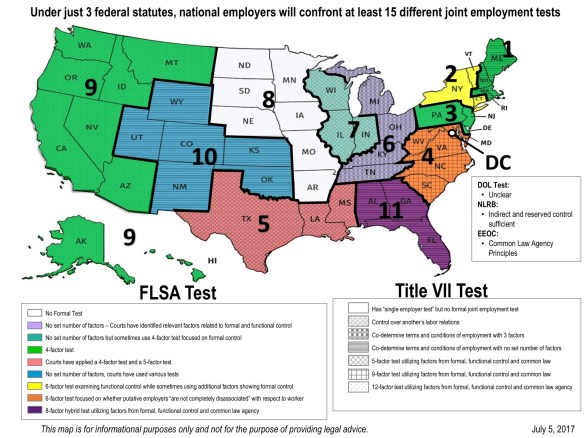 The tests for determining whether a business is a joint employer vary, depending on which law applies. That means there are different tests under federal labor law, wage and hour law, and employee benefits law, to name a few. There are also different tests under different states’ laws.
 When I was an undergrad at Michigan, any time I would drive to the airport or to Tiger Stadium, I’d see billboards for Deja Vu, a strip club with (apparently) lots of locations. I never visited (not into that sort of thing, thanks for asking), and I never thought much of it. I certainly did not expect to be writing about Deja Vu and independent contractor misclassification 25 years later. But here goes.
 In the Lynyrd Skynyrd song, “Gimme Three Steps,” we find our hero cutting a rug down at a place called The Jug with a girl named Linda Lou. This catchy song has nothing to do with labor law but does deal with someone who finds himself in a bad situation (shakin’ like a leaf on a tree!) and needs three steps to get out the back door.
 The Family and Medical Leave Act (FMLA) is already one of the hardest employment laws to comply with. Add joint employment into the mix, and the level of difficulty further increases.
 Who Is My Employee?