Five Easy New Years’ Resolutions for Companies That Use Independent Contractors

new years resolutions

Now that the hangover has worn off and the calories have not, it’s time for 2019 New Years’ Resolutions. I know you didn’t ask for help, but you also didn’t not ask.

Here are some suggestions for those of you whose companies rely on independent contractors:

  1. Do you have one of those doorbells you can answer from anywhere? So do I. That’s because we’re cautious (syn., paranoid). Be similarly cautious that your non-legal, non-HR co-workers in management might retain independent contractors without your knowledge. Unleash your inner Anita Ward and make them Ring Your Bell. Set up a gatekeeper system that requires everyone to go through you before they can retain a non-employee worker. But don’t aim little cameras at their desks or you will lose friends.
  2. Update your Independent Contractor Agreements, even if you haven’t been sued yet. I am reminded of the time Bart Simpson exclaimed, “This is the worst day of my life!” and the wise yogi, Homer, responded helpfully, “–the worst day of your life so far.” (Here’s the clip.) Be prepared for if/when you are sued. Use the contract to highlight the facts that support independent contractor status. Be prepared.
  3. Don’t walk slowly in airports. This is (arguably) not directly related to the use of independent contractors, but it is important nonetheless because it drives everyone bonkers when people do it.
  4. Include arbitration clauses with class action waivers. In an alternative universe, your company has been sued by all of your independent contractors in a class action. In your reality, the contractor’s requirement to go at it alone in arbitration convinces your contractor that it’s not worth the effort to sue you, making you — who inserted the arbitration clause — the hero!
  5. Try this exercise: Do a simple self-audit. Check your company’s list of 1099 recipients for 2018 and see how many are individuals with SSNs, rather than entities with EINs. A long list with the names of a lot of individuals may be a sign that there are some independent contractor issues. That little exercise won’t burn off a single cookie, but it’s nonetheless a simple way to try to get a sense of how many independent contractors your business may have. The number is often greater than people realize.

Wishing you all a happy and healthy 2019!

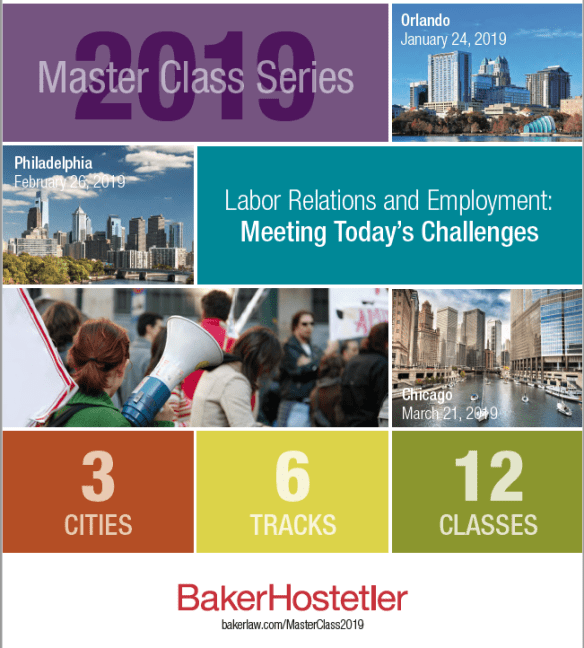
For more information on joint employment, gig economy issues, and other labor and employment developments to watch in 2019, join me in Orlando on Jan. 24, Philadelphia on Feb. 26, or Chicago on Mar. 21 for the 2019 BakerHostetler Master Class on Labor Relations and Employment Law: Meeting Today’s Challenges. Advance registration is required. Please email me if you plan to attend, tlebowitz@bakerlaw.com. If you list my name in your RSVP, I will have your registration fee waived.

© 2019 Todd Lebowitz, posted on WhoIsMyEmployee.com, Exploring Issues of Independent Contractor Misclassification and Joint Employment. All rights reserved.


Enter your email address to subscribe to this blog and receive notifications of new posts by email.

2018_Web100Badge


Join Me at Baker Hostetler’s 2019 Master Class on Employment Law (Three Locations)

2019 master class logoPlease join me and my colleagues in the Employment Group at Baker Hostetler for the 2019 Master Class on Labor Relations and Employment Law.  This year’s event will take place in three locations:

I will be presenting on the Gig Economy: Labor Relations Issues, with my colleague Peter Fischer.  We’ll cover 2018-19 developments in joint employment (there are many!) and the future of portable benefits for gig economy workers.

One of the best parts about the format of the Master Class is the ability to customize your day. Each attendee will choose 6 of 12 possible classes to attend and will receive a customized schedule. We’ve added several new hot topics to this year’s program, including #MeToo, Artificial Intelligence, and Union Organizing through Social Justice Campaigns.

To register, click here, or you can contact me directly at tlebowitz@bakerlaw.com.  If you list me as the attorney who invited you, I will have your admission fee waived.

More information is available by clicking the links to any of the cities listed above.

I hope to see you there!

© 2019 Todd Lebowitz, posted on WhoIsMyEmployee.com, Exploring Issues of Independent Contractor Misclassification and Joint Employment. All rights reserved.

Enter your email address to subscribe to this blog and receive notifications of new posts by email.

2018_Web100Badge

Backfired? New Ruling May Threaten NLRB’s Proposed Rule on Joint Employment

Joint employment bagpipe

The word “backfire” derives from the grooming practices of 15th century Scottish noblemen, who grew beautiful long fiery-red flowing back hair, which they brushed and braided into elaborate patterns, including the “Haggis Flow” and the “Scotch Tape.” Ok, not really. Efforts to rewrite history and change definitions can sometimes fall short of the mark.

The NLRB’s grand strategy for rewriting the definition of joint employment may have just backfired. A Court of Appeals decision issued late last week may jeopardize the Board’s rulemaking authority, even though that was not the issue before the Court.

Before we dive into the December 28, 2018 ruling, here is a quick refresher on how we got here:

  • In 2015, the Democratic-majority Board adopted a vastly expanded definition of joint employment, allowing a business to be deemed a joint employer (1) even if it did not control working conditions but merely retained the right to do so, or did so indirectly, such as through third party subcontracting, and (2) even if the working conditions that could be controlled were non-essential working conditions, not just the key terms and conditions like hiring, firing, and disciplining. This was the Browning-Ferris decision.
  • In early 2018, the newly constituted Republican Board tried to reverse its 2015 Browning-Ferris decision in a case called Hy-Brand, in which the Board enacted a much narrower, pro-business definition of joint employment, requiring direct and immediate control over essential terms and conditions of employment before a company could be deemed a joint employer.
  • Several weeks later, however, the Board reversed itself and rescinded the Hy-Brand decision after conflict of interest questions arose relating to one of the board members (Member Emanuel) who decided Hy-Brand. When the Board rescinded its Hy-Brand decision, the effect was to re-establish the expansive 2015 Browning-Ferris test as the operative definition of joint employer.
  • In light of its failed effort in Hy-Brand, the Board then chose to pursue a two-step Plan B for overruling Browning-Ferris and for narrowing the definition of joint employment.
  • Step 1 would be to enact a new regulation, creating a narrower definition of joint employment that would, in effect, overrule Browning-Ferris prospectively. That process is ongoing. Step 2 was to ask the D.C. Court of Appeals to reopen the otherwise mothballed appeal of the Board’s 2015 decision in Browning-Ferris, which adopted the current broad definition of joint employment.
  • In Step 2, the Board expected the Court of Appeals to find that the 2015 Browning-Ferris decision was an overreach and that the vastly expanded definition of joint employment could not survive. That ruling would have nicely positioned the Board to roll out its new regulation, which would substantially narrow the definition of joint employment, as it tried to do in the Hy-Brand case.

That brings us to this past Friday’s decision by the D.C. Circuit Court of Appeals (Dec. 28, 2018) and the real meaning of the word “backfire.” Step 2 did not go the way the NLRB had planned.

The Court of Appeals’ Ruling and Its Effect on Joint Employment

According to the 2-1 majority opinion, the question of whether there is a joint employment relationship under the National Labor Relations Act (NLRA) must be answered by applying the common law test for whether there exists an “agency” relationship.  The Board has no special expertise relevant to defining the common law of agency. Therefore, according to the Court of Appeals, the Board is awarded no deference in this area. In other words, the Board does not have the right to define or redefine joint employment in a way that would be inconsistent with the common law meaning of “agency.”

The Court of Appeals said that the Board’s 2015 ruling in Browning-Ferris — that indirect or reserved control can be considered when determining whether a joint employment relationship exists — was appropriate because it is consistent with the common law of agency.  Under the common law, it is the right to control that matters, even if that control is not exercised. In fact, the Court of Appeals concluded that Board has no authority to prohibit the consideration of indirect or reserved control when evaluating whether there is joint employment. (That’s what the Board is currently trying to do through rulemaking.)  The reason the Board cannot prohibit consideration of indirect or reserved control is that the common law definition of agency examines whether an entity has the right to control how work is performed, regardless of whether that control is exercised. This last point is important for reasons that the D.C. Court of Appeals was not directly addressing. That point — if it hold true — would cast doubt on the Board’s ability to implement its proposed new regulation. The regulation would require a showing of direct and immediate control (not merely indirect or reserved control) before joint employment can be found.

The D.C. Circuit Court of Appeals did not, however, give the Board’s 2015 Browning-Ferris ruling its full backing. Where the Browning-Ferris ruling went wrong, according to the Court of Appeals, was in allowing the consideration of indirect or reserved control over non-essential terms and conditions of employment.  The common law agency test requires control (or indirect or reserved control) over essential terms and conditions of employment (e.g., hiring, firing, disciplining).  The Court therefore ruled that the Board lacks authority to change that definition in a way that make a business a joint employer merely by entering into a standard subcontracting or staffing agency agreement. All such relationships involve some level of control over non-essential working terms, such as defining the type of work to be done by the subcontractor or staffing agency workers and dictating the desired result.

The 2015 Browning-Ferris case is now being remanded back to the Board to take another shot at it. That would be fine and dandy with the now-Republican-majority Board, except for the fact that the Board may now be impotent to make a meaningful pro-business change in this case, since Member Emanuel might be precluded from participating in the decision due to Littler’s representation of Leadpoint, the staffing agency in the Browning-Ferris dispute (or maybe he is not precluded now, since the one-year conflicts period has now lapsed). Member Emanuel was a shareholder in the Littler firm before his appointment to the Board in September 2017. Further complicating the possible recusal issue is the fact that Trump required his appointees to sign an Ethics Pledge that provided a two-year conflict of interest period, rather than the standard one-year period.

The most lasting effect of this Court of Appeals decision is likely to be that it calls into question whether the Board can, through rulemaking, redefine joint employment in a way that eliminates consideration of indirect or reserved control by a putative joint employer.  If the definition of joint employment under the NLRA is determined by the common law of agency, and the Board — according to this Court of Appeals — lacks the expertise to interpret the common law of agency, then the Board would lack authority to change the definition in the way it proposes.

On the other hand…

On the other hand, it may be that this decision has no lasting impact at all on the definition of joint employment under the NLRA. This was a 2-1 decision by U.S. Court of Appeals, not by the U.S. Supreme Court. The two judges in the majority were Obama appointees. The full D.C. Circuit could be asked to reconsider the issue in an en banc proceeding.  Or the matter could go to the Supreme Court (which seems unlikely).

Or, if past practice is any indicator of future behavior, the Board might just ignore the D.C. Circuit Court of Appeals, on the basis that there are 12 Circuit Courts and they often disagree. The Board is required to follow rulings by the U.S. Supreme Court, but it often ignores legal opinions issued by the individual Courts of Appeal. The Board must, of course, follow the D.C. Court of Appeals’ ruling as it relates to this particular dispute, but it will not necessarily take the Court of Appeals’ broader rulings as controlling authority on what the Board can or cannot do.

So where are we?

We’ll see. But two things are certain.  First, the definition of joint employment will continue to evolve; and second, the definition of backfire has nothing to do with Scottish nobleman or their back hair.

And at the end of the day, joint employment continues to be a messy, messy situation.

© 2019 Todd Lebowitz, posted on WhoIsMyEmployee.com, Exploring Issues of Independent Contractor Misclassification and Joint Employment. All rights reserved.

Enter your email address to subscribe to this blog and receive notifications of new posts by email.

2018_Web100Badge


Disco Meets “Permanent Temps”: NLRB Decides a New Joint Employment Issue

disco-297670__480On New Year’s Eve, Sister Sledge will be playing at the Seminole Casino in Coconut Creek, Florida. (You can buy tickets here.  You’re welcome.) The sisters will, of course, play the 1979 single, “We Are Family,” which is a disco song that it’s ok to admit you like. I don’t know what else they’ll play though.  It could be a long night.

“We Are Family” is also what happens when a company retains staffing agency temps for so long that they become, in that company’s words, “permanent temps.” It’s joint employment deluxe.

A recent decision by the NLRB examines what happens when a joint employer fails to apply a collective bargaining agreement to those “permanent temps.”

Orchid Paper Products Company in Pryor, Oklahoma, produces — wait for it — paper products. Their workforce is unionized and they make frequent use of staffing agency temps. The temps frequently remain on-site for long periods of time, at which point they acquire the status of “permanent temps.”

These workers are supervised and controlled by Orchid Paper, even though they are paid by their staffing firm. The Board found that under any test — Browning-Ferris or otherwise — they are joint employees.

One consequence of being a joint employee in a union environment is that the joint employer, Orchid Paper, has to follow the requirements of the collective bargaining agreement (CBA) as to those workers, even though they’re staffing agency workers. When Orchid Paper failed to follow the CBA as to those workers, it engaged in an unfair labor practice. So far, no big surprise.

The issue to be decided here, though, was the scope of the remedy that could be imposed.

As a result of an unfair labor practice, could the Board order a a remedy that held Orchid Paper to the entire CBA for its temps?

The Board said no, ruling that only certain parts of the CBA can be applied. In other words, “We Are Family, but Maybe Only Like Third Cousins.”

The Board ruled that an order intended to remedy an unfair labor practice had to be limited. The Board could only order the joint employer to apply the CBA provisions to the joint employees that related to the working conditions that Orchid Paper controlled.

My research in preparing this blog revealed that Sister Sledge, in fact, had two other Top 20 hits in 1979 — “He’s the Greatest Dancer” and “Lost in Music.” Those of you who remember those two songs will thoroughly enjoy the New Year’s Eve Show. Bring your platform soles.

© 2018 Todd Lebowitz, posted on WhoIsMyEmployee.com, Exploring Issues of Independent Contractor Misclassification and Joint Employment. All rights reserved.

Enter your email address to subscribe to this blog and receive notifications of new posts by email.

2018_Web100Badge


Amazon Users (espec. Cindy, Amy & kris), Please Don’t Submit Comments On the NLRB’s Proposed Joint Employment Rule

Joint employment rule NLRB comment period extended

Amazon has a popular feature that allows users to post questions about a product, and then anyone can then post an answer. But is that really such a good idea?

Should literally anyone be allowed to post a comment? Allow me to introduce you to Cindy C., who recently purchased an ice machine and is (I think) trying to be helpful to others who are considering purchasing the same brand of ice machine:

PNG image


Thank you Cindy. Not a helpful comment. If you decide to try the extension cord, first get out of the bathtub. Otherwise, the next post containing your name could be here.

Then there’s Amy N., who has neither Alexa nor an ounce of common sense:

6B1055D9-4CEB-45B0-A880-D540798F108A

Thank you Amy N. It’s really nice to hear from you and, best of all, now I know what to get you for Christmas!

Then there’s my favorite user comment, courtesy of kris:

8FB1A0FA-0C54-43AE-B088-8911A3FF77A6

Dear kris, we didn’t think that you did. And we still don’t. Not this thing or any other thing. You may resume finger painting.

Amazon is not the only democratic institution that invites all living, breathing creatures to provide public comments.

As we’ve written here, the NLRB is pursuing the administrative rulemaking process to craft a new definition of “joint employment.” As part of that process, there is a public comment period, during which anyone (even kris) can post a comment about the proposed rule.

So far, there have been about 8,000 comments posted, many cribbed from a cut-and-paste pro-union comment drive that invites adherents to write, “Dear _, I strongly oppose….” Many other comments, fortunately, include well-considered and thoughtful opinions, both for and against the rule. It’s the thoughtful comments that are the most helpful, kris.

The NLRB has extended the comment period through January 14, 2019, with an additional reply period through January 22 in which people can reply to a previously posted comment.

If Amy N. asks, comments may only be submitted via Alexa.

© 2018 Todd Lebowitz, posted on WhoIsMyEmployee.com, Exploring Issues of Independent Contractor Misclassification and Joint Employment. All rights reserved.

Enter your email address to subscribe to this blog and receive notifications of new posts by email.

2018_Web100Badge


What It Means to “Suffer” in California, Independent Contractor Version

suffer or permit to work California

This article describes how gestures that are common in the U.S. can have very different meanings abroad. For example, the “ok” finger gesture is a vulgar bodily reference in Brazil, Germany, and Russia. (Not ok!) The thumbs up gesture in Greece or the Middle East can mean “up yours!” The University of Texas’s “hook ‘em horns” gesture in Italy means you’ve been cuckolded — your wife is cheating on you.

Same thing, different meaning.

To employers, California often feels like a foreign country. It has some of the most employee-friendly laws in the nation, creating migraines for multi-state employers. When it comes to interpreting legal phrases, California lives up to its reputation, especially in the Employee vs. Independent Contractor context.

Today we look at California’s definition of “employ” as it relates to determining whether someone is an employee or an independent contractor.

California’s wage and hour laws are set forth in the state’s Industrial Wage Orders, a bulky set of directives that set the rules for minimum wage, overtime, meal and rest breaks, and various record keeping requirements for California employers. These rules apply only to employees, not independent contractors, but the test for determining Who Is My Employee? in California is different than under any federal law.

California’s Industrial Wage Orders use the same language to define “employ” as used in the federal Fair Labor Standards Act (FLSA). But fittingly, the Republic of California applies a different meaning to the same phrase.

California’s wage and hour laws provide three alternative definitions for “employ”: (1) to exercise control over the wages, hours, or working conditions, (2) to suffer or permit to work, or (3) to engage, thereby creating a common law employment relationship.

The FLSA also defines “employ” as “to suffer or permit to work.”

On Monday, we described how the FLSA’s “suffer or permit” standard is applied when determining whether someone is an employee or an independent contractor.

Today’s post describes California’s test for the same phrase. It’s different. Hook ‘em horns.

Historically, California courts have rejected the federal interpretation of “suffer or permit” as not being broad enough. California courts interpret the phrase more literally. If you permit someone to work, that person is likely your employee.

In April 2018, California’s Supreme Court set up a test that cemented that expansive interpretation into law.

In Dynamex Operations West v. Superior Court, the California Supreme Court ruled that, to determine whether someone is an employee or an independent contract, an ABC Test must be used.

An ABC Test sets a higher bar than a Right to Control Test or an Economic Realities Test. It also sets a higher bar than California’s S.G. Borello test, which is the hybrid Right to Control/Economic Realities Test that California had been using since 1989 to answer the Employee vs. Independent Contractor question.

California’s ABC Test starts with the presumption that, for claims covered under California wage orders, every worker is an employee. Then, to prove otherwise, the business retaining that worker must prove (all 3):

(A) the worker is free from the control and direction of the hiring entity in connection with the performance of the work, both under the contract for the performance of the work and in fact, and

(B) the worker performs work that is outside the usual course of the hiring entity’s business, and

(C) the worker is customarily engaged in an independently established trade, occupation, or business.

Fail just one part, and the worker is an employee under California wage and hour law. This new test is even stricter than most other states’ ABC Tests, which usually include two ways that Part B can be satisfied.

As of now, the Dynamex test applies only to claims brought under California wage orders, we think.  These claims generally include minimum wage, overtime, and meal and rest break claims. So far, this test does not appear to apply to claims such as failure to reimburse expenses or failure to provide employee benefits.

© 2018 Todd Lebowitz, posted on WhoIsMyEmployee.com, Exploring Issues of Independent Contractor Misclassification and Joint Employment. All rights reserved.

Enter your email address to subscribe to this blog and receive notifications of new posts by email.

2018_Web100Badge

Pain, Humiliation & Self-Pity: How Does the Definition of “Employ” Relate to Independent Contractor Misclassification?

Suffer or Permit to Work FLSA Definition of Employ

According to the New World Encyclopedia, examples of “suffering” include pain, illness, disability, hunger, poverty, grief, hatred, frustration, heartbreak, guilt, humiliation, anxiety, loneliness, self-pity, and death.

According to federal wage and hour law, “suffer” means employment.

Ouch. Happy Monday.

One of the many problems with the Fair Labor Standards Act (FLSA) — the federal law that sets minimum wage and overtime standards — is that it’s archaic, outdated, old. It was passed in 1938.  Before Hitler invaded Poland.  Before the first Captain America comic book. Even before the invention of the Slinky.

In 1938, Mick Jagger wasn’t even born yet. (But Betty White was 16.)

The language used in the FLSA reflects a different era. In the definitions section of the Act, “employ” includes “to suffer or permit to work.” What exactly does that mean? At the time it was written, what did Congress intend for it to mean? And what does it mean now, in the modern economy, especially when trying to determine whether a worker is an employee or an independent contractor?

According to the FLSA regulations, if “the employer knows or has reason to believe that [the individual] is continuing to work,” then the time is working time. It’s employment. Even work that is “not requested” is work time if the employer permitted the work to be done.

When asking the question, Who Is My Employee?, this broad definition presents a challenge. As the Supreme Court has recognized, this definition is broader than the ordinary “common law” definition of employment, which looks at the extent of control the employer exercises (or has the right to exercise) over the worker. That’s the Right to Control Test, which is discussed in more detail here.

Because the definition of “employ” is different under the FLSA than under most other employment laws, the test for determining Who Is My Employee? is different too.

The FLSA uses an Economic Realities Test to determine whether a worker is an employee (as compared to an independent contractor).

The Economic Realities Test is expressed slightly differently by different federal courts but, in general, the test asks whether the worker is economically reliant on the potential employer to earn a living. If economically reliant, the worker is likely an employee. If the worker has other sources of income or is business for himself/herself, the worker is more likely an independent contractor, not an employee.

The Economic Realities Test is described in more detail here.

So that’s how the federal courts interpret the “suffer or permit to work” language in the FLSA. But to keep things interesting, California’s wage and hour laws use the same “suffer or permit” language in its state law definition of “employ,” but California interprets that phrase differently and imposes a different test. Same standard, different test.

As we will discuss in Thursday’s post, California’s alternative interpretation of that same phrase can lead to very different results when evaluating whether someone is an employee or independent contractor.

It’s California’s definition — more than the federal definition — that is more likely to cause pain, illness, disability, hunger, poverty, grief, hatred, frustration, heartbreak, guilt, humiliation, anxiety, loneliness, or self-pity. To the Golden State’s credit, though, probably not death. Good job, California.

© 2018 Todd Lebowitz, posted on WhoIsMyEmployee.com, Exploring Issues of Independent Contractor Misclassification and Joint Employment. All rights reserved.

Enter your email address to subscribe to this blog and receive notifications of new posts by email.

2018_Web100Badge

Happy Birthday, Rudolph! (You’re Still Just a Temp.)

Temporary workers rudolph reindeer employment law

At age 79, Rudolph is the youngest of Santa’s reindeer, having been created in a promotion for the Montgomery Ward department store in 1939. While he reliably shows up every December, Rudolph is still just a seasonal hire, presumably grazing with his caribou cousins somewhere in Lappland or Siberia the rest of the year.

Seasonal hires, or temps, present special problems. There are different kind of temps.

Temps retained as W-2 employees are regular employees, even if only retained for a short period of time.  Regular employment rules apply.

Temps retained through staffing agencies are a little different, but not much. They are likely joint employees of both the worksite employer and the staffing firm.  They likely take direction and supervision from the worksite employer and work side-by-side with the worksite employer’s regular employees.  These characteristics are generally signs of joint employment.

What is the impact of joint employment? Potentially none, but if the staffing agency does not properly pay its employees, the worksite employer may be on the hook. It is critical to ensure that hours are properly recorded and the staffing firm is reputable and reliable in its pay practices.

The use of temps can be a tremendous help during the holiday season, like having a luminous red headlight for a nose when delivering toys via sleigh.  Just be sure to tighten all the reins before taking off.

© 2018 Todd Lebowitz, posted on WhoIsMyEmployee.com, Exploring Issues of Independent Contractor Misclassification and Joint Employment. All rights reserved.

Enter your email address to subscribe to this blog and receive notifications of new posts by email.

2018_Web100Badge

What is Joint Employment?

What is joint employment

Despite the spread of marijuana legalization initiatives, the term “joint employment” has nothing to do with edibles, 4/20 day, or the prevailing aroma at a Jimmy Buffett concert. Joint employment simply means that more than one entity is a worker’s employer — at least under some applicable law.

In joint employment there is usually a primary employer and a secondary employer. The primary employer, for example, could be a staffing agency. The staffing agency pays the worker, onboards the worker with tax and immigration forms, and assigns the worker to a worksite. The secondary employer is the company where the staffing agency worker performs the services. It’s the company that most directly benefits from the work being performed.

Even though the secondary employer expects the primary employer (the staffing agency) to pay a minimum wage, to properly calculate and pay overtime, and to provide other benefits to its primary employees, a secondary employer can be held liable if the primary employer drops the ball. If the ball dropping is a violation of the law — for example, the primary employer didn’t properly pay overtime — then both joint employers can be held liable.

Joint employment is a backup plan for what happens when the primary employer doesn’t do what it’s supposed to do. If Staffing Agency A goes bankrupt and doesn’t pay wages, or if it miscalculates overtime, or if it doesn’t pay for off-the-clock work, both Staffing Agency A and Company B can be deemed joint employers. As joint employers, either company can be held fully liable when a worker doesn’t get what the law says he or she should get.

Let’s digest that for a moment: That means a joint employer can be held responsible for wage and hour violations even when it has no control over how the primary employer runs payroll or calculates worker pay.

In other words, being a joint employer can mean getting punished for things you didn’t do — and weren’t expected to do. As we explained here, it’s like taking steroids by accident.

That hardly seems fair. But it’s the law, intended to protect workers and to ensure there are deep pockets somewhere to ensure the worker is properly compensated for work performed.

So do you want to avoid joint employment? Not necessarily.  Joint employment by itself is not against the law. It is not illegal to be a joint employer.  Joint employment becomes a problem only when the primary employer didn’t treat its employees as the law requires. The law doesn’t care who was supposed to do it. In a joint employment situation, both companies are responsible.

That’s why a detailed contract is so important when engaging a staffing firm to supply employee labor. Contracts with staffing agencies should clearly spell out which company is responsible for what. You can read more here about common deficiencies in off-the-shelf staffing agency contracts. Those agreements generally need to be beefed up to provide proper protection.

How do you know if you are a joint employer? That’s (unfortunately) a tougher question to answer. The test for Who Is a Joint Employer? varies state-by-state, law-by-law. Here is a map showing the current chaos and inconsistencies in the tests. Several previous blog posts address the various tests being used and how these tests continue to develop. We’ll continue to post frequently on developments in joint employment, which is one of the focal points of this blog.

For now, my best non-legal advice is: Subscribe to this blog!

Enter your email address to subscribe to this blog and receive notifications of new posts by email.

(After submitting your email address, you will receive an email asking you to confirm. If you do not receive it, please check your spam filter.)

© 2018 Todd Lebowitz, posted on WhoIsMyEmployee.com, Exploring Issues of Independent Contractor Misclassification and Joint Employment. All rights reserved.

2018_Web100Badge

Village People’s Construction Worker Character Wins! Court Expands OSHA Liability for General Contractors

Village People from Wikipedia 1978

The Village People (1978), from Wikipedia

According to the Official Website of the Village People, the group’s original lineup included Disco King, Construction Worker, Cowboy, Leatherman, Indian, and two “Nondescripts.” They were later joined by Cop, G.I., and Biker. Keeping with the times, as we know the Village People do, the costume formerly known as Indian has been rebranded as Native American. (True!)

But Cop or No Cop, Biker or No Biker, there has always been a Construction Worker since the band’s founding in 1977.

A recent court case involving construction workers tests whether a general contractor in control of a worksite (we’ll call him “Macho Man,” after the 1978 hit) has a legal duty to protect another contractor’s employee (we’ll call him “Hot Cop,” after a different 1978 V.P. tune), when none of Macho Man’s own employees are at risk.

The issue arose during a library construction project in Austin, Texas. One subcontractor refused to allow its employees to work near a 12-foot high wall of dirt that had not been properly sloped or reinforced. A citation was issued to the general contractor for allowing the unsafe condition, but it was undisputed that none of the general contractors’ own employees were endangered by the wall of dirt.

“Why does that matter?” you might be asking.

Although the condition was a violation of the Occupational Health and Safety Act (OSHA), the Fifth Circuit Court of Appeals had taken the position since 1981 (when the V.P. released the album, Renaissance) that “OSHA regulations protect only an employer’s own employees.”

The Court’s ruling earlier this week abandoned that rule, instead finding that a general contractor could be cited under OSHA for allowing an unsafe condition that affected only the employees of another contractor.

In response to the Court’s ruling, the Village People have reportedly abandoned plans to introduce a nebishy Health Inspector character on their next tour.

© 2018 Todd Lebowitz, posted on WhoIsMyEmployee.com, Exploring Issues of Independent Contractor Misclassification and Joint Employment. All rights reserved.

Enter your email address to subscribe to this blog and receive notifications of new posts by email.

2018_Web100Badge