If you’re a frequent online shopper and reading this post from Japan, you’re probably familiar with the online Japanese flea market app Mercari. What I mean is, I never heard of it either.
Mercari, though, made big news last month when it took the controversial step of banning the sale of prenatal photos on its website. Why would anyone buy someone else’s prenatal photo? For scamming purposes, apparently. And that’s what led Mercari to take action.
The practice of “ninshin sagi” (a phrase that autocorrect vehemently tried to reject) means pregnancy fraud. It occurs when a woman tries to blackmail a male partner into paying money for a supposed pregnancy or to get an abortion. Mercari wants no part in the scheme, so if you want to buy photos of someone else’s uterus, you’ll have to look elsewhere.
New Jersey lawmakers are also saying to look elsewhere, but their ire is aimed at the NJ Department of Labor. As we discussed here, the NJ DOL issued a proposed rule that would change the state’s test for determining independent contractor status. The public comment period for the rule has closed, and now the NJ DOL needs to consider each comment and decide what to do.
Several NJ lawmakers, however, are urging the DOL to back off, and the sentiment is bipartisan. The proposed rule, they say, is not consistent with the current state of NJ court decisions or the NJ statute. (I agree!)
There is no timetable for the NJ DOL to issue a final rule. Or the NJ DOL may abandon its effort to adopt the rule. It’s also possible that lawmakers would enact legislation to block the proposed rule.
Companies with independent contractors in NJ should keep an eye on what happens here. The proposed rule would make NJ’s current ABC Test much stricter and harder to meet, thereby making it very difficult to maintain independent contractor status in NJ.
But at least in New Jersey you can still buy online uterus pics.
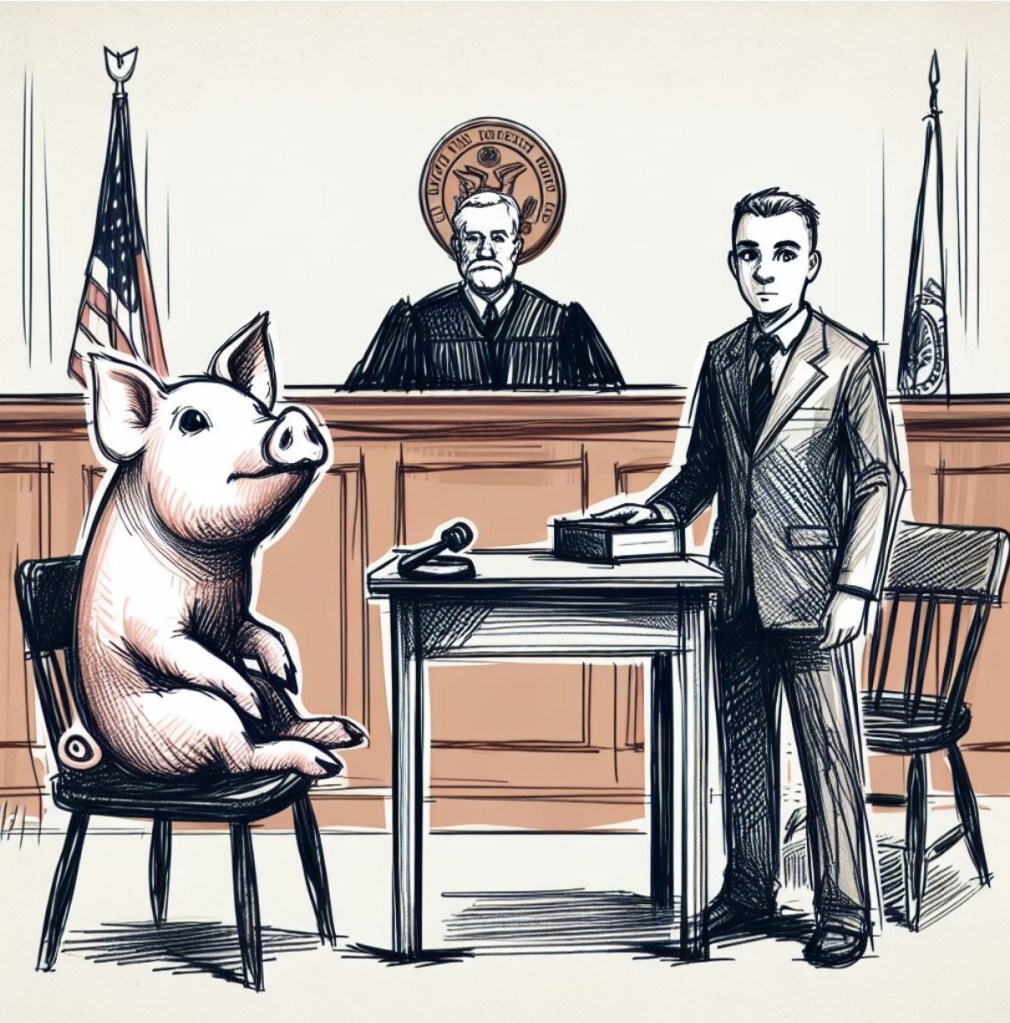
In medieval Europe, it was not uncommon to put animals on trial for various crimes. In France, Italy, Switzerland, and elsewhere, courts tried pigs, dogs, rats, grasshoppers, and snails for crimes against people, property, and God.
Examples include cases brought against vermin who dared to ransack stores of grain and prosecutions for pigs having maimed or killed people.
There’s a whole book about the practice, Chronological List of the Prosecution of Animals from the Ninth to the Twentieth Century, by E.P. Evans. I typed the name of the book in the search bar at Amazon. Apparently it is not available, and the site instead recommended that I purchase a DVD of Ransom, starring Mel Gibson. (?)
No, thank you.
I also say no, thank you to New Jersey Department of Labor and Workforce Development (NJ DLWD), which has proposed new independent contractor classification regulations.
The regulations would re-interpret NJ’s ABC Test in a way that would make it much harder to maintain IC status. The regulations would apply to the NJ Wage Payment Law, the Unemployment Compensation Law, and the Earned Sick Leave Law.
For years New Jersey has used an ABC Test, but with the standard version of part B, unlike California and Massachusetts, which have a strict version of part B.
To satisfy a standard ABC Test, like in NJ, the party engaging the contractor must prove (all three):
The individual has been and will continue to be free from control or direction over the performance of work performed, both under contract of service and in fact; and
The work is either outside the usual course of the business for which such service is performed, or the work is performed outside of all the places of business of the enterprise for which such service is performed; and
The individual is customarily engaged in an independently established trade, occupation, profession or business.
The regulations would largely re-interpret part B to make it more like the strict version, which can be met only if the work is performed “outside the course of the business for which such service is performed.”
The regulation would essentially eviscerate the second option — that the work is performed outside of all the places of business of the enterprise for which such service is performed — and make it nearly impossible to satisfy this alternative.
For example, under the regulations, the retaining party’s “place of business” could include any place where the work is typically performed, even customer’s homes.
The regulations would also make parts A and C harder to meet. In part A, for example, the regulations would declare that control exerted to make sure a contractor follows the law is relevant control that can convert the worker to an employee. But control exerted to ensure compliance with a law is control imposed by the government, which passed the law, not by the company retaining the contractor. This re-imagining of part A would be inconsistent with a multitude of court decisions that have addressed this issue.
I say no, thank you, because the regulation is not consistent with New Jersey law and is not consistent with how other courts around the country have interpreted the ABC factors. The NJ DLWD is supposed to apply the law, not change it. The NJ DLWD is not a legislative body and is not a court.
Nonetheless, it seems like there’s a good chance this will pass.
A 60-day public comment period began with the publication of the proposed rule on May 5. Companies that will be impacted by the rule should consider submitting comments. Page 1 of the proposed regulations explains how.
Misclassification in New Jersey is serious business. The state has been aggressive about pursuing legal action against companies that systemically misclassify workers as ICs. (But so far, no cases against pigs, dogs, rats, grasshoppers or snails. I think.)
I see the bad moon a-rising I see trouble on the way I see earthquakes and lightning I see bad times today
When John Fogerty wrote “Bad Moon Rising,” he was reportedly inspired by the 1941 film The Devil and Daniel Webster. There’s a scene in the film where a hurricane destroys the crops of several farms, but spares those of a man who had made a deal with the devil in exchange for wealth.
When classifying independent contractors, a deal with the devil generally doesn’t work. If you misclassify your workers as contractors, when the law says they should be employees, trouble will eventually be on the way.
A printed media delivery company found that out the hard way, after being investigated by the New Jersey Department of Labor and Workforce Development (DLWD).
There was no civil lawsuit here. A state agency went after the company. Be wary of state agency audits. This one cost the company $2.7 million in a recent settlement.
Overview: The New Jersey Attorney General and the DLWD reached a $2.7 million settlement with Publishers Circulation Fulfillment, Inc. (PCF) for misclassifying delivery workers as independent contractors.
Findings: The investigation revealed that PCF exerted significant control over its delivery workers, who were largely immigrants working overnight for low wages. PCF failed to classify these workers as employees, violating New Jersey labor laws.
Settlement Details: The settlement totals $2.7 million, covering approximately 2,400 workers.
History of the Investigation: The investigation began in 2021, focusing on PCF’s compliance with state employment laws from 2019 to 2022. It was found that PCF made unlawful deductions from workers’ pay and failed to provide essential protections. In a separate 2022 settlement, PCF was required to pay nearly $2.7 million for failing to contribute to the state’s Unemployment Compensation and Disability Benefits Funds between 2015 and 2018.
When considering independent contractor relationships, companies often make the mistake of assuming that if both parties are satisfied with the arrangement, it will be ok. Not so.
State agencies are becoming more and more aggressive in enforcing misclassification on their own. States lose money from misclassification because employers contribute funds to state unemployment and workers’ compensation funds for employees, but not for contractors.
So make sure your workers are properly classified, and heed this warning from John Fogerty and the band:
Hope you got your things together Hope you are quite prepared to die Looks like we’re in for nasty weather One eye is taken for an eye.
The band America (“A Horse with No Name,” “Ventura Highway”) was formed in England. Yes, really. But by three Americans whose fathers were in the U.S. Air Force and stationed overseas.
That got me thinking about other bands with place names. When I was growing up in Miami in the 1980s, if someone mentioned Boston, I thought of just another band out of Boston, on the road to make ends meet. If someone mentioned Kansas, I thought of dust in the wind, even though I never particularly liked that song. Chicago made me think of the Cubs, but only in 1984. Otherwise, does anybody really know what time it is?
Not that I am older and have a life, place names mean something different to me. They now make me think of federal, state, and local laws affecting independent contractor status.
(Ok, I take back the comment about having a life. I realize this is a sad and pathetic way to think of place names.)
After the election, place names are going to take on greater importance as businesses aim to protect their independent contractor relationships. Federal enforcement activity isn’t going away, but I expect to see a growing emphasis on legislation and enforcement at the state and local level.
In the realm of non-employee workers (independent contractors, staffing agency temps), I expect to more state and local legislation in these areas:
1) Freelancer Laws. We now have freelancer laws in CA, NY, IL, Los Angeles, NYC, Minneapolis, Seattle, and Columbus. These laws impose requirements when retaining individuals who are independent contractors. The laws generally require written contracts that contain several mandatory components.
2) Temporary Worker Laws. We have these in NJ and IL. They generally require that staffing agencies pay their workers an equivalent wage rate (and sometimes the value of benefits) being paid to workers they work alongside at the company where they are providing services.
3) Misclassification Laws – the Bad Kind. In states with Democrat trifectas (house, senate, governor), expect new laws that make it harder to be an independent contractor. Expect more ABC Tests, like in CA and MA. Other states have ABC Tests for determining who is an employee under workers’ comp and unemployment law.
4) Misclassification Laws – the Good Kind. In states with Republican trifectas, expect more safe harbor laws. If you satisfy a set of basic requirements in your dealings with a non-employee worker, then the worker is an independent contractor under that state’s laws. Pesky balancing tests (and long-haired freaky people) need not apply. We have these state laws in WV and LA (not L.A.)
We will likely see changes at the federal level too, but these may take years to develop. The federal agency rulemaking process is slow and cumbersome, and agency rules will take on less importance as federal agency power continues to diminish after the Supreme Court’s Loper Bright decision.
I haven’t touched on Europe or Asia, but those are bands for another day and another post. When? At some point, in the heat of the moment, but only time will tell.
Teacher, don’t you fill me up with your rules (fn1)
Brownsville Station was a rock band formed in Ann Arbor in 1969. (Go Blue!) Their biggest hit, Smokin’ in the Boys Room, reached #3 on the Billboard charts and was later covered by Motley Crue. The song was Motley Crue’s first Top 40 hit. Apparently LeeAnn Rimes covered the song too in an album called Nashville Outlaws: A Tribute to Motley Crue, which is I guess was her tribute to a tribute to Brownsville Station.
Business groups in New Jersey and Illinois have also been pleading don’t you fill me up with your rules – in particular, rules related to the use of temp workers.
As discussed here and here, these two states passed temporarily worker laws that required temps to be paid wages and benefits equivalent to the regular workers they are supplementing.
Those rules are both in effect, but there are still several moving parts you should know about.
In Illinois, a judge struck down the portion of the law that required payment of equivalent benefits, ruling that this portion of the law was preempted by ERISA. Illinois lawmakers are now considering options to amend the law to require the payment of the value of benefits, if not the benefits themselves.
In New Jersey, the law took effect, but there’s an active lawsuit in which staffing and other business groups have challenged the law. The case is pending. New Jersey Staffing Alliance et al. v. Fais et al., No. 1:23-cv-02494, D. N.J.
For now, these two temporary work laws remain in effect, except for the benefits aspect of the Illinois law. But the situation remains fluid. It also would not be surprising if other states enacted similar laws. Companies using temp labor should continue to monitor these developments.
fn1 – Everybody knows that smokin’ ain’t allowed in school.
This is a venomous Eastern Brown Snake, native to Australia. Stay away.
Tennis star Dominic Thiem knew what to watch for in his match this past weekend in Brisbane. It was on-court hazard he couldn’t ignore.
Play was interrupted when a “really poisonous snake” slithered onto the court near the ballkids. The intruder, an Eastern Brown Snake, “has the unfortunate distinction of causing more deaths by snake bite than any other species of snake in Australia.” The snake’s venom causes “progressive paralysis and uncontrollable bleeding,” which is not one of the on-court hazards typically of ballkidding.
(I don’t know if ballkidding is the real word for this, but it should be. Or ballkiddery maybe. I also learned from the snake bite article that the proper term for being bit by a venomous snake is “envenomation,” which is a word I hope to use elsewhere in a sentence sometime in 2024. So there’s a New Year’s resolution. [@Lisa, take note, I made one, even though you {correctly} say I am no fun because I won’t play the New Year’s Resolution game.])
The Eastern Brown Snake is not present in the U.S., so we don’t have to watch for any in 2024.
But here are several other things that could bite you in the behind in 2024 if you’re not paying attention:
1. New DOL test for independent contractor misclassification. The DOL issued its proposed new rule in October 2022 and targeted the fall of 2023 for release of a new final rule. The proposed rule would identify seven factors to consider when evaluating whether someone is an employee under the Fair Labor Standards Act (FLSA). The final rule will likely be very similar. We’re still waiting, and the final rule could be released at any time.
2. The new NLRB test for joint employment takes effect Feb. 26, 2024. Unless it doesn’t. The new rule is being challenged in both a federal district court in Texas and the U.S. Court of Appeals in D.C. Either court could quash the rule. The new rule will substantially expand who is a joint employer under the NLRA, even for worksites without unions.
3. Increased state and local enforcement activity. States and localities are filing their own lawsuits alleging worker misclassification. The New Jersey Attorney General recently filed a major lawsuit. The California Attorney General and California localities have been pursuing misclassification lawsuits too. Remember this: As much as I advocate for individual arbitration agreements with class waivers, they have no effect on enforcement actions brought by a state or local government. These lawsuits pose a substantial risk, and the governments love to issue one-sided accusatory press releases when they file the lawsuits.
4. The feds are doing this too. The DOL is bringing its own enforcement actions and publicizing them.
5. State and local laws that affect independent contractor classification and joint employment. We’re seeing legislative activity in three main areas:
(a) laws to change the tests; (b) laws that provide a safe harbor for independent contractor classification if certain protections are provided to the workers (Cal. Prop 22, this proposed Mass. state law); and (c) Freelancers laws that impose various requirements when retaining a solo independent contractor (currently: NY, IL, Los Angeles, Minneapolis, Seattle, NYC, Columbus).
6. State laws that criminalize worker misclassification. Take a look at recent legislation passed in NY State and Rhode Island.
7. State laws governing the use of temporary workers. Look for more states to enact laws like the Illinois Day and Temporary Worker Services Act (amended in Aug. 2023) and the New Jersey Temporary Workers’ Bill of Rights (enacted in Aug, 2023). These laws force companies that use staffing agencies to disclose the wages and benefits being paid to direct employees.
8. California’s AB 5 is still being challenged. This is the law that codified the ABC Test for most independent contractor relationships. But it also included a grab bag of miscellaneous and arbitrary exceptions. A full en banc Ninth Circuit has agreed to rehear Olson v. State of California, which challenges the constitutionality of AB 5.
Wishing you a happy, healthy, and litigation-free 2024.
Today we offer some fun facts about New Jersey. Raise your hand if you knew these things, but only if you are working from home because otherwise it would be weird:
The Lambert Castle Museum in Paterson has a spoon exhibit with over 5,400 spoons from every state and almost every country in the world.
The Passaic River in Paterson was the site of the first submarine ride in 1878 by its inventor John P. Holland.
New Jersey’s capital city, Trenton, was once the capital of the United States – but only for about eight weeks in 1784.
A less fun fact about New Jersey is that this past weekend, the NJ Temporary Workers’ Bill of Rights went into effect. It is a well-intentioned law that will have loads of unintended consequences. Rather than helping temp workers, the law’s requirements seem more likely to cause companies to stop using temp workers entirely.
The law’s requirements have been discussed elsewhere, and you can check out the BakerHostetler blog, The Bargaining Table, for a more complete discussion. But I want to focus on one aspect of the law that I think is particularly dumb and poorly drafted.
Section 7(b) requires that temp workers “shall not be paid less than the average rate of pay and average cost of benefits, or the cash equivalent thereof, of employees of the third party client performing the same or substantially similar work on jobs the performance of which requires equal skill, effort, and responsibility, and which are performed under similar working conditions for the third party client at the time the temporary laborer is assigned to work at the third party client. Each violation of this subsection for each affected temporary laborer shall constitute a separate violation….”
Take a minute to digest that. It requires that temps are paid at least as much as similarly situated regular employees, but not just in wages. You also have to add in the cost of benefits. The cash value of benefits is often around a third of total compensation.
Suppose you have full time maintenance employees who average $20/hour plus benefits. If the cash value of benefits are one-third of the worker’s compensation package, then the temp worker “shall not be paid less than” $26.67/hour. And that’s before the staffing agency takes its markup of, maybe, 35%. You’d have to pay $36/hour for a temp maintenance worker, and the temp worker’s take home pay will be 33% higher (because of the cash value of benefits) than your comparable maintenance employee.
What if the temp agency provides benefits? Unclear. Poorly drafted. The law sets the temp worker’s minimum wage based on the cash value of the benefits the similarly situated employees receive. Maybe if the temp worker gets benefits, then the temp’s hourly wage floor would be $20, not $26.67, but that’s not clear.
Not only does the law greatly increase the cost of using temp labor, it also requires the company using the staffing agency’s services to disclose to the staffing agency the average wages and cost of benefits it provides to its similarly situated employees. If your company didn’t disclose this information, the staffing agency wouldn’t be able to comply with the pay floor requirement.
A failure to comply results in joint liability. So now you need to make sure the staffing agency pays its temps a particular wage, calculated based on the wages your company pays its employees. In your staffing agency agreement, you’ll need to require the agency to pay a particular wage to ensure compliance.
Here’s where things get tricky. An indemnity provision might not be sufficient to shift liability because the law says both parties are liable. So you need a breach of contract claim to rely on instead.
To build a potential breach of contract claim, the company will want to contractually require the agency to pay the workers a wage that is not less than the average cost of the company’s wages and cost of benefits. But directing and controlling wages is a strong indicator of joint employment under other laws. The act of complying with the NJ law could turn companies into joint employers. The wording in any staffing agreement, therefore, needs to thread the needle.
The text in a staffing agency agreement (or amendment) will need to be carefully drafted so that the company is requiring only that the agency comply with NJ law with respect to wages and benefits and is not directing or controlling the wages and benefits that the agency pays its temps.
Something like this might work: “If required under N.J.S.A. [insert citation], but only to the extent required by such statute, Agency shall pay the temporary workers at a rate not less than the average rate of pay and average cost of benefits, or the cash equivalent thereof, of employees of the company performing the same or substantially similar work on jobs the performance of which requires equal skill, effort, and responsibility, and which are performed under similar working conditions for the company at the time the temporary laborer is assigned to work at the company.”
I don’t like telling the agency what it must pay its workers, but you’ll want a breach of contract claim available to you if the agency fails to comply and your company is jointly liable under the NJ law. An amendment to your staffing agency agreement is appropriate, but it needs to be carefully drafted.
And here’s another possible unintended consequence. How will your maintenance employees like being paid less than the maintenance temps? Maybe we need a union in here to get us a fair wage! I could see things going in that direction. If a temp can take home $26.67/hour, we want $26.67/hour too, not $20!
The NJ law does not apply to all temps. It applies to temps in these “occupational categories as designated by the Bureau of Labor Statistics of the United States Department of Labor:
33-90000 Other Protective Service Workers;
35-0000 Food Preparation and Serving Related Occupations;
37-35 0000 Building and Grounds Cleaning and Maintenance Occupations;
39-0000 Personal Care and Service Occupations;
47-37 2060 Construction Laborers;
47-30000 Helpers, Construction Trades;
49-0000 Installation, Maintenance, and Repair Occupations;
51-0000 Production Occupations;
53-0000 Transportation and Material Moving Occupations; or
any successor categories as the Bureau of Labor Statistics may designate.”
If all of this makes you want to take a long walk and get away, then fun fact: New Jersey has more than 4,000 miles of trails!
The albumOld New Borrowed and Blue was released in 1974 by the British rock band Slade. It reached No. 1 on the UK albums chart. Slade recorded the album shortly after a near-fatal car crash involving drummer Don Powell, who played drums on the album despite walking with a cane and needing to be lifted onto his drum stool.
For whatever reason, Slade doesn’t get much air play on classic rock stations in the US. I remember the songs “Run Runaway” and “My Oh My,” both released in 1984, but I don’t remember hearing much more from Slade.
Getting back to Old New Borrowed and Blue, the “Borrowed” portion of the title refers to the fact that at least one song, “Just Want a Little Bit,” was a cover. It wasn’t Slade’s song, until it was. They borrowed it and made it their own.
Can the same thing happen in employment settings? Yes, it can.
We often consider the concept of joint employment, but did you know there’s also a doctrine called the “borrowed employee” doctrine?
What is a “borrowed employee,” and why does it matter?
The concept of “borrowed employee” arises in negligence cases involving vicarious liability. The “borrowed employee” doctrine is a defense that can be asserted if an injured employee at one company alleges that an employee of another company negligently caused the injury. If your employees ever provide services for another company, pay attention.
Philip Pantano, a mechanic employed by Container Services of New Jersey (CSNJ) had his foot crushed and amputated following a workplace accident. Pantano alleged that an employee of a different company, Marine Transport (MT), was negligent and caused the injury. Pantano claimed that MT was vicariously liable for that employee’s negligence and should have to pay for the damages. A jury agreed and awarded Pantano $861,000, on top of his workers’ compensation recovery.
The issue that went before the New Jersey Supreme Court centered around whether MT could be held vicariously liable for its employee’s negligence. The answer would depend on whether the MT employee who caused the accident was deemed a “borrowed employee” of CSNJ when the accident occurred. If MT could prove that the MT employee who caused the injury was a borrowed employee of CSNJ at the time of the accident, then MT is not vicariously liable, even though the worker was being paid by MT and was MT’s W2 employee.
The borrowed employee doctrine is a creation of state law. In New Jersey, there’s a two-part multi-factor test to determine whether someone is a “borrowed employee” for purposes of vicarious liability.
The first part of the test looks at control, which can be demonstrated through “direct evidence of on-spot control” or broad control based on method of payment, furnishing equipment, or having the right of termination. If the primary employer has control over the worker, then we go to part two of the test.
The second part of the test is the “business furtherance” prong. If the worker was furthering the primary employer’s business when committing the negligent act, then the primary employer is vicariously liable. “Business furtherance” is established under NJ law if (1) the work being done is within “the general contemplation” of the primary employer’s business, and (2) the primary employer derives economic benefit by loaning its employee.
Applying the test, a jury is supposed to determine whether the employee was acting on behalf of the primary employer, or was acting as a borrowed employee of the secondary employer, or if both are responsible.
Tip: It is in a primary employer’s interest to show that its loaned employee was acting as a “borrowed employee” of the other company at the time of the accident, if the injured employee was also employed by that other company.
Here’s why. If the employee who caused the accident was acting as a “borrowed employee” of the company that employed the injured worker, then the injured worker’s remedy is limited to workers’ compensation law. But if the accident was caused by the negligence of another company’s employee (and the worker is nit a “borrowed employee”), then the injured worker can bring a negligence claim against that other company.
If all of this is making your head hurt, remember a few things here:
1) When you lend an employee, make sure there’s worker’s compensation coverage all around.
2) When you lend an employee, make sure you have a well drafted agreement between the two companies. Allocation of risk should be addressed in advance.
Borrowing employees is commonplace. If you plan in advance, the arrangement can work well for both companies, and there’s no need to Run Runaway.
What Companies Using Temps In New Jersey Need to Know
According to the National Constitution Center, there were 14 original copies of the Bill of Rights, with one sent to each of the 13 states and another kept by the federal government. The Center also reports, however, that four of the states — Georgia, Maryland, New York, and Pennsylvania — lost their copies. North Carolina’s was stolen by a Union soldier during the Civil War but recovered in 2002 through an FBI sting. (“Hey buddy, I’m lookin’ to buy a Bill of Rights. Ya know anyone?”)
New Jersey kept its copy, but also just added some new stuff. Sort of.
This month, New Jersey passed the Temporary Workers Bill of Rights. It’s less sweeping than the original 1791 Bill of Rights, but it co-opts the important sounding name to get everyone’s attention and to show constituents that the lawmakers are doing really important things that warrant re-election, financial support, the undying love of chatbots, etc.
The Temporary Workers’ Bill of Rights imposes new burdens on staffing agencies and the companies using temp workers. This post will focus on the obligations imposed by the companies using the temp workers.
Does the Bill apply to your industry?
The Bill applies to temp workers assigned by a temp staffing firm to work in any of the following industries, using Bureau of Labor Statistics (BLS) designations:
33-90000 Other Protective Service Workers
35-0000 Food Preparation and Serving Related Occupations
37-0000 Building and Grounds Cleaning and Maintenance Occupations
39-0000 Personal Care and Service Occupations
47-2060 Construction Laborers
47-30000 Helpers, Construction Trades
49-0000 Installation, Maintenance, and Repair Occupations
51-0000 Production Occupations
53-0000 Transportation and Material Moving Occupations
If you’re not in one of these industries, stop reading and get on with your day.
What obligations does the Bill impose on the users of temp labor?
1. Equal Pay. This sounds fair but may be problematic in practice. Temp workers must be paid “not less than the average rate of pay and average cost of benefits, or the cash equivalent thereof” of the user’s similarly situated employees.
I see two immediate problems here.
First, one of the benefits of using a staffing agency is the ability to pay the temps less until they prove themselves and earn an offer of direct hire. No longer. Now you’ll have to pay the same amount as you pay your regular workers, plus the markup.
Second, how is the staffing agency going to know the wages paid to your similarly situated regular workers and the value of the benefits package you provide them? Presumably you’ll have to tell the staffing agency.
But the staffing agency is not your confidant or fiduciary. It has multiple clients, probably including your competitors. Do you really want the staffing agency to know what your cost of insurance is, or what you pay your regular workers, or the full suite of benefits you offer? The staffing agency will have to adjust what it charges you — and your competitors — based on what each of its clients pay their similarly situated worker. That sounds like a pretty useful set of data for anyone wanting to know what competitors are doing.
You can (and should) designate this information as confidential when disclosing it to a staffing agency, and you should make sure your staffing agency agreement includes an obligation to protect confidential information. But is the information really that safe from prying eyes? If a competitor or temp worker is involved in litigation, couldn’t this information be subject to subpoena? Once you reveal this information, you lose a good bit of control over it.
2. Freedom to direct hire. Under the new law, temp workers must be free to accept offers of direct hire. Staffing agencies cannot restrict the workers’ ability to accept offers of direct hire. The agency can impose a “placement fee” on its client (you), but the amount is limited by statute.
The amount of the placement fee cannot exceed “the equivalent of the total daily commission rate the temporary help service firm would have received over a 60-day period, reduced by the equivalent of the daily commission rate the temporary help service firm would have received for each day the temporary laborer has performed work for the temporary help service firm in the preceding 12 months.”
For purposes of contracting, any provisions prohibiting direct hire for limited periods of time need to be removed. Instead, staffing contracts (in NJ, for these job classifications) should permit direct hire but may charge a permitted placement fee.
3. Reimbursement of tax obligations. The user of services is required to reimburse the temp agency for wages and “related payroll taxes.” Presumably this is already basked into the markup, but now it’s required.
4. Joint and several liability. The law imposes joint liability for any violations of the equal pay or direct hire provisions. Consider what that means for equal pay. You might have to disclose to the temp agency what you pay your similarly situated employees, but you don’t control the temp agency’s payroll practices. If they mess up and pay the temp worker less than the law requires, the law says you’ll be jointly liable.
Who said anything about fair?
Be sure your staffing agency agreement includes robust indemnity provisions. The agreement should also create a contractual obligation for the temp agency to pay workers all amounts they are due under the law so that, if the agency fails to do so, you can point to a breach of contract when seeking indemnity. Indemnity claims based purely on the law could be subject to challenge since the law also says there is joint liability.
Conclusions
This Temporary Workers’ Bill of Rights applies only to certain industries in New Jersey but, for users of temps in these industries, the law creates important new obligations.
For violations, the law allows for a private right of action and carries a six-year statute of limitations.
If you use temp labor in New Jersey in one of the covered industries, be sure you understand the new requirements. This would be a good time to go back and revisit your staffing agency agreements. They may need some tidying up.
Also consider requiring temp workers to sign individual arbitration agreements as a condition of being placed at your worksite. This strategy can help insulate you from a class action filed against both the temp agency and your company. Class actions against both entities are a particular concern, given the joint liability section of the new law.
In Russia, a new variant on boxing involves chaining the two combatants to opposite sides of a podium, with one arm of each boxer immobilized. They then pound each other with the remaining good arm and, because they’re tied to the podium, they have nowhere to go.
The contests, called armboxing, last for three one minute rounds. If the fighters last two rounds, their arms are both freed up for round three, but the boxers remain chained to the podium.
Getting pummeled with nowhere to go is also a fair way to describe Uber’s most recent run-in with the New Jersey Department of Labor over unpaid unemployment contributions. The NJDOL claims that under the Strict ABC Test governing New Jersey unemployment law, rideshare drivers are employees, not independent contractors.
The NJDOL pursued Uber and a subsidiary for failing to pay into the state’s unemployment fund over a five-year period, 2014-2018.
Last week, the NJDOL announced a settlement with Uber to cover the unpaid assessments – for a cool $100 million. The amount was based on $78 million in unpaid contributions plus $22 million in interest. Uber has made the payment but did not concede there was any misclassification.
New Jersey uses a strict ABC Test to determine employee status for unemployment coverage, but uses a different version of the ABC Test for wage and hour law. The strict ABC Test used for unemployment law follows the same formula as the tests in Massachusetts and California. The danger in these tests, of course, lies in prong B, which requires that to be an independent contractor, the work being performed must be “outside the usual course” of the hiring party’s business.
State departments of labor are notoriously aggressive in pursuing misclassification, and courts often defer to their judgment, even if the facts could support independent contractor status. The NJDOL is among the most aggressive enforcers, as you might expect when its Labor Commissioner says this: “Let’s be clear: there is no reason temporary, or on-demand workers who work flexible hours, or even minutes at a time can’t be treated like other employees in New Jersey or any other state.”
For businesses using independent contractors, tools such as arbitration agreements with class action waivers can be effective in preventing class action litigation. But arbitration agreements can’t stop a state agency from conducting an audit and imposing its own penalties for noncompliance.
And that’s how Uber found itself tied to a podium with one arm immobilized as it got hit.
Businesses in states using strict ABC Tests need to be particularly careful when setting up their business plans, their contracts, and their external messaging. State audits can be random, or they can be initiated after a worker complaint.
Unemployment filings by independent contractors can be especially dangerous. State departments of labor will typically investigate those claims, assess whether the worker is misclassified and — most troubling of all — will find that if the one worker was misclassified, then all similarly situated workers were also misclassified. The state DOL may then issue back assessments based on its assumptions about how many workers are similarly situated and how many were therefore misclassified.
When an independent contractor files an unemployment claim, pay attention and be prepared to defend your classification decision. Merely denying that the worker was an employee may not be enough, and a full-fledged audit could follow. In a full-fledged audit, the stakes can be high, and it might not feel like a fair fight.
Be proactive, plan ahead, and don’t chain your business to a podium.






 Who Is My Employee?