
 Life is full of serious questions. For example, Should I stay or should I go? (The Clash, 1982). Or, Will you love me forever? (practically every song ever, but for now, we’ll go with Meatloaf in Paradise by the Dashboard Lights, 1977).
When engaging non-employee workers, businesses must also confront a serious question: Embrace joint employment, or try to avoid it? (Frank Zappa confronted a different kind of serious question in Why Does It Hurt When I Pee?, 1979, but that’s beyond the scope of this blog.)
Many of my posts have been geared toward strategies for trying to avoid joint employment. There is another way, though. Sometimes, it may be better to embrace joint employment. But know the pros and cons.
Here are some things to consider: Continue reading
 Companies in distress sometimes retain management consultants to try to turn them around. Sometimes the plan works, sometimes not. When the turnaround effort fails and the company shuts down, can the management company be held liable as a joint employer?
 A federal Court of Appeals has
  On Monday,
  Congress may finally provide some clarity in determining who is a joint employer. In legislation introduced last week, the House proposed a bill that would rewrite the definition of “joint employer” under federal labor law (National Labor Relations Act) and federal wage and hour law (Fair Labor Standards Act).
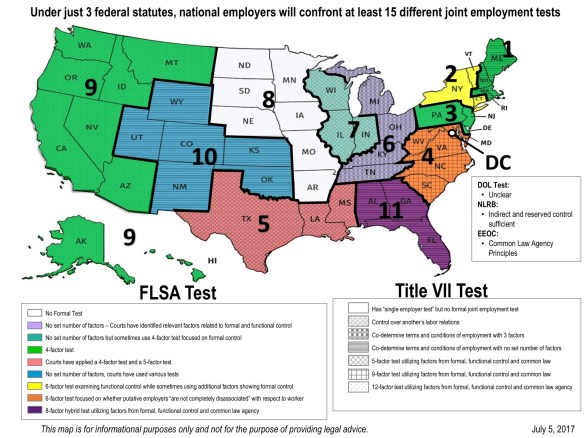 The tests for determining whether a business is a joint employer vary, depending on which law applies. That means there are different tests under federal labor law, wage and hour law, and employee benefits law, to name a few. There are also different tests under different states’ laws.

 In the Lynyrd Skynyrd song, “Gimme Three Steps,” we find our hero cutting a rug down at a place called The Jug with a girl named Linda Lou. This catchy song has nothing to do with labor law but does deal with someone who finds himself in a bad situation (shakin’ like a leaf on a tree!) and needs three steps to get out the back door.
 The Family and Medical Leave Act (FMLA) is already one of the hardest employment laws to comply with. Add joint employment into the mix, and the level of difficulty further increases.
