

Appeals Court Slams NLRB Joint Employer Finding in Landmark CNN Case, But Ruling May Prove Hollow

NLRB CNN joint employment Browning-Ferris overrule Second Circuit Court of Appeals IMG_1094A federal Court of Appeals has ruled that the NLRB cannot abruptly change its definition of joint employment without sufficient explanation. This decision (the CNN case) rebukes the NLRB for its initial attempt, in 2014, to expand the definition of joint employment.

This decision does not, however, address the Browning-Ferris case that followed in 2015, in which the Board similarly expanded the definition of joint employment but, that time, with an expansive explanation and justification for doing so. Browning-Ferris in on appeal too.

Here’s what happened.

Back in the good old days, when TV was pure and the world had not yet been exposed to Janet Jackson’s halftime nipple, CNN used to contract with an outside company who Continue reading

Joint Employment Legislation Needs to Be Expansive — If It’s to Be Effective

IMG_1093On Monday, we wrote about the Save Local Business Act — proposed legislation that, if passed, would create a new definition for joint employment under the NLRA and FLSA. But would that law go far enough?

No. Not at all.

On the bright side for businesses, the law would provide some predictability in that staffing agency workers would most likely be excluded from bargaining units. It would also remedy the current unfairness that results when a staffing agency makes payroll and overtime miscalculations but the company using the workers is held responsible as a joint employer.

But much more needs to be done to provide real clarity and predictability for business owners.

First, the law fails to address who is a joint employer under other federal employment Continue reading

Congress May Rewrite “Joint Employment” Definition

IMG_1092Congress may finally provide some clarity in determining who is a joint employer. In legislation introduced last week, the House proposed a bill that would rewrite the definition of “joint employer” under federal labor law (National Labor Relations Act) and federal wage and hour law (Fair Labor Standards Act).
The Save Local Business Act — despite lacking a fun-to-say acronym — would create a new standard for determining who is a joint employer under these two laws. The proposed new standard would allow a finding of joint employment “only if such person [business] directly, actually, and immediately, and not in a routine and limited manner, exercises significant control over the essential terms and conditions of employment….”

The definition provides examples of what are “essential terms and conditions,” including: Continue reading

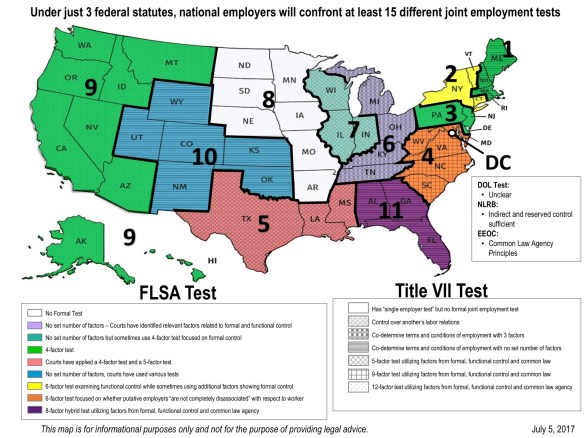
Map Shows Joint Employment Tests Are a Mess!

IMG_8284The tests for determining whether a business is a joint employer vary, depending on which law applies. That means there are different tests under federal labor law, wage and hour law, and employee benefits law, to name a few. There are also different tests under different states’ laws.



Further complicating the analysis, there are even different tests when applying the same law — depending on where you live.

Yes, you read that right. Even though the Fair Labor Standards Act (FLSA) is a federal wage and hour law that applies across the country, federal courts in different states use different methods for determining whether a business is a joint employer under that single law.

Continue reading

NLRB Nominees Hate Puppies & Rainbows, Dems Claim

dog nlrb independent contractor -1674115_1920

Image credit:   Well Pet Coach

Ok, not really, but it seemed that way.

Last week, NLRB nominees William Emanuel and Marvin Kaplan were alternatively tossed softballs and stink bombs in “questions” from Senators on the Health Education Labor and Pensions Committee (known in Congressional circles as the HELP Me Rhonda, HELP HELP Me Rhonda Committee).

I use the word “questions” in quotes because, as both Americans who have ever watched C-SPAN would know, these events are typically staged to allow Senators who have already made up their minds to hear themselves talk, rather than ask questions. Here’s an example:

Question by Sen. Elizabeth Warren:  “Your entire career has been to discourage union Continue reading

Two Key Developments in Joint Employment are Expected This Week

IMG_1091.JPG

This could be a busy week for developments in the joint employment area.

1) Congressional Republicans have begun drafting legislation that could change the definition of joint employment, Bloomberg BNA reports. Presumably the goals of a new bill would be (a) to add clarity to the standards for deciding who is a joint employer, and (b) to make it more difficult for workers or unions to claim they are jointly employed.

Continue reading

New NLRB Nominations May Lead to New Joint Employment Test (or to my misuse of Lynyrd Skynyrd song lyrics)

IMG_1088In the Lynyrd Skynyrd song, “Gimme Three Steps,” we find our hero cutting a rug down at a place called The Jug with a girl named Linda Lou. This catchy song has nothing to do with labor law but does deal with someone who finds himself in a bad situation (shakin’ like a leaf on a tree!) and needs three steps to get out the back door.

Same thing here (in a sense). [C’mon, work with me here, I’m trying to make NLRB appointments interesting!]. When not posting tweets of himself pummeling a photoshopped CNN logo outside a WWE ring, President Trump found the time to make two important nominations to fill vacancies on the National Labor Relations Board (NLRB), giving companies two of the three steps needed to undo a long list of anti-business decisions from the past eight years.

The two new appointmnents, once confirmed, will shift the Board back to a 3-2 Republican majority, which should spell relief for businesses in several areas — including joint employment. (Two appointments = two steps. There’s a third step coming.  Wait for it….)

Continue reading

Avoid These FMLA Traps with Joint Employment

nurse - FMLA leave and joint employment-359321_1920The Family and Medical Leave Act (FMLA) is already one of the hardest employment laws to comply with. Add joint employment into the mix, and the level of difficulty further increases.

Here are some pointers for handling FMLA issues when joint employment is likely to exist:

Issue 1: Is there Joint Employment?

To determine whether two companies are joint employers under the FMLA, the Economic Realities Test is used. This is the same test used under the Fair Labor Standards Act (FLSA). (See this post for a recent development that threatens to expand the definition of joint employment under the FLSA.)

The DOL has advised that in most staffing agency relationships, there is joint employment.

Issue 2: How Does Joint Employment Affect An Employee’s FMLA Eligibility?

Continue reading

The DOL Wants You to Know Its Opinions (Here’s Why That’s Good News!)

IMG_1087

Everybody has an opinion, so why not share?

This week, Labor Secretary Alex Acosta announced that the WHD will resume its prior practice of issuing opinion letters to advise on difficult wage and hour issues. This is good news for companies and employees because it increases predictability.

An opinion letter is an official, written opinion by the WHD of how a particular law applies to a specific set of circumstances presented by an employer or employee. The benefit to the general public is that opinion letters are published and may be relied upon.

Continue reading

When an Employee Double-Dips On a Paycheck, Who Pays?

Remember this?

Suppose the chip is a check, and the employee tries to cash it twice? Who would you rather be, Costanza or Timmy?

Staffing agency clients are increasingly pointing to a fraud committed by disloyal short-term employees. They cash a paycheck on their mobile app, then deposit the paper check a second time for duplicate payment. The check clears twice. Who must pay?

While this problem can arise in many scenarios, including with regular W-2 employees, it seems to be occurring more frequently with staffing agency employees, PEOs, temps, and other short-term workers. So let’s take a look.

Continue reading