That’ll Cost You 96 Camels: Court Headlocks Staffing Agency with $7.2M Misclassification Judgment

Mom feeding a non-wrestling camel, May 2010

If you weren’t in Turkey last month, you missed the annual Selçuk Efes Camel Wrestling Festival, which featured 162 competitors in four categories.

The camels are paired by weight and skill, and their techniques include tripping their opponents with foot tricks or applying headlocks then sitting on their opponents. Some just push until the other camel gives up. A winner is declared when one camel scares away the other, making him scream or collapse. The camels are muzzled so there is no biting.

Among those missing the spectacle were the owners of Steadfast Medical Staffing, a Virginia-based firm that maintains a database of nurses and pairs them with healthcare facilities. That’s because they were in federal court, defending against a lawsuit by the Department of Labor. The DOL alleged that they had misclassified the nurses as independent contractors in violation of the Fair Labor Standards Act (FLSA).

After a bench trial, the judge agreed with the DOL and ruled that the nurses — which included CNAs, LPNs and RNs — were employees of the staffing agency. The Court applied the Economic Realities Test, which is the proper test for determining who is an employee under the FLSA.

The Court considered all relevant factors, then applied camel-style headlocks while sitting on the defendant, causing the staffing agency to either scream or collapse (unclear from the opinion). The Court ruled that the staffing agency failed to pay overtime and failed to comply with FLSA record keeping requirements. The agency will be liable for approximately $3.6M in back wages plus another $3.6M in liquidated damages.

Following the judgment, the DOL issued a statement with quotes from the Secretary of Labor, Marty Walsh, and the Solicitor of Labor, Seema Nanda, that the DOL was sending an “unequivocal message” to Steadfast and other staffing companies that the DOL is serious about pursing independent contractor misclassification.

Staffing agencies that treat workers as independent contractors are on notice that the DOL is serious about enforcement. Remember, the facts of the relationship determine whether a worker is an employee or an independent contractor, not how the parties choose to characterize the relationship.

More than 1,100 nurses will share in the award, with a healthy-but-to-be-determined amount of fees headed to the plaintiffs’ lawyers.

A prized wrestling camel can be sold for more than a million Turkish lira. That’s about $75,000. Large awards like this for systemic misclassification are not surprising. This one will cost the staffing firm about 96 wrestling camels.

Enter your email address to subscribe to this blog and receive notifications of new posts by email.

© 2022 Todd Lebowitz, posted on WhoIsMyEmployee.com, Exploring Issues of Independent Contractor Misclassification and Joint Employment. All rights reserved.

2018_Web100Badge
 

>

More Than One Iota: Supreme Court Agrees to Decide Scope of Arbitration Law; Outcome Will Affect Independent Contractor Agreements

Last week I read that Sirhan Sirhan had been denied parole again. No surprise there. But what captured my attention was his attorney’s comment that there was not “one iota” of evidence he would be a threat to society if released.

Not even one iota? Why are there never any iotas? And what is the plural of iota anyway? And how do you even respond to that? Well, actually, we had a few iotas. Let me check my notes here. Yes, three iotas.

“Iota” means an infinitesimal amount. Synonyms include bupkus and diddly-squat. But if you search for “iota” online, no one ever has any iotas. The word is always used in the negative.

Well here are a few iotas for you. The Supreme Court has agreed to hear two cases that will affect when arbitration agreements with independent contractors can be enforced. The Supreme Court generally gets involved when there are at least a few iotas of good arguments on both sides.

Both cases address the scope of the Federal Arbitration Act (FAA), which creates a presumption that arbitration agreements should be enforced, but includes a few iotas of carveouts.

In the first case, Viking River Cruises v. Moriana, the Supreme Court will determine whether cases brought under California’s Private Attorneys General Act (PAGA) are subject to arbitration. California courts have said they are not.

In the second case, Southwest Airlines Co. v. Saxon, the Court will address the scope of the Section 1 exemption, which makes the FAA inapplicable to certain types of transportation workers in interstate commerce. The Saxon decision is likely to clear up the mass confusion (and circuit split) over whether last mile delivery drivers and local rideshare fall within the exemption.

In the political arena, arbitration agreements have come under fire, and there is a movement among Democrats to abolish mandatory pre-dispute arbitration agreements. The Supreme Court, on the other hand, appears more likely to enforce the contracts as written, deferring to the contractual intent of the parties and interpreting any exemptions to the FAA narrowly.

There is more than one iota of evidence to support both sides of these disputes. But expect some 6-3s.

If I am pulling out my crystal ball, I expect the Supreme Court will uphold the arbitration agreements, at least in Saxon. Moriana is tougher to predict since PAGA is a state law creation in which the individual bringing the claim acts as a private attorney general, bringing the claim on behalf of the state. On one hand, the state never agreed to arbitrate. But on the other hand, the individual bringing the PAGA claim did agree to arbitrate any disputes, not to bring them in court under the guise of PAGA.

Whenever the Court rules, we’ll see arbitration agreements back in the news. More visibility on this issue will mean louder and more urgent calls from politicians to abolish pre-dispute arbitration agreements.

We can expect many iotas of news on arbitration agreements later in 2022.

Enter your email address to subscribe to this blog and receive notifications of new posts by email.

© 2022 Todd Lebowitz, posted on WhoIsMyEmployee.com, Exploring Issues of Independent Contractor Misclassification and Joint Employment. All rights reserved.

2018_Web100Badge
 

Low-Hanging Fruit? DOL and NLRB Join Forces to Fight Misclassification

Much has been written about the phrase low-hanging fruit. The metaphor’s origins are fairly obvious, referring to obtaining quick wins through minimal effort.

But how good is the metaphor? For harvesters, starting with the lowest hanging fruit is not the best strategy. Fruit near the top of a tree is generally riper and ready to eat, due to better sun exposure. Fruit can also be heavy, and harvesters who start at the top of the tree can work their way down as their bags grow heavier. Then there’s this insightful warning from one author’s mother, who cautioned that the blackberries near the bottom of the bush are the ones most likely to have been peed on by an animal.

Pee notwithstanding, the Department of Labor and the NLRB have seized on the low-hanging fruit strategy as a way to go after companies that misclassify independent contractors.

Last month the two agencies signed a Memorandum of Understanding, agreeing to share information and better coordinate investigations when they suspect there have been violations of the law.

While the DOL and NLRB apply different tests to determine Who Is My Employee?, it’s likely that a relationship failing one test also fails the other. Violators of one law are the low-hanging fruit.

What does that mean for businesses? It means that if the NLRB believes your company misclassified its independent contractors, they’ll share that information with the DOL, which would be pleased to piggyback on the NLRB’s finding and tag you with wage and hour violations as well. And vice versa.

The information sharing arrangement raises the stakes for alleged violators. Companies found to be in violation of one law are more likely to be found in violation of multiple laws. And that means more fines, more assessments, and more disruption to your business.

For the DOL and NLRB, the information-sharing arrangement means they’ll go after each other’s targets and seek to double up on penalties. For companies whose independent contractors may resemble employees, it means you’re the blackberry that’s about to get peed on.

Enter your email address to subscribe to this blog and receive notifications of new posts by email.

© 2022 Todd Lebowitz, posted on WhoIsMyEmployee.com, Exploring Issues of Independent Contractor Misclassification and Joint Employment. All rights reserved.

2018_Web100Badge
 

New Year’s Resolutions: 5 Tips for Avoiding Trouble in 2022

Last spring in Poland, a menacing brown object appeared in a tree. Locals grew concerned about the mysterious beast and closed their windows. After a few days it was still there, and a call was placed to the local animal welfare society.

The authorities responded to the call and arrived on the scene to investigate. The citizens were relieved to learn it was not a bird of prey, a dangerous rabies-infested rodent, or a trapped pet. It was a croissant.

Somebody probably threw it into the tree while trying to feed birds.

The locals were likely embarrassed, but better safe than sorry. When in doubt, take steps to avoid problems. Be proactive.

Here are five tips to start off the new year the right way, with or without arboreal baked goods:

1. Review and revise your agreements with staffing agencies. Make sure you include The Monster with Three Eyes and these other clauses. Consider requiring all individual workers to sign arbitration agreements, and don’t forget the impact a choice of law clause may have.

3. Self-audit your use of independent contractors to determine whether these relationships are defensible. Here’s a tip for quickly identifying the riskiest relationships.

2. Review and revise your agreements with independent contractors. Add safe harbor clauses if you do business in WV or LA. Remember these rules, akin to discomfitting a bear.

4. Create a gatekeeper system so that managers and procurement team members cannot retain non-employee labor without first going through a designated individual. You can’t guard against the risks you don’t even know about.

5. Check your website for references to independent contractor relationships. Don’t refer to your contractors as “our whatevers” or “our team of whatevers.”

Remember, to those who say they haven’t been sued for misclassification, I say you haven’t been sued yet.

Wishing you all a happy and healthy 2022!

Enter your email address to subscribe to this blog and receive notifications of new posts by email.

© 2022 Todd Lebowitz, posted on WhoIsMyEmployee.com, Exploring Issues of Independent Contractor Misclassification and Joint Employment. All rights reserved.

2018_Web100Badge
 

Famed Miami Nightspot Gets Hit with $15 Misclassification Verdict

I grew up in Miami, but not this Miami. My weekends were Miami Jai-alai and Coconut Grove, certainly not the hip hop adult club scene.

But if I had grown up in that other world, I might have heard of the King of Diamonds, which I am now aware was the place to be seen if you are looking to spot celebrities at a famous adult entertainment venue. According to Miami newspaper archives, the original club went bankrupt in 2018 after failing to pay its mortgage and its rent. This came on the heels (high heels?) of being cited for serious safety code violations, including malfunctioning fire sprinklers.

Making matters worse, at about the same time, 27 of the club’s dancers sued, alleging wage and hour violations and that they had been illegally misclassified as independent contractors.

The case was delayed because of COVID-19, but it finally went to trial last fall, and the jury agreed that the dancers had been misclassified. Two weeks ago, the judge entered a final judgment, awarding the dancers more than $15 million. Some of the dancers’ individual awards exceeded $800,000.

The takeaway here is that independent contractor misclassification claims are big dollar claims. The defendants in this case drew more attention than usual because of the high profile of their club, but the legal risks apply to any business making widespread use of contractors.

Remember, it’s the law that decides whether a worker is an independent contractor or an employee. It doesn’t matter what the parties call the relationship or what the written contract says.

The club (or, a club with essentially the same name) reopened in 2020 with new ownership. I don’t know whether they’ve changed the classification and pay structure of their performers, but that would seem like a good idea. They’ll want to keep the place up and running in case Floyd Mayweather comes back with his infamous Money Truck to drop $100,000 on an evening’s entertainment.

For some other wild tales at the old joint, you can read more here.

I was oblivious to that whole scene growing up, but I sure had some great times at Miami Jai Alai (video highlights from 1980s), rooting for Michelena, Benny, and Harretche, and hoping to hit on my trifecta. Good times.

Enter your email address to subscribe to this blog and receive notifications of new posts by email.

© 2021 Todd Lebowitz, posted on WhoIsMyEmployee.com, Exploring Issues of Independent Contractor Misclassification and Joint Employment. All rights reserved.

2018_Web100Badge
 

You Don’t Have to Be An Official Wizard to Write a Solid Independent Contractor Agreement

Farewell, my bearded friend.
Photo by Shellie, Flickr CC BY-NC-ND 2.0

The Christchurch City Council has voted to discontinue paying its official wizard $16,000 a year to “provide acts of wizardry” for this New Zealand city. Ian Brackenbury Channell, known as The Wizard of New Zealand, lamented the decision, calling city council “a bunch of bureaucrats who have no imagination.”

As you can see from this sad state of affairs, acts of wizardry do not always get the appreciation they deserve. But fortunately it doesn’t take acts of wizardry to draft a solid independent contractor agreement.

A recent Illinois case shows the value of a solid agreement. In a decision earlier this month, a federal court ruled that a freight broker was not vicariously liable for catastrophic injuries caused in an accident involving a driver under contract to haul loads.

The driver had collided with a motorcycle, killing the motorcyclist. His widow sued the freight broker, alleging it was an employer and was therefore liable for the negligent driving of its employee. But the court reviewed the facts of the relationship and the terms of the contract, and it found that the driver was not an employee of the broker.

The broker did not provide equipment, select routes, or exhibit other elements of control. A Right to Control Test governed the analysis in this case. The broker did not retain the right to control the manner or means by which the work was performed. This lack of control was evident in both the facts of the relationship and the text of the contract.

When there’s a tragic loss, like here, it seems natural to point fingers at everybody, including the deepest pockets. But that doesn’t mean the deepest pockets are necessarily responsible for what went wrong. By drafting a careful and through independent contractor agreement, companies can avoid being held responsible for losses that are not their fault.

Although The Wizard of New Zealand undoubtedly has great powers of wizardry and although he is probably almost as much of a tourist attraction as the nearby penguins, he probably wouldn’t have the first clue how to draft a comprehensive independent contractor agreement.

Fortunately, it doesn’t take a wizard to draft a thorough agreement. But do make sure you do it right. Having a thorough agreement in place can make all the difference, especially in a catastrophic loss case when lots of parties — including those not really responsible — are going to be blamed.

You can read more about The Wizard here.

Enter your email address to subscribe to this blog and receive notifications of new posts by email.

© 2021 Todd Lebowitz, posted on WhoIsMyEmployee.com, Exploring Issues of Independent Contractor Misclassification and Joint Employment. All rights reserved.

2018_Web100Badge
 

He-Gassen! This Telecom Company Should Have Smelled a Misclassification Claim Coming

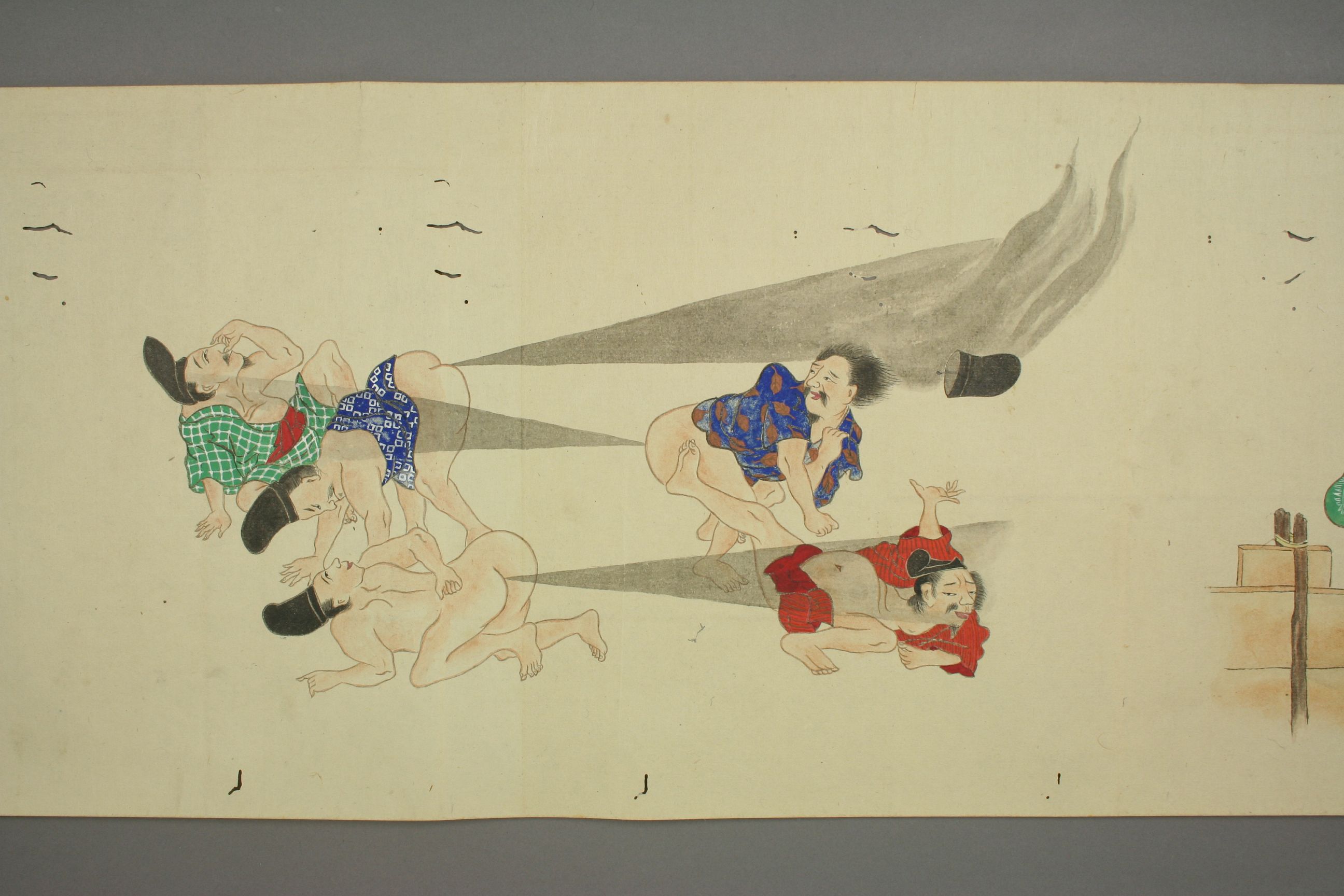
Fire away! Source: Waseda U. Library

The Waseda University Library in Tokyo maintains an online archive of drawings dedicated to epic Japanese fart battles of the 17th and 18th centuries. The depictions, called he-gassen (really!), show farts so powerful they penetrate walls and blow cats out of trees.

This mode of attack must have been intimidating, but approaching enemies should have smelled what was coming and taken evasive action.

The same can be said for a Nevada telecommunications company, which had engaged 1,400 call center workers but treated them all as independent contractors. In the immortal words of Daryl Hall, no can do.

Under federal wage and hour law, the Economic Realities Test is used to determine whether a worker is an employees, regardless of what the parties call the relationship. In this case, the telecom company failed virtually every part of the test. The workers were economically reliant on the telecom company, which controlled their work in just about every relevant way, making the workers employees.

The facts were so bad that the Department of Labor took the laboring oar on this one, filing its own lawsuit in federal court. The DOL won a $1.4 million award, and the Ninth Circuit Court of Appeals upheld the decision.

Remember, a worker’s status as an employee or independent contractor is determined using the legal test and the facts of the relationship, regardless of what the parties call themselves.

The moral of the story is that if it smells like an employment relationship, it probably is. Choose your battles wisely. He-gassen!

Enter your email address to subscribe to this blog and receive notifications of new posts by email.

© 2021 Todd Lebowitz, posted on WhoIsMyEmployee.com, Exploring Issues of Independent Contractor Misclassification and Joint Employment. All rights reserved.

2018_Web100Badge

California Adopts New Exemptions to the ABC Test (and an Odd Way to Seek Comfort in a Storm)

Looking for Florence? Take the stairs on your left. One flight down.

Florence Ford was terrified of storms and, seeing as how she was born in 1861, none of the weather apps on her phone were working yet. Her mother Ellen provided comfort when the rains came. So naturally, when Florence died at age 10, Ellen felt she still needed to comfort her daughter when it rained.

In Natchez, Mississippi, you can visit one of the oddest graves in the world. Ellen fitted her daughter’s coffin with a small window and built stairs down to the casket. When it poured in Natchez, Ellen would head down to the casket and provide much-needed comfort to Florence’s bones.

Ellen couldn’t quite accept the reality of Florence’s death and tried to create an exception. In her version of death, reading or singing to the corpse still brought comfort to her daughter — or maybe just to herself.

A less creepy version of dueling realities continues to play out in California, as the legislature keeps reviving exceptions from the harshness of the ABC Test it adopted in AB 5.

The state continues to make tweaks. Two recent bills (AB 1506 and AB 1561) adopt these changes:

  • Extends the temporary exemption for newspaper publishers and distributors who meet certain criteria;
  • Imposes reporting requirements on publishers and distributors to ensure they are complying with the Borello Test, if they’re exempt from the ABC Test;
  • Extends the manicurists exemption for three more years (Kudos to the manicurists’ lobby! They nailed it!);
  • Extends the construction industry subcontractor exemption for another three years;
  • Amends the data aggregator exemption; and
  • Modifies the insurance exemption.

This grab bag of edits comes soon after the adoption of AB 2257, last fall, which rewrote AB 5 to change the long list of exemptions.

What’s going on here? The problem is that the ABC Test doesn’t make a lot of sense when you try to apply it across all types of working relationships. That’s why California’s ABC Test statute keeps getting a makeover. After the state legislature codified the ABC Test in September 2019 by passing AB 5, the state has adopted dozens and dozens of exceptions, and as you can see here, the list keeps growing.

Here’s what businesses in California need to remember:

  1. The ABC Tests is still the default test for determining whether an independent contractor is misclassified and should really be an employee.
  2. There are loads of exemptions, many of which are difficult to follow and require compliance with a long list of criteria before they will apply. Check the list of exemptions to see if they apply.
  3. If an exemption applies, it does not mean that independent contractor status is proper. It just means you make the independent contractor vs. employee determination using the Borello balancing test instead of the ABC Test.
  4. The rules keep changing.

If this monsoon of details makes you uncomfortable, it should. Fortunately, today you learned one more way that a person can find comfort in a storm. Thank you Ellen of Natchez.

Enter your email address to subscribe to this blog and receive notifications of new posts by email.

© 2021 Todd Lebowitz, posted on WhoIsMyEmployee.com, Exploring Issues of Independent Contractor Misclassification and Joint Employment. All rights reserved.

2018_Web100Badge
 

Zombie Copyrights: Tips for Preserving IC Status With Writers While Avoiding the Risk of Losing Copyright After 35 Years

In Return of the Living Dead, a warehouse owner accidentally reanimates some cadavers, who then become unkillable zombies. While not based on a true story, the 1985 film does have some parallels in real life (if you squint real hard and just go with it).

As discussed last week, copyright claims can also return from the dead when the author is an independent contractor. This week we discuss what can be done to avoid this zombie copyright scenario.

In the case of Horror Inc. v. Miller, the Second Circuit ruled that screenwriter Victor Miller could reclaim the copyright to Friday the 13th after 35 years, since he wrote the script as an independent contractor.

The case highlights a serious risk when retaining a writer as an independent contractor instead of as an employee. If a work is not a “work made for hire” under the U.S. Copyright Act, the author can reclaim a copyright 35 years after having transferred the rights away.

Horror, Inc. argued that Miller was an employee when he wrote the script, which made it a “work made for hire.” The court disagreed, but the rights holder should have had another argument in its back pocket – one that would have been much cleaner and could have changed the result of the case.

Employment is just one path for designating something a “work made for hire.” Another path toward the same designation is to have a “specially commissioned work.”

If Miller’s contract to write the movie had indicated that the movie was a specially commissioned work for use as part of a motion picture, it would not have mattered whether he was an employee or an independent contractor. The “specially commissioned work” designation would have made the work a “work made for hire” without getting into the messiness of employment, which would mean that Miller could not reclaim any rights after 35 years. This circular from the copyright office explains the “specially commissioned work” rule.

There are important lessons from this case for anyone seeking to engage a writer, whether it’s a freelancer or a script writer.

First, think through the implications of employee vs. independent contractor, not only in the context of employment law but also copyright law.

Second, consider a belt-and-suspenders approach. Even if the writer is your employee under labor law, the writer might not be your employee under U.S. Copyright Act — at least according to the Horror, Inc. case. Consider Plan B. You maybe able to designate the work a “specially commissioned work” or use one of the other definitions of a “work made for hire,” assuming that the facts fit within the definition.

But there are pitfalls to the second approach too. The California Labor Code says that if a work is a “work made for hire,” then the relationship between the writer and the acquirer is automatically employment, at least under certain provisions in the Labor Code. See Cal. Unemp. Ins. Code Section 686 and Cal. Lab. Code Section 3351.5(c).

If the California Economic Development Department (EDD) performs a misclassification audit, it will likely ask for all independent contractor agreements, and if a deliverable has been designated as a “work made for hire,” that may serve as conclusive proof of misclassification, with back assessments owed for failure to pay unemployment taxes.

You can get around the whole “work made for hire” issue by assigning the work, but that leaves the door open for the writer to reclaim the copyright after 35 years. And we’re right back where we started.

The independent contractor vs. employee decision has important implications in copyright law that are often overlooked. The Horror, Inc. case is a good reminder of some of the surprises that may arise many years later.

Enter your email address to subscribe to this blog and receive notifications of new posts by email.

© 2021 Todd Lebowitz, posted on WhoIsMyEmployee.com, Exploring Issues of Independent Contractor Misclassification and Joint Employment. All rights reserved.

2018_Web100Badge
 

Major Scare for the Movie Industry: Independent Contractor Can Reclaim Copyright to Friday the 13th

With Halloween around the corner, it’s scary movie season. Every year, various publications post what they claim is the definitive list of All-Time Scariest Movies. Go ahead, google it.

But in 2021, the Science of Scare Project took a more scientific approach. The Project measured heart rate elevation in 250 volunteers while watching 40 scary movies, and the scariest – measured by increased beats per minute – was a low budget 56-minute thriller you might not expect. The full rankings, with beats per minute spike chart, can be found here.

The movie industry got a different scare last month. Usually, we’re looking for ways to preserve independent contractor status. But in this case, a script writer’s independent contractor status may allow him to take back the copyright to the script, since 35 years have passed since its publication.

In a case called Horror Inc. v. Miller (yes, really), the Second Circuit Court of Appeals ruled that Victor Miller, who wrote the script for Friday the 13th, could legally reclaim copyright on the original screen play. After 40 years, he can take it back!

This surprising outcome is no surprise to those who know the intricacies of the U.S. Copyright Act. The Act says that authors who executed a license or granted a copyright transfer after January 1, 1978, can terminate the license or grant 35 years after the original transaction. The author has five years to provide notice of termination, and Miller provided that notice in 2016, 36 years after the 1980 film was released.

Horror, Inc., which owns the rights to Friday the 13th, argued that the script was a “work made for hire” and that Miller was acting as an employee under federal labor law when he wrote the script. Miller was a member of the Writer’s Guild of America, and the film’s rights holder had registered the screenplay as a work made for hire.

But the Second Circuit Court of Appeals ruled that the test for “employee” under federal labor law is different than the test under U.S. Copyright law. Federal labor law tries define employment broadly, in a way to protect workers and their right to organize. In contrast, U.S. Copyright law applies a narrower interpretation, designed to protect authors. Even if Miller was an employee under labor law, that didn’t make him an employee under copyright law.

The Court looked at five factors for determining whether the screenplay was a “work made for hire,” and the Court ruled that the test was not met. Miller was not an employee under the U.S. Copyright Act, even if he was an employee under federal labor law.

It is here that I strongly disagree with the Court’s analysis. The test for employment status under federal labor law is fundamentally the same as the test under the Copyright Act. Both tests seek to apply the common law of agency, and both are Right to Control Tests. The Court’s attempt to distinguish between the tests falls flat, in my mind, and it appears to me as if the Court made up its mind first and then tried to fit the desired result into a legal framework that would justify the outcome. If Miller was an employee using the common law agency (Right to Control) test that applies to federal labor law, he should have been an employee under the common law agency test that applies to copyright law. (Fun fact: Miller signed a document called “Employment Agreement,” but the Court was not swayed.)

Since Miller wrote the screenplay as an independent contractor under the Copyright Act, the Act grants him the right to cancel the transfer after 35 years, and he properly served notice of his intent to do so. Horror, Inc. is going to lose the copyright to the film.

Copyright termination cases are starting to pop up more frequently, posing a real threat to rights holders in the film and comic book industries.

When engaging a writer, businesses need to weigh the benefits of retaining an independent contractor with the risks. For commercials or social media posts with short-term value, retention as an independent contractor is likely the best path.

But with movies or other assets that are likely to have value for 35 years or more, retention as an independent contractor leaves open the risk that the writer can reclaim the copyright after 35 years. Buyer beware.

The scariest horror movies have plot twists and unexpected scares. For many rights holders, the idea that a script writer could reclaim copyright after 35 years is the kind of scare they could do without. Heart rates among movie rights holders are increasing with this decision.

Content creators need to know what they’re getting into and need to understand the long-term risks.

Enter your email address to subscribe to this blog and receive notifications of new posts by email.

© 2021 Todd Lebowitz, posted on WhoIsMyEmployee.com, Exploring Issues of Independent Contractor Misclassification and Joint Employment. All rights reserved.

2018_Web100Badge