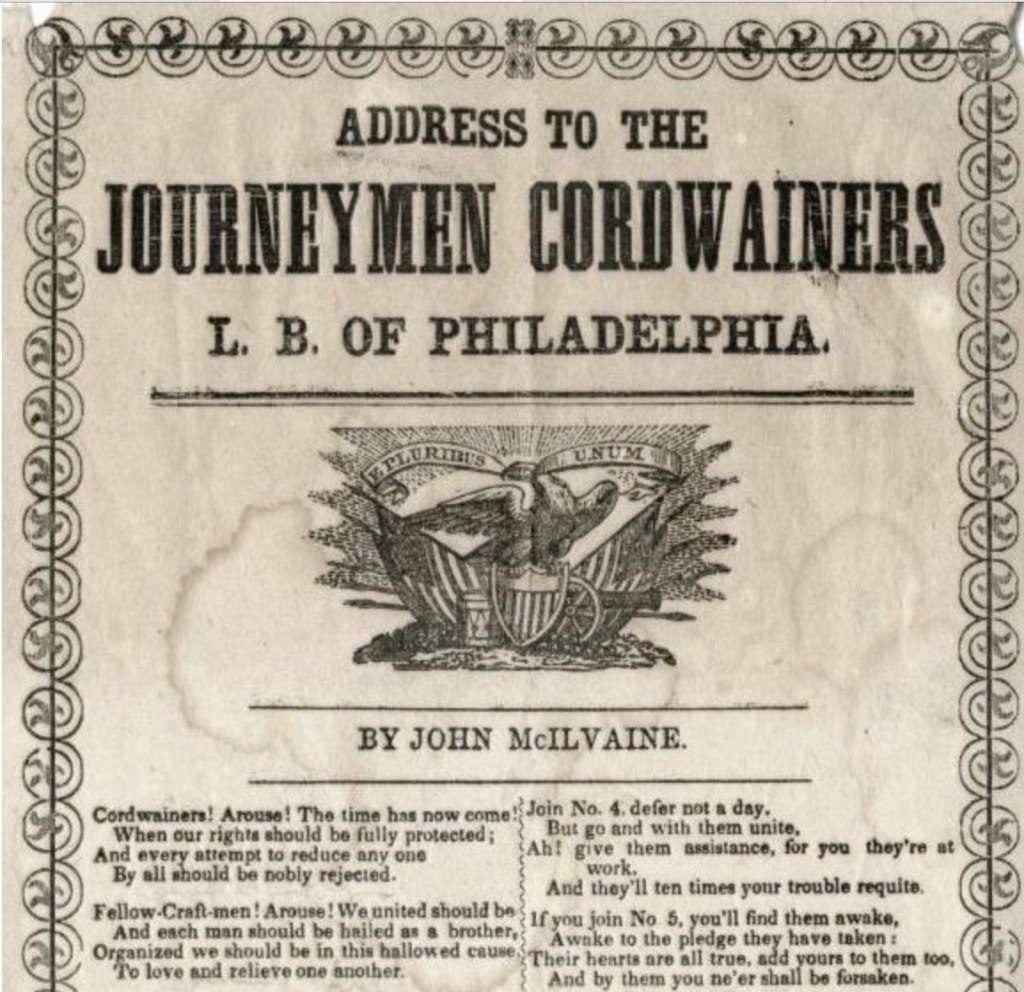
The first labor union in the United States was the the Federal Society of Journeymen Cordwainers, founded in 1794. What is a cordwainer? I had to look that up too, so I’ll save you the trouble.
It’s a shoemaker who makes new shoes from new leather, in contrast to a cobbler who repairs shoes. There aren’t a lot of cordwainers around anymore that I know of. Or maybe there are but they go by a name that sounds less weenie-ish.
There are, however, a lot of rideshare drivers. And the State of California thinks they would like to organize too.
But there’s a problem with that. The National Labor Relations Act protects employees, not contractors. When independent businesses band together to set prices, that’s called price fixing, and it presents all sorts of antitrust problems.
A new California law tries to get around these pesky legal problems.
The Transportation Network Company Drivers Labor Relations Act, AB 1340, allows rideshare drivers the right to collectively bargain, using a process to be overseen by the Public Employment Relations Board (PERB).
Rideshare companies must submit a list of eligible drivers every quarter, and these companies are required to negotiate in good faith with the yet-to-be-formed drivers’ group.
But they’re not “unions,” I suppose, even thought they walk like a union and quack like a union.
The statute is long and detailed. It has lots of procedures.
In 1805, the cordwainers’ union was alleged to be a coercive and violent organization, allegations that arose after a cordwainer on strike threw a potato at a scab. The potato broke a window.
Let’s hope the whole rideshare law thingie goes more smoothly, and we’ll see how this actually works in practice. A possible bad omen: The statute says nothing about the unauthorized use of potatoes.
Alabama jewelry store owner Slater Jones owns a two-carat diamond. That might not seem surprising, but stay with me here. Jones keeps the diamond in his eye. Literally, in his eye.
You see, Jones lost his right eye to illness. Rather than living with a boring old prosthetic eye that looks like, well, an eye, Jones engaged eye prosthetic expert John Lin to create a custom artificial eye from a diamond.
Having a diamond for an eye may seem a bit gaudy, but I guess if you’re in the jewelry business, you may as well just go for it.
Those in the home health care business, on the other hand, should not just go for it — especially if “it” is classifying in-home health aides as independent contractors.
In a settlement finalized earlier this month, California Attorney General Rob Bonta secured a $9.5 million settlement against the individual owners of a home health care company for misclassifying its workers in violation of California law. In this case, the owners appears to have operated the home health agency as a d/b/a without having incorporated. Oopsie. The settlement included another $1.5 million against a different incorporated home health care entity and its family of owners.
The settlement also prohibited all of the defendants from classifying their aides as independent contractors in the future.
We have seen a lot of recent cases brought against home health care companies that classify their workers as independent contractors. This settlement is a stern warning that home health care companies choosing that model need to be extremely cautious.
Because this case was brought by the State, some of the protections we often recommend, like individual arbitration agreements with class action waivers, provide no protection. This case and the settlement also serve as a reminder that individuals can be held liable for intentional misclassification.
The claims brought against the agencies focused largely on California’s Unfair Competition Law (UCL). Misclassification allegations under the UCL typically claim that the wrongdoer gained an improper advantage in the marketplace by unlawfully classifying employees as independent contractors.
Treating in-home aides as contractors may seem like a bright shiny object worth pursuing. But that sparkle you see is no diamond. It’s just the gleam in the eye of the State Attorney General, preparing to count the cash from another misclassification settlement.
In 1959, residents of São Paulo, Brazil, elected Cacareco to city counsel. Cacareco was a five-year and female and lived at the Sao Paulo zoo. She was a big girl, known to eat 70 pounds of vegetables a day. Cacareco was a rhinoceros.
Cacareco, which means “rubbish,” got on the ballot through a student prank. Her success is generally attributed to residents’ frustration with city officials over local conditions, which included unpaved streets and open sewers. Said one local, “Better to elect a rhino than an ass.”
Back in the U.S., businesses in California have been calling the state’s independent contractor test “rubbish” since it went into effect in 2020. A group of truckers, called the Owner-Operator Independent Drivers Association (OOIDA) mounted one of the more persistent challenges to the law, known as AB 5, and that challenge finally resulted in a Ninth Circuit Court of Appeals decision earlier this month.
Unfortunately for the OOIDA and its owner-operator trucker members, the Ninth Circuit upheld the constitutionality of AB5 and rejected the truckers’ challenge to the law.
The truckers had argued that AB 5 violates the dormant Commerce Clause because it imposes a substantial burden on interstate commerce, which outweighs its putative benefits. the truckers also- argued that the law’s business-to-business exception violates the dormant Commerce Clause because it discriminates against interstate commerce and violates the Equal Protection Clause because it treats interstate and intrastate drivers differently. the truckers argued that there is no rational basis to support this alleged disparate treatment.
The Ninth Circuit saw things differently. In an unpublished opinion, the court rejected each argument and upheld the law.
The ABC Test appears here to stay, and the chances of getting it overturned now seem about as likely as electing a rhinoceros to the California State Assembly.
A man was detained at Newark International Airport earlier this month for concealing a live turtle in his pants.
The turtle was detected as the man passed through TSA screening. When questioned about the bulge in his groin area, the man said he was just happy to see the TSA agent. No, that’s not what happened at all. Instead, the man reached into his pants and pulled out a 5-inch long red-ear slide turtle.
It is unclear whether the turtle was a pet and whether the man was charged. But he did miss his flight. So let this be a lesson to all of us.
Meanwhile, in California, an in-home healthcare agency learned the hard way that it was concealing a much larger problem. And this problem cost it $2.3 million in fines.
As explained in this news release from the Department of Industrial Relations (DIR), the agency had been classifying its in-home healthcare aides as independent contractors, not employees.
After receiving a complaint, the DIR investigated and found that under California law, the aides should have been treated as employees. The Labor Commissioner issued citations under a relatively new section of the California Labor Code, making this the first enforcement action in which the civil penalties for misclassification were collected as damages for the affected workers, rather than as a penalty paid to the state. (How generous, California!)
This enforcement action is an important reminder of three things.
First, when the work performed is within the company’s normal course of business, the workers are probably going to be deemed employees under California’s ABC Test (unless one of several exceptions applies). California law makes it very difficult to retain solo workers as independent contractors if you retain them to perform a core business function.
Second, in-home health care is an industry in which misclassification maybe widespread, especially when applying California law. The business of in-home healthcare is to provide in-home healthcare. It’s difficult to say that those who do the work are not employees.
Finally, this action illustrates the breadth and depth of penalties a company can face for misclassifying its workers. The $2.3 million in penalties here included:
$422,033 in unpaid minimum wages*
$424,809 in unpaid overtime wages*
$165,162 in meal and rest period premiums*
$27,400 in wage statement penalties
$108,094 in waiting time penalties for delayed final wages
$550,000 in penalties for willful worker misclassification
$81,673 in penalties for no workers’ compensation insurance for the misclassified employees
$422,033 in liquidated damages
$18,950 for other civil penalties
When a company treats its workers as contractors, it’s not following the laws that would apply to employees. If, by law, the workers were misclassified, then there are a whole lot of employment laws that the company was almost certainly not following. That makes for a lot of damages.
The advice here is the same as always. Companies using indepednent contractors should be proactive in evaluating these relationships and whether they can survive a legal challenge. There are almost always things that a company can do to better solidify its workers’ status as independent contractors. The best time to act is before an investigation or lawsuit begins.
Complacency is no defense. The fact that you’ve been doing it this way for years and haven’t been sued only means that you haven’t been sued yet.
In other words, if there’s a turtle in your pants, there’s a good chance you get caught at some point, so you better have a good explanation prepared in advance.
When Joni Mitchell wrote “Big Yellow Taxi,” she had just arrived in Honolulu. She was inspired by the view outside her hotel window, with beautiful green mountains in the distance and, closer to the hotel, a “parking lot as far as the eye could see.” Ugly.
For business owners, the beautiful green mountains are successful business operations, with the business having been built the way you wanted and cultivated over a number of years. Paving over that paradise with a parking lot is the government coming in and forcing you to change how you do business. Ugly.
That’s what is happening to companies that rely on independent contractors but aren’t deliberate enough in how they set up their IC relationships. Looking back at 2024, here’s what I mean, with two specific examples.
Two companies with nationwide operations were forced to convert all independent contractors to employees, at least those working in California.
WorkWhile and Qwick provide gig workers to fill empty shifts. Qwick operates in the hospitality industry, and WorkWhile operates across multiple fields, including manufacturing, hospitality, and general labor.
The companies treat the gig workers as independent contractors. The City of San Francisco sued each company on behalf of the State. The lawsuits alleged that the gig workers were misclassified and should have been treated as employees under California law.
In 2024, both companies settled. Each agreed to pay a seven-figure settlement and to reclassify all gig workers as employees. (Press releases are here and here.)
Before the lawsuits, both companies had operated their businesses this way for years. They didn’t get sued and didn’t have to reclassify the contractors — until they did.
This case is a good reminder of two important rules.
1. Just because you have been doing it this way for years doesn’t mean it’s lawful.
2.The fact that you haven’t been sued means only that you haven’t been sued yet.
Before the lawsuits were filed, the companies had options.
They could have been proactive about changing the facts of the relationships and the contracts. They could have molded the facts the way they wanted without government oversight, in a way that would better insulate them from misclassification claims. This would have been difficult in California, with its strict ABC Test, but not impossible. But it would have taken hard work and a willingness to make changes proactively.
Or they could have converted their contractors to employees, but done it on their own terms, without the government telling them how they have to operate their business.
Now, as part of their settlements, these companies are forced to allow the government to monitor and dictate how they interact with these workers.
Don’t it always seem to go / that you don’t know what you’ve got ‘til it’s gone?
Once the government is monitoring how you do business, you’ve lost the flexibility to adapt and build on your terms. It’s too late. The time to act is before you get audited, investigated, or sued. See Rule #2.
Remember Rick Astley? Yes, this guy. And this song. I assume he had other songs but I know of none of them.
I recently read a Reddit post that offers the Astley Paradox. And it’s a good one.
If you ask Rick Astley for his copy of the movie Up, he cannot give it you as he will never give you up. However, in doing so, he lets you down. Thus creating the Astley Paradox.
California’s tests for determining independent contractor status are not paradoxical, But they are complicated.
There are essentially two tests, the ABC Test and the S.G. Borello Test. The ABC Test is the default test, and it’s the hardest to please.
There are a gazillion exceptions to the ABC Test, and you can find these in California Labor Code sections 2776-2784. But when an exception applies, it doesn’t mean the worker is an independent contractor. It means you use the S.G. Borello test to make that determination instead of the ABC Test.
The S.G. Borello Test is a balancing test. In contrast to the ABC Test, you don’t have to satisfy every factor.
Here’s the S.G. Borello test, with some bonus commentary from the California Department of Industrial Relations:
The California Supreme Court established the Borello test in S.G. Borello & Sons, Inc. v. Dept. of Industrial Relations (1989) 48 Cal.3d 341. The test relies upon multiple factors to make that determination, including whether the potential employer has all necessary control over the manner and means of accomplishing the result desired, although such control need not be direct, actually exercised or detailed. This factor, which is not dispositive, must be considered along with other factors, which include:
Whether the worker performing services holds themselves out as being engaged in an occupation or business distinct from that of the employer;
Whether the work is a regular or integral part of the employer’s business;
Whether the employer or the worker supplies the instrumentalities, tools, and the place for the worker doing the work;
Whether the worker has invested in the business, such as in the equipment or materials required by their task;
Whether the service provided requires a special skill;
The kind of occupation, and whether the work is usually done under the direction of the employer or by a specialist without supervision;
The worker’s opportunity for profit or loss depending on their managerial skill;
The length of time for which the services are to be performed;
The degree of permanence of the working relationship;
The method of payment, whether by time or by the job;
Whether the worker hires their own employees;
Whether the employer has a right to fire at will or whether a termination gives rise to an action for breach of contract; and
Whether or not the worker and the potential employer believe they are creating an employer-employee relationship (this may be relevant, but the legal determination of employment status is not based on whether the parties believe they have an employer-employee relationship).
Borello is referred to as a “multifactor” test because it requires consideration of all potentially relevant facts – no single factor controls the determination. Courts have emphasized different factors in the multifactor test depending on the circumstances. For example, where the employer does not control the work details, an employer-employee relationship may be found if (1) the employer retains control over the operation as a whole, (2) the worker’s duties are an integral part of the operation, and (3) the nature of the work makes detailed control unnecessary. (Yellow Cab Cooperative, Inc. v. Workers’ Compensation Appeals Board (1991) 226 Cal.App.3d 1288.) As the Supreme Court has explained, Borello “emphasizes statutory purpose as the touchstone for deciding whether a particular category of workers should be considered employees rather than independent contractors for purposes of social welfare legislation.” (Dynamex, 4 Cal.5th at 935.) The emphasis on statutory purpose “sets apart the Borello test for distinguishing employees from independent contractors from the [common law] standard . . . in which the control of details factor is given considerable weight.” (Id.)
Most contractor relationships won’t satisfy all of the factors, but you’re going to need to satisfy most if you want independent contractor status under the S.G. Borello test. There’s no precise mathematical formula for how many factors you need, and different judges may evaluate the same set of facts differently, so it’s important to satisfy as many factors as you can.
California law isn’t as forgiving as Rick Astley. California law will often let you down and desert you.
This clever illustration of sampling bias is from @sketchplanator. Marketers, under California law, provide “professional services.” So do photographers, fine artists, travel agents, barbers, foresters, human resource administrators, and a grab bag of other miscellaneous service workers. But not construction workers, lawyers, electricians, nannies, or dog walkers.
Why does this matter?
Well, California’s new Freelancer Worker Protection Act (FWPA) (explained here) only applies to “professional services.” The term “professional services” is defined as having the same meaning as in AB5, the law that sets up the ABC Test and then adds a medley of exceptions. “Professional services” is one of the exceptions.
So what does that mean for companies retaining freelancers in California?
If they provide “professional services” (as defined in Labor Code 2778), then:
There’s an exception to the ABC Test, meaning that to determine whether they are truly independent contractors, you use the S.G. Borello test. That’s a multi-part balancing test.
If they pass the IC test, the FWPA potentially applies.
If they pass the IC test and provide at least $250 in services in any 120-day period, then the FWPA does apply. A written contract is required, along with several other requirements, explained here.
If you want the full list of “professional services,” scroll down. I’ve copied it here. Otherwise, you’ve successfully completed this post, and you will earn a gold star on your chart on my refrigerator. (Do parents still do that? Please let me know.)
Professional Services under Labor Code 2778:
(2) “Professional services” means services that meet any of the following:
(A) Marketing, provided that the contracted work is original and creative in character and the result of which depends primarily on the invention, imagination, or talent of the individual or work that is an essential part of or necessarily incident to any of the contracted work.
(B) Administrator of human resources, provided that the contracted work is predominantly intellectual and varied in character and is of such character that the output produced or the result accomplished cannot be standardized in relation to a given period of time.
(C) Travel agent services provided by either of the following:
(i) A person regulated by the Attorney General under Article 2.6 (commencing with Section 17550) of Chapter 1 of Part 3 of Division 7 of the Business and Professions Code.
(ii) An individual who is a seller of travel within the meaning of subdivision (a) of Section 17550.1 of the Business and Professions Code and who is exempt from the registration under subdivision (g) of Section 17550.20 of the Business and Professions Code.
(D) Graphic design.
(E) Grant writer.
(F) (i) Fine artist.
(ii) For the purposes of this subparagraph, “fine artist” means an individual who creates works of art to be appreciated primarily or solely for their imaginative, aesthetic, or intellectual content, including drawings, paintings, sculptures, mosaics, works of calligraphy, works of graphic art, crafts, or mixed media.
(G) Services provided by an enrolled agent who is licensed by the United States Department of the Treasury to practice before the Internal Revenue Service pursuant to Part 10 of Subtitle A of Title 31 of the Code of Federal Regulations.
(H) Payment processing agent through an independent sales organization.
(I) Services provided by any of the following:
(i) By a still photographer, photojournalist, videographer, or photo editor who works under a written contract that specifies the rate of pay and obligation to pay by a defined time, as long as the individual providing the services is not directly replacing an employee who performed the same work at the same volume for the hiring entity; the individual does not primarily perform the work at the hiring entity’s business location, notwithstanding paragraph (1) of subdivision (a); and the individual is not restricted from working for more than one hiring entity. This subclause is not applicable to a still photographer, photojournalist, videographer, or photo editor who works on motion pictures, which is inclusive of, but is not limited to, theatrical or commercial productions, broadcast news, television, and music videos. Nothing in this section restricts a still photographer, photojournalist, photo editor, or videographer from distributing, licensing, or selling their work product to another business, except as prohibited under copyright laws or workplace collective bargaining agreements.
(ii) To a digital content aggregator by a still photographer, photojournalist, videographer, or photo editor.
(iii) For the purposes of this subparagraph the following definitions apply:
(I) “Photo editor” means an individual who performs services ancillary to the creation of digital content, such as retouching, editing, and keywording.
(II) “Digital content aggregator” means a licensing intermediary that obtains a license or assignment of copyright from a still photographer, photojournalist, videographer, or photo editor for the purposes of distributing that copyright by way of sublicense or assignment, to the intermediary’s third-party end users.
(J) Services provided by a freelance writer, translator, editor, copy editor, illustrator, or newspaper cartoonist who works under a written contract that specifies the rate of pay, intellectual property rights, and obligation to pay by a defined time, as long as the individual providing the services is not directly replacing an employee who performed the same work at the same volume for the hiring entity; the individual does not primarily perform the work at the hiring entity’s business location, notwithstanding paragraph (1) of subdivision (a); and the individual is not restricted from working for more than one hiring entity.
(K) Services provided by an individual as a content contributor, advisor, producer, narrator, or cartographer for a journal, book, periodical, evaluation, other publication or educational, academic, or instructional work in any format or media, who works under a written contract that specifies the rate of pay, intellectual property rights and obligation to pay by a defined time, as long as the individual providing the services is not directly replacing an employee who performed the same work at the same volume for the hiring entity, the individual does not primarily perform the work at the hiring entity’s business location notwithstanding paragraph (1) of subdivision (a); and the individual is not restricted from working for more than one hiring entity.
(L) Services provided by a licensed esthetician, licensed electrologist, licensed manicurist, licensed barber, or licensed cosmetologist provided that the individual:
(i) Sets their own rates, processes their own payments, and is paid directly by clients.
(ii) Sets their own hours of work and has sole discretion to decide the number of clients and which clients for whom they will provide services.
(iii) Has their own book of business and schedules their own appointments.
(iv) Maintains their own business license for the services offered to clients.
(v) If the individual is performing services at the location of the hiring entity, then the individual issues a Form 1099 to the salon or business owner from which they rent their business space.
(vi) This subparagraph shall become inoperative, with respect to licensed manicurists, on January 1, 2025.
(M) A specialized performer hired by a performing arts company or organization to teach a master class for no more than one week. “Master class” means a specialized course for limited duration that is not regularly offered by the hiring entity and is taught by an expert in a recognized field of artistic endeavor who does not work for the hiring entity to teach on a regular basis.
(N) Services provided by an appraiser, as defined in Part 3 (commencing with Section 11300) of Division 4 of the Business and Professions Code.
(O) Registered professional foresters licensed pursuant to Article 3 (commencing with Section 750) of Chapter 2.5 of Division 1 of the Public Resources Code.
The band America (“A Horse with No Name,” “Ventura Highway”) was formed in England. Yes, really. But by three Americans whose fathers were in the U.S. Air Force and stationed overseas.
That got me thinking about other bands with place names. When I was growing up in Miami in the 1980s, if someone mentioned Boston, I thought of just another band out of Boston, on the road to make ends meet. If someone mentioned Kansas, I thought of dust in the wind, even though I never particularly liked that song. Chicago made me think of the Cubs, but only in 1984. Otherwise, does anybody really know what time it is?
Not that I am older and have a life, place names mean something different to me. They now make me think of federal, state, and local laws affecting independent contractor status.
(Ok, I take back the comment about having a life. I realize this is a sad and pathetic way to think of place names.)
After the election, place names are going to take on greater importance as businesses aim to protect their independent contractor relationships. Federal enforcement activity isn’t going away, but I expect to see a growing emphasis on legislation and enforcement at the state and local level.
In the realm of non-employee workers (independent contractors, staffing agency temps), I expect to more state and local legislation in these areas:
1) Freelancer Laws. We now have freelancer laws in CA, NY, IL, Los Angeles, NYC, Minneapolis, Seattle, and Columbus. These laws impose requirements when retaining individuals who are independent contractors. The laws generally require written contracts that contain several mandatory components.
2) Temporary Worker Laws. We have these in NJ and IL. They generally require that staffing agencies pay their workers an equivalent wage rate (and sometimes the value of benefits) being paid to workers they work alongside at the company where they are providing services.
3) Misclassification Laws – the Bad Kind. In states with Democrat trifectas (house, senate, governor), expect new laws that make it harder to be an independent contractor. Expect more ABC Tests, like in CA and MA. Other states have ABC Tests for determining who is an employee under workers’ comp and unemployment law.
4) Misclassification Laws – the Good Kind. In states with Republican trifectas, expect more safe harbor laws. If you satisfy a set of basic requirements in your dealings with a non-employee worker, then the worker is an independent contractor under that state’s laws. Pesky balancing tests (and long-haired freaky people) need not apply. We have these state laws in WV and LA (not L.A.)
We will likely see changes at the federal level too, but these may take years to develop. The federal agency rulemaking process is slow and cumbersome, and agency rules will take on less importance as federal agency power continues to diminish after the Supreme Court’s Loper Bright decision.
I haven’t touched on Europe or Asia, but those are bands for another day and another post. When? At some point, in the heat of the moment, but only time will tell.
I am entertained by poorly translated things. I have no idea what this shirt means or what the designer thought it would mean. I saw this one in Italy.
I can’t help but wonder what the reaction would be if I wore this shirt in the U.S. Would people say anything to me? I was tempted to ask the wearer about it or to try to buy it from her, but I chickened out.
Last week, the U.S. Supreme Court kind of chickened out too.
A petition had been filed with the Court, asking it to invalidate California’s AB5, its stringent independent contractor law. The petition argued that the law singles out certain businesses and therefore violates the Equal Protection Clause of the U.S. Constitution.
As you may recall, AB5 is the California law that makes it much harder to maintain independent contractor status. The law presumes that most workers are employees and requires a hiring party to satisfy a three-part ABC Test to classify someone as a contractor.
The law, however, does not apply the same standards to everyone. The law exempts loads of industries and types of workers from the ABC Test, and — if we’re being honest here — the law was really targeted toward rideshare and delivery companies.
And that’s exactly what the rideshare and delivery companies argued.
In June 2024, the Ninth Circuit voted to preserve the law, and the case (called Olson v. State of California) was appealed to the U.S. Supreme Court. The Supreme Court, however, can decide which cases to hear and does not have to give a reason for declining to hear a case.
Last week, the Supreme Court declined the petition, opting not to hear the case. The Court provided no reason.
A year earlier, in July 2023, the U.S. Supreme Court denied a different petition asking it to review AB5. The earlier petition, in Mobilize the Message LLC v Bonta, argued that the law’s restrictions on freelance work violated the first Amendment.
For some companies, the Supreme Court’s decision last week not to hear the Olson case will have limited effect. The passage of Prop 22 in late 2020 exempted certain rideshare and delivery app companies from having to comply with AB5. (Prop 22 was also challenged in court and survived.) But AB5 and its ABC Test, later recodified in AB2257, remain in effect for many industries and businesses.
This most recent petition to the Supreme Court alleged that AB5 violated the Equal Protection Clause by unfairly singling out certain industries. I think the evidence is plain that this is what motivated the law, but whether that motivation rises to the level of an Equal Protection violation is another matter.
But no matter. The Supreme Court can decline to hear the appeal, and that’s exactly what it did.
AB5 remains on the books, and I can now start thinking about how I could turn all of this into a poorly translated t-shirt.
Don’t tell anyone, but there is a motorcycle toward the front of this photo. I know, it blends right in and is hard to see because it’s camouflaged. But look carefully and you’ll see it.
I saw it recently while in Bellagio on our vacation to Italy. Yes, I have better photos, but this one helps me make a point about blending in.
The California legislature has decided to blend in too, adopting a freelancer protection bill that is similar to laws already in place in New York State, Illinois, and several cities.
The law has no bearing on the determination of whether someone is an employee or independent contractor. But if the worker is a contractor and other criteria are met, then the requirements of the law must be followed by the party retaining the independent contractor.
If you’ll be retaining a freelancer in California, here’s what you need to know. As a reward for reading to the end, I’ve included some tips and a better photo.
Applies if:
Retention of individual IC or single member entity,
Retained to provide “professional services” (as defined in Labor Code sec 2778), and
$250 in services to be provided within 120 days
But not applicable if:
The hiring party is an individual and the work is for the hiring party’s personal benefit or benefit of the family (e.g., n/a to babysitter, dog walker)
Requirements:
Written contact that includes:
Name and address of each party
Itemized list of services and value
Rate and method of compensation
Date when payment is due or mechanism for determining when payment is due
Date when IC must submit invoice to allow for timely payment
Payment to IC is due on the date specified in contract or, if no date is specified, then 30 days after work is completed
Once work is completed, hiring party cannot require freelancer (a) to accept less in payment, (b) to provide more goods or services, or (c) to grant more IP rights than agreed to in the contract
Other provisions:
The law does not limit existing contract law or prevent an IC from enforcing a verbal contract or recovering under promissory estoppel
Waivers are void
Retaliation prohibited
Civil action permitted; recovery to include attorneys fees and costs
Damages:
If IC requested and was denied a written contract, then additional $1000
If hiring party failed to timely pay, then 2x unpaid portion
Damages equal to value of contract for other violations
Hiring party must provide IC with a copy of the contract
Hiring party must retain contract for 4 years
Tips:
Clarify intellectual property rights in contract; don’t leave that until later or assume there is a handshake understanding of who will own the IP
Specify a due date for payment or a process for determining when payment is due
Define when the work is completed, and define it in a way that requires specifications to be met. This is to protect against poor workmanship and to try to preserve the right to pay less for a shoddy output.
And here’s a more representative photo from the Italy vacation. This is at Alpe di Suise in the Dolomites.










 Who Is My Employee?