In 1959, residents of São Paulo, Brazil, elected Cacareco to city counsel. Cacareco was a five-year and female and lived at the Sao Paulo zoo. She was a big girl, known to eat 70 pounds of vegetables a day. Cacareco was a rhinoceros.
Cacareco, which means “rubbish,” got on the ballot through a student prank. Her success is generally attributed to residents’ frustration with city officials over local conditions, which included unpaved streets and open sewers. Said one local, “Better to elect a rhino than an ass.”
Back in the U.S., businesses in California have been calling the state’s independent contractor test “rubbish” since it went into effect in 2020. A group of truckers, called the Owner-Operator Independent Drivers Association (OOIDA) mounted one of the more persistent challenges to the law, known as AB 5, and that challenge finally resulted in a Ninth Circuit Court of Appeals decision earlier this month.
Unfortunately for the OOIDA and its owner-operator trucker members, the Ninth Circuit upheld the constitutionality of AB5 and rejected the truckers’ challenge to the law.
The truckers had argued that AB 5 violates the dormant Commerce Clause because it imposes a substantial burden on interstate commerce, which outweighs its putative benefits. the truckers also- argued that the law’s business-to-business exception violates the dormant Commerce Clause because it discriminates against interstate commerce and violates the Equal Protection Clause because it treats interstate and intrastate drivers differently. the truckers argued that there is no rational basis to support this alleged disparate treatment.
The Ninth Circuit saw things differently. In an unpublished opinion, the court rejected each argument and upheld the law.
The ABC Test appears here to stay, and the chances of getting it overturned now seem about as likely as electing a rhinoceros to the California State Assembly.
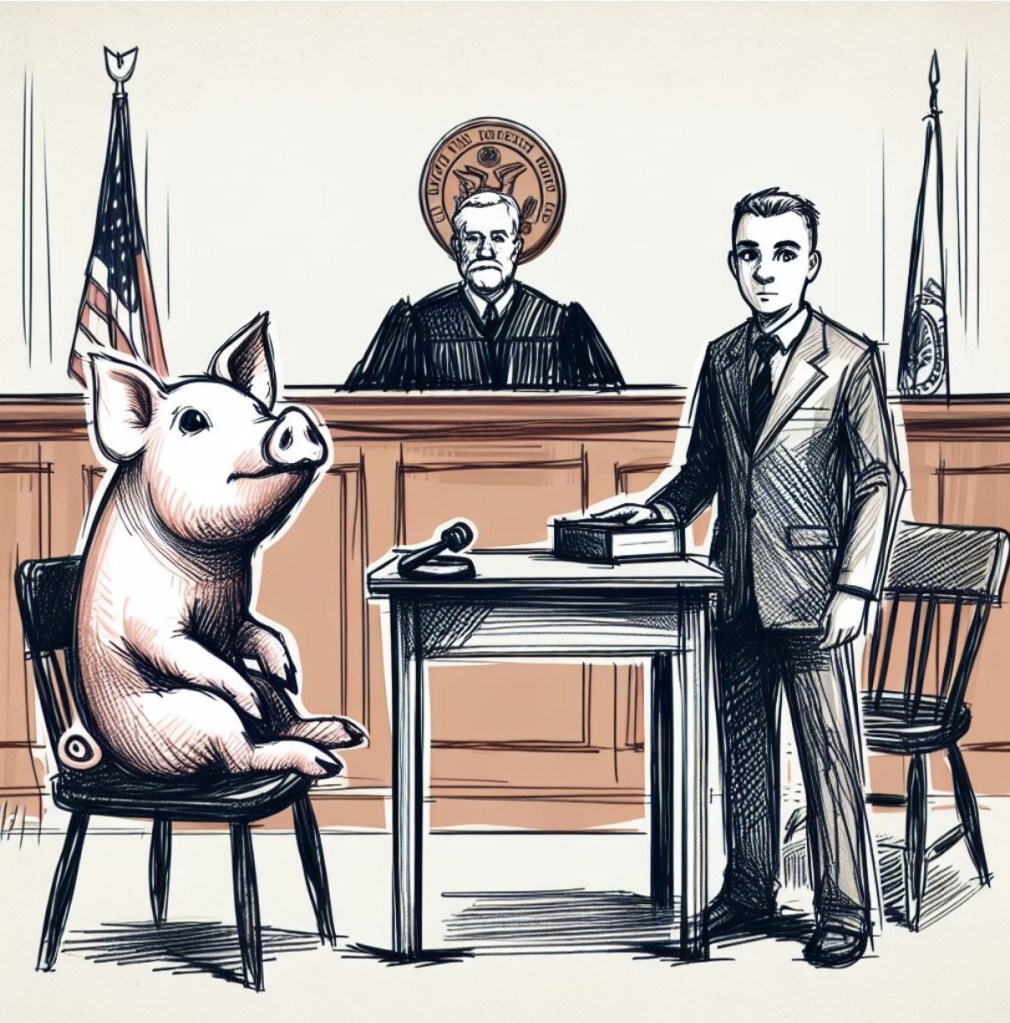
In medieval Europe, it was not uncommon to put animals on trial for various crimes. In France, Italy, Switzerland, and elsewhere, courts tried pigs, dogs, rats, grasshoppers, and snails for crimes against people, property, and God.
Examples include cases brought against vermin who dared to ransack stores of grain and prosecutions for pigs having maimed or killed people.
There’s a whole book about the practice, Chronological List of the Prosecution of Animals from the Ninth to the Twentieth Century, by E.P. Evans. I typed the name of the book in the search bar at Amazon. Apparently it is not available, and the site instead recommended that I purchase a DVD of Ransom, starring Mel Gibson. (?)
No, thank you.
I also say no, thank you to New Jersey Department of Labor and Workforce Development (NJ DLWD), which has proposed new independent contractor classification regulations.
The regulations would re-interpret NJ’s ABC Test in a way that would make it much harder to maintain IC status. The regulations would apply to the NJ Wage Payment Law, the Unemployment Compensation Law, and the Earned Sick Leave Law.
For years New Jersey has used an ABC Test, but with the standard version of part B, unlike California and Massachusetts, which have a strict version of part B.
To satisfy a standard ABC Test, like in NJ, the party engaging the contractor must prove (all three):
The individual has been and will continue to be free from control or direction over the performance of work performed, both under contract of service and in fact; and
The work is either outside the usual course of the business for which such service is performed, or the work is performed outside of all the places of business of the enterprise for which such service is performed; and
The individual is customarily engaged in an independently established trade, occupation, profession or business.
The regulations would largely re-interpret part B to make it more like the strict version, which can be met only if the work is performed “outside the course of the business for which such service is performed.”
The regulation would essentially eviscerate the second option — that the work is performed outside of all the places of business of the enterprise for which such service is performed — and make it nearly impossible to satisfy this alternative.
For example, under the regulations, the retaining party’s “place of business” could include any place where the work is typically performed, even customer’s homes.
The regulations would also make parts A and C harder to meet. In part A, for example, the regulations would declare that control exerted to make sure a contractor follows the law is relevant control that can convert the worker to an employee. But control exerted to ensure compliance with a law is control imposed by the government, which passed the law, not by the company retaining the contractor. This re-imagining of part A would be inconsistent with a multitude of court decisions that have addressed this issue.
I say no, thank you, because the regulation is not consistent with New Jersey law and is not consistent with how other courts around the country have interpreted the ABC factors. The NJ DLWD is supposed to apply the law, not change it. The NJ DLWD is not a legislative body and is not a court.
Nonetheless, it seems like there’s a good chance this will pass.
A 60-day public comment period began with the publication of the proposed rule on May 5. Companies that will be impacted by the rule should consider submitting comments. Page 1 of the proposed regulations explains how.
Misclassification in New Jersey is serious business. The state has been aggressive about pursuing legal action against companies that systemically misclassify workers as ICs. (But so far, no cases against pigs, dogs, rats, grasshoppers or snails. I think.)
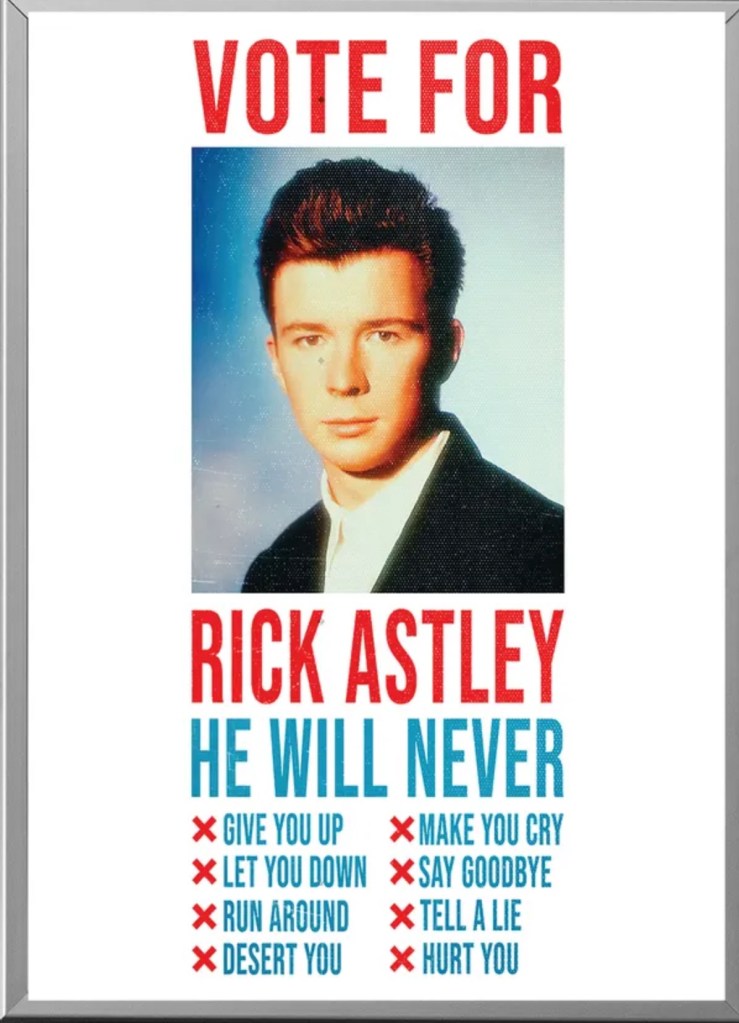
Remember Rick Astley? Yes, this guy. And this song. I assume he had other songs but I know of none of them.
I recently read a Reddit post that offers the Astley Paradox. And it’s a good one.
If you ask Rick Astley for his copy of the movie Up, he cannot give it you as he will never give you up. However, in doing so, he lets you down. Thus creating the Astley Paradox.
California’s tests for determining independent contractor status are not paradoxical, But they are complicated.
There are essentially two tests, the ABC Test and the S.G. Borello Test. The ABC Test is the default test, and it’s the hardest to please.
There are a gazillion exceptions to the ABC Test, and you can find these in California Labor Code sections 2776-2784. But when an exception applies, it doesn’t mean the worker is an independent contractor. It means you use the S.G. Borello test to make that determination instead of the ABC Test.
The S.G. Borello Test is a balancing test. In contrast to the ABC Test, you don’t have to satisfy every factor.
Here’s the S.G. Borello test, with some bonus commentary from the California Department of Industrial Relations:
The California Supreme Court established the Borello test in S.G. Borello & Sons, Inc. v. Dept. of Industrial Relations (1989) 48 Cal.3d 341. The test relies upon multiple factors to make that determination, including whether the potential employer has all necessary control over the manner and means of accomplishing the result desired, although such control need not be direct, actually exercised or detailed. This factor, which is not dispositive, must be considered along with other factors, which include:
Whether the worker performing services holds themselves out as being engaged in an occupation or business distinct from that of the employer;
Whether the work is a regular or integral part of the employer’s business;
Whether the employer or the worker supplies the instrumentalities, tools, and the place for the worker doing the work;
Whether the worker has invested in the business, such as in the equipment or materials required by their task;
Whether the service provided requires a special skill;
The kind of occupation, and whether the work is usually done under the direction of the employer or by a specialist without supervision;
The worker’s opportunity for profit or loss depending on their managerial skill;
The length of time for which the services are to be performed;
The degree of permanence of the working relationship;
The method of payment, whether by time or by the job;
Whether the worker hires their own employees;
Whether the employer has a right to fire at will or whether a termination gives rise to an action for breach of contract; and
Whether or not the worker and the potential employer believe they are creating an employer-employee relationship (this may be relevant, but the legal determination of employment status is not based on whether the parties believe they have an employer-employee relationship).
Borello is referred to as a “multifactor” test because it requires consideration of all potentially relevant facts – no single factor controls the determination. Courts have emphasized different factors in the multifactor test depending on the circumstances. For example, where the employer does not control the work details, an employer-employee relationship may be found if (1) the employer retains control over the operation as a whole, (2) the worker’s duties are an integral part of the operation, and (3) the nature of the work makes detailed control unnecessary. (Yellow Cab Cooperative, Inc. v. Workers’ Compensation Appeals Board (1991) 226 Cal.App.3d 1288.) As the Supreme Court has explained, Borello “emphasizes statutory purpose as the touchstone for deciding whether a particular category of workers should be considered employees rather than independent contractors for purposes of social welfare legislation.” (Dynamex, 4 Cal.5th at 935.) The emphasis on statutory purpose “sets apart the Borello test for distinguishing employees from independent contractors from the [common law] standard . . . in which the control of details factor is given considerable weight.” (Id.)
Most contractor relationships won’t satisfy all of the factors, but you’re going to need to satisfy most if you want independent contractor status under the S.G. Borello test. There’s no precise mathematical formula for how many factors you need, and different judges may evaluate the same set of facts differently, so it’s important to satisfy as many factors as you can.
California law isn’t as forgiving as Rick Astley. California law will often let you down and desert you.
Sometimes things don’t make sense when you read them. Like this: Here’s an adorable video of a dog getting hit by a car.
You need to dig deeper to make sense of it. If you watch the video, you’ll understand. The sentence is true, and the video is adorable.
Another thing that didn’t make sense to me when I first read it is that Trump’s pick for Secretary of Labor, Lori Chavez-DeRemer, was a co-sponsor of the PRO Act.
I had to dig deeper. Is that really true? It is.
Remember the PRO Act? It’s an acronym for Protecting the Right to Organize. It’s a Democrat-sponsored bill that threatens to blow up the gig economy and convert most independent contractors to employees.
The PRO Act would change the definition of “employee” under the NLRA so that all workers are presumed to be employees, not independent contractors, unless the strictest version of the ABC Test is met. That’s the same test as in California, but without all the exceptions.
In the 2023 version of the PRO Act, a worker is an employee under the NLRA unless (all 3):
(A) the individual is free from control and direction in connection with the performance of the service, both under the contract for the performance of service and in fact;
(B) the service is performed outside the usual course of the business of the employer; and
(C) the individual is customarily engaged in an independently established trade, occupation, profession, or business of the same nature as that involved in the service performed.
Yes, that’s the same dreaded Part B that makes California such a difficult place to maintain independent contractor relationships.
The PRO Act would also broaden the definition of joint employment under the NLRA.
Chavez-DeRemer was one of three Republicans to co-sponsor the bill.
The PRO Act will not get the 60 votes needed in the Senate, so it’s not going to pass anytime soon (so long as the filibuster rule remains intact). But this bill is so pro-union that her support should be of concern to any business that engage contractors.
Chavez DeRomer served only one term in Congress, so she did not build an extensive record. But her support of the PRO Act is a part of that limited record.
I expect we’ll learn more about her views during the confirmation process. Her support of the PRO Act is something to keep an eye on. Getting hit with the PRO Act (or some DOL-authorized version of it) would be far worse that the damage done by the car hitting the dog in the video, which you really should watch if you skipped over the link above.
I am entertained by poorly translated things. I have no idea what this shirt means or what the designer thought it would mean. I saw this one in Italy.
I can’t help but wonder what the reaction would be if I wore this shirt in the U.S. Would people say anything to me? I was tempted to ask the wearer about it or to try to buy it from her, but I chickened out.
Last week, the U.S. Supreme Court kind of chickened out too.
A petition had been filed with the Court, asking it to invalidate California’s AB5, its stringent independent contractor law. The petition argued that the law singles out certain businesses and therefore violates the Equal Protection Clause of the U.S. Constitution.
As you may recall, AB5 is the California law that makes it much harder to maintain independent contractor status. The law presumes that most workers are employees and requires a hiring party to satisfy a three-part ABC Test to classify someone as a contractor.
The law, however, does not apply the same standards to everyone. The law exempts loads of industries and types of workers from the ABC Test, and — if we’re being honest here — the law was really targeted toward rideshare and delivery companies.
And that’s exactly what the rideshare and delivery companies argued.
In June 2024, the Ninth Circuit voted to preserve the law, and the case (called Olson v. State of California) was appealed to the U.S. Supreme Court. The Supreme Court, however, can decide which cases to hear and does not have to give a reason for declining to hear a case.
Last week, the Supreme Court declined the petition, opting not to hear the case. The Court provided no reason.
A year earlier, in July 2023, the U.S. Supreme Court denied a different petition asking it to review AB5. The earlier petition, in Mobilize the Message LLC v Bonta, argued that the law’s restrictions on freelance work violated the first Amendment.
For some companies, the Supreme Court’s decision last week not to hear the Olson case will have limited effect. The passage of Prop 22 in late 2020 exempted certain rideshare and delivery app companies from having to comply with AB5. (Prop 22 was also challenged in court and survived.) But AB5 and its ABC Test, later recodified in AB2257, remain in effect for many industries and businesses.
This most recent petition to the Supreme Court alleged that AB5 violated the Equal Protection Clause by unfairly singling out certain industries. I think the evidence is plain that this is what motivated the law, but whether that motivation rises to the level of an Equal Protection violation is another matter.
But no matter. The Supreme Court can decline to hear the appeal, and that’s exactly what it did.
AB5 remains on the books, and I can now start thinking about how I could turn all of this into a poorly translated t-shirt.
If I type “Olson” into google, my top results are Matt Olson, first baseman for Atlanta (makes sense since a lot of my web activity is baseball-related); James A. Olson Guitars (no idea why since the only place I play guitar is on the radio); and Major John Olson of the U.S. Space Force (also no idea why since I have never been to outer space).
The most relevant Olson for me today though is none of these. Instead, it’s a long-awaited decision in a case called Olson v California. In this case, a group of app-based gig economy companies sued the State of California, alleging that AB 5 and its ABC Test are unconstitutional.
Their argument is that the arbitrary grab bag of exceptions to AB 5 is arbitrary and that the law unfairly targets rideshare and delivery drivers.
An 11-judge panel of the Ninth Circuit heard the case en banc, and rejected these arguments.
The Ninth Circuit ruled that AB 5 is constitutional and that the legislature had a rational basis for including and excluding various types of workers from the ABC Test.
The result: AB 5 remains in place. As for rideshare and delivery app companies, Prop 22 created an exception allowing them to treat drivers as independent contractors, although the validity of Prop 22 is being challenged as well. More on that in a future post. The California Supreme Court is hearing arguments on Prop 22 and when a decision is issued, I’ll post about it. But I expect the Prop 22 will survive, just like AB 5 survived.
If I googled Olsen instead of Olson, that might have been more fun. I hopefully would have landed on Keith Olsen, who produced a number of classic rock albums, including Fleetwood Mac by Fleetwood Mac, Double Vision by Foreigner, and a Rick Springfield album with one of the all-time great album covers, Working Class Dog.
This is a venomous Eastern Brown Snake, native to Australia. Stay away.
Tennis star Dominic Thiem knew what to watch for in his match this past weekend in Brisbane. It was on-court hazard he couldn’t ignore.
Play was interrupted when a “really poisonous snake” slithered onto the court near the ballkids. The intruder, an Eastern Brown Snake, “has the unfortunate distinction of causing more deaths by snake bite than any other species of snake in Australia.” The snake’s venom causes “progressive paralysis and uncontrollable bleeding,” which is not one of the on-court hazards typically of ballkidding.
(I don’t know if ballkidding is the real word for this, but it should be. Or ballkiddery maybe. I also learned from the snake bite article that the proper term for being bit by a venomous snake is “envenomation,” which is a word I hope to use elsewhere in a sentence sometime in 2024. So there’s a New Year’s resolution. [@Lisa, take note, I made one, even though you {correctly} say I am no fun because I won’t play the New Year’s Resolution game.])
The Eastern Brown Snake is not present in the U.S., so we don’t have to watch for any in 2024.
But here are several other things that could bite you in the behind in 2024 if you’re not paying attention:
1. New DOL test for independent contractor misclassification. The DOL issued its proposed new rule in October 2022 and targeted the fall of 2023 for release of a new final rule. The proposed rule would identify seven factors to consider when evaluating whether someone is an employee under the Fair Labor Standards Act (FLSA). The final rule will likely be very similar. We’re still waiting, and the final rule could be released at any time.
2. The new NLRB test for joint employment takes effect Feb. 26, 2024. Unless it doesn’t. The new rule is being challenged in both a federal district court in Texas and the U.S. Court of Appeals in D.C. Either court could quash the rule. The new rule will substantially expand who is a joint employer under the NLRA, even for worksites without unions.
3. Increased state and local enforcement activity. States and localities are filing their own lawsuits alleging worker misclassification. The New Jersey Attorney General recently filed a major lawsuit. The California Attorney General and California localities have been pursuing misclassification lawsuits too. Remember this: As much as I advocate for individual arbitration agreements with class waivers, they have no effect on enforcement actions brought by a state or local government. These lawsuits pose a substantial risk, and the governments love to issue one-sided accusatory press releases when they file the lawsuits.
4. The feds are doing this too. The DOL is bringing its own enforcement actions and publicizing them.
5. State and local laws that affect independent contractor classification and joint employment. We’re seeing legislative activity in three main areas:
(a) laws to change the tests; (b) laws that provide a safe harbor for independent contractor classification if certain protections are provided to the workers (Cal. Prop 22, this proposed Mass. state law); and (c) Freelancers laws that impose various requirements when retaining a solo independent contractor (currently: NY, IL, Los Angeles, Minneapolis, Seattle, NYC, Columbus).
6. State laws that criminalize worker misclassification. Take a look at recent legislation passed in NY State and Rhode Island.
7. State laws governing the use of temporary workers. Look for more states to enact laws like the Illinois Day and Temporary Worker Services Act (amended in Aug. 2023) and the New Jersey Temporary Workers’ Bill of Rights (enacted in Aug, 2023). These laws force companies that use staffing agencies to disclose the wages and benefits being paid to direct employees.
8. California’s AB 5 is still being challenged. This is the law that codified the ABC Test for most independent contractor relationships. But it also included a grab bag of miscellaneous and arbitrary exceptions. A full en banc Ninth Circuit has agreed to rehear Olson v. State of California, which challenges the constitutionality of AB 5.
Wishing you a happy, healthy, and litigation-free 2024.
There are quite a few songs about gals named Sue. There’s “Peggy Sue,” “Wake Up Little Susie,” “Susie Q,” and “Runaround Sue.” There’s a even a song about a “Boy Named Sue.” (The results of a recent survey consisting of me revealed that “Boy Named Sue” is by far the best of the Sue-themed songs.)
As far as I know, no one has yet written a song about Labor Secretary nominee Julie Su, but I would not be surprised if one of the unions in California wrote a ballad to applaud her work heading the state’s Division of Labor Standards Enforcement (DLSE) and Labor and Workforce Development Agency. Maybe something like Fatboy Slim’s “Praise You.”
Su is Biden’s pick for Secretary of Labor, following the resignation of Marty Walsh, who left to lead the NHL player’s union. Her nomination is controversial, and businesses fear they’ll be singing the blues if she’s confirmed.
But in a recent Senate committee hearing, she provided at least two answers that businesses will like.
First, she said she would not advocate for an independent contractor test modeled after California’s AB 5. She testified that it’s her view (mine too, probably the courts’ too) that only Congress could adopt an ABC Test to determine worker classification under the Fair Labor Standards Act (FLSA). That’s reassuring.
Second, she said that the DOL’s next regulatory agenda would not include a new joint employer test. The 2020 joint employer regulation adopted by the Trump DOL has been rescinded, and there has been no replacement regulation, which leaves a regulatory crater in the Code of Federal Regulations, where the joint employer rule used to be. Read more here.
On April 26, a Senate committee voted to advance Su’s nomination to the full Senate. All Democrats on the committee voted yes, and she received no Republican support. In a 51-49 Senate, the success of her nomination will likely depend on whether she can secure the support of Senators Manchin, Sinema, and Tester and whether Sen. Feinstein is healthy enough to vote.
And on that note, we turn back to Johnny Cash:
He said, “Now you just fought one heck of a fight And I know you hate me, and you got the right to kill me now And I wouldn’t blame you if you do But you ought to thank me, before I die For the gravel in ya gut and the spit in ya eye ‘Cause I’m the son of a bitch that named you Sue”
When I hear the name Lorena, my mind automatically goes back to 1993, which is probably true for many men about my age. That’s the year when Lorena Bobbitt brought a kitchen knife into the bedroom and cut off her husband John’s member while he was sleeping. She then tossed it in a field near the house, alerted police where to find it, and became an overnight celebrity for having taken revenge after years of alleged domestic abuse.
John later tried to cash in on the detachment, forming a band called The Severed Parts and appearing in two pornos called John Wayne Bobbitt Uncut and Frankenpenis.
It was a different Lorena who grabbed headlines last week, when the Ninth Circuit Court of Appeals considered whether it’s unconstitutional to pass a law because of personal animus.
The law is California’s AB 5, and the Lorena is former California assemblywoman Lorena Gonzalez. As a quick refresher, AB 5 is the California law that imposed a hard-to-satisfy ABC Test for determining independent contractor status. Lorena Gonzalez, a driving force behind the bill, was vocal in her animus toward rideshare and delivery app companies.
In Olson v. California, the rideshare and delivery app companies sued to invalidate AB 5, arguing that the law contained dozens of exceptions targeted toward a grab bag of industries, and their exclusion from the list of exemptions was due to animus toward them, rather than reason.
This might have been a hard argument to make, but for Lorena. Congresswoman Gonzalez made frequent public statements against rideshare and delivery companies, claiming they mistreated workers by not classifying them as employees. Gonzalez said she was open to including exceptions in the bill, but not for these companies. The legislature then passed an exemption for other referral-based app businesses, but not rideshare or delivery, even though the business models are basically the same. A few other vocal lawmakers joined Gonzalez with similar public statements targeting the rideshare and delivery app companies. It’s the old familiar “[insert name] said the quiet part aloud” story.
Last week the Ninth Circuit ruled that personal animus is not a legit reason to pass a law. The Court wrote, “We are persuaded that these allegations plausibly state a claim that the ‘singling out’ of Plaintiffs effectuated by A.B. 5, as amended, fails to meet the relatively easy standard of rational basis review.” The Court was referring to the standard used for evaluating equal protection claims under the Constitution. It does not advance a governmental interest to pass a law out of a desire to harm a politically unpopular group of citizens.
The Court’s ruling did not overturn AB 5. The ruling sent the case back to the district court, which will have to reopen the case against AB 5.
For now the law remains in effect, and there is no immediate impact to businesses in California. But the fight to overturn AB 5 has fresh legs and some momentum.
In other words, businesses in California are still subject to the ABC Test — unless you’re a licensed insurance business or individual, physician, surgeon, dentist, podiatrist, psychologist, veterinarian, lawyer, architect, engineer, private investigator, accountant, registered securities broker-dealer or investment adviser, direct sales salesperson, commercial fisherman working on American vessels for a limited period, marketer, human resources administrator, travel agent, graphic designer, grant writer, fine artist, payment processing agent, still photographer or photo journalist, freelance writer, editor, or cartoonist, licensed esthetician, electrogist, manicurist, barber, cosmetologist, real estate licensee, repossession agent, recording artist, songwriter, lyricist, composer, proofer, manager of recording artists, record producer or director, musical engineer or mixer, vocalist, musician engaged in the creation of sound recording, photographer working on recording photo shoots or album covers, independent radio promoter, newspaper distributor working under contract with a newspaper publisher, newspaper carrier working under contract either with a newspaper publisher or newspaper distributor, contracting party in certain types of business-to-business relationships, or referral agency other than for rideshare or delivery — all of which are subject to possible exemptions.
And so you can see the point. The exemptions are a mishmosh created by special interests and lobbying efforts, with no coherent overall theme — except to make sure rideshare and delivery apps are subject to the ABC Test.
We’ll continue to follow this case. Meanwhile, if you’d like to read more about the original Lorena and the incident, there’s a Lifetime movie, an Amazon docuseries, and a whole bunch ofarticles.
If you have a beard at least 8 inches long, here’s an opportunity you might not have considered. At a bar in Casper, Wyoming, a group of bewhiskered patrons tied their beards together to take the world’s record for Longest Beard Chain.
How long? 150 feet, shattering the previous record of 62 feet, set by a shaggy German crew in 2007.
But that wasn’t even the hairiest highlight of the weekend. Down the street was the National Beard and Moustache Championships, a visual delight featuring moustache categories such as best handlebar, Dali, freestyle, and uber-stache, and partial beard categories including best friendly sideburns, goatee freestyle, musketeer, and Fu Manchu.
Meanwhile, 1,000 miles to the west, a different sort of hairy situation was nearing conclusion for several operators of gentleman’s clubs or nightclubs or strip joints, depending on your preferred terminology.
Last week, a federal district court in San Francisco approved a settlement that combined multiple class action claims of independent contractor misclassification brought by exotic dancers. The settlement covered more than 8,000 dancers and included a total payout of $6.5 million.
The cases were complicated by a number of legal issues, including the fact that — because of the timing of the lawsuit — the question of whether the dancers were contractors or employees was to be determined using different tests for different claims. The dancers’ classification for their California wage order claims would be determined using an ABC Test, but their classification under other Labor Code claims would be determined using the Borello balancing test, which is a California hybrid of Right to Control and Economic Realities Tests.
The class period covered 2010 through 2018, so the Dynamex decision applied to the wage claims, but AB5 had not yet been enacted, which left the Borello test to govern the Labor Code claims. This post explains the complicated situation that existed at the time. Had the class covered the period from January 2020 forward, the ABC Test likely would have been used to determine classification under all of the California claims.
But there were also Fair Labor Standards Act (FLSA) claims. The FLSA uses an Economic Realities Test to determine a worker’s classification, but that test is fluid too. The Economic Realities Test used by most courts is different from the test that was written into the current FLSA regulations in 2020, which is different from the test the DOL recently proposed to enact in a new set of regulations currently under consideration.
So for these class members, there were at least three different tests that would determine whether they were employees or independent contractors under different laws. That’s kind of like trying to determine who had the best musketeer or Fu Manchu but with everyone’s facial hair tied together in a 150-foot beard chain.
There are a few takeaways here for the rest of us.
First, misclassification claims by exotic dancers remain common. The business model needs some internal review. But that’s probably not your concern.
Second, the settlement is a good reminder of how complicated it can be to determine a worker’s classification when multiple laws apply. Different tests apply to different laws, even within the same state. The dancers, had they gone to trial, might have been employees under some laws and contractors under other laws.
Third, there are significant costs in reclassifying contractors to employees. The settlement required the clubs to reclassify their dancers to employees, which means the dancers would become eligible for unemployment, workers’ comp coverage, and protection under the anti-discrimination and leave laws that apply to employees.
Regardless of your business, it’s always a good idea to proactively review independent contractor relationships to see how well they would withstand a classification challenge in court. Misclassification cases are high stakes and can take many twists and turns. Sort of like the facial hair in the Full Beard Freestyle category. (Photos here.)






 Who Is My Employee?