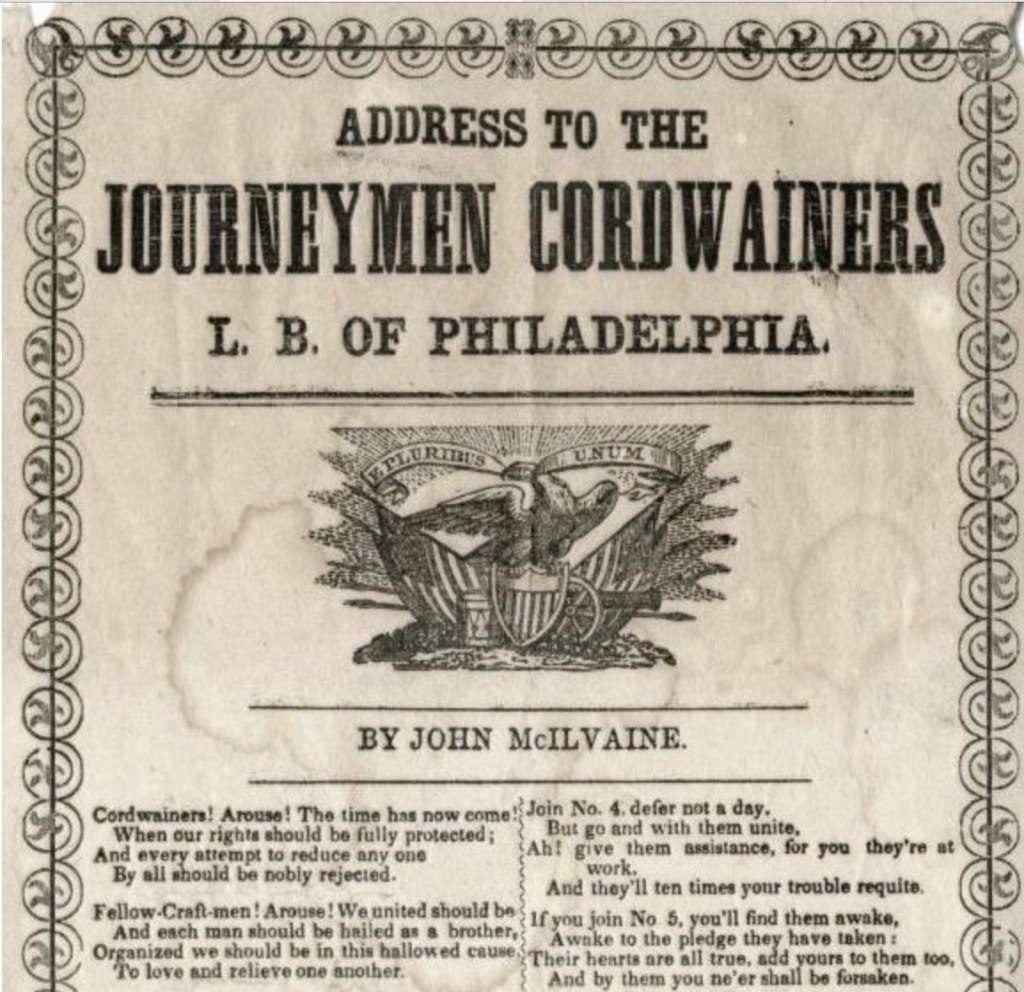
The first labor union in the United States was the the Federal Society of Journeymen Cordwainers, founded in 1794. What is a cordwainer? I had to look that up too, so I’ll save you the trouble.
It’s a shoemaker who makes new shoes from new leather, in contrast to a cobbler who repairs shoes. There aren’t a lot of cordwainers around anymore that I know of. Or maybe there are but they go by a name that sounds less weenie-ish.
There are, however, a lot of rideshare drivers. And the State of California thinks they would like to organize too.
But there’s a problem with that. The National Labor Relations Act protects employees, not contractors. When independent businesses band together to set prices, that’s called price fixing, and it presents all sorts of antitrust problems.
A new California law tries to get around these pesky legal problems.
The Transportation Network Company Drivers Labor Relations Act, AB 1340, allows rideshare drivers the right to collectively bargain, using a process to be overseen by the Public Employment Relations Board (PERB).
Rideshare companies must submit a list of eligible drivers every quarter, and these companies are required to negotiate in good faith with the yet-to-be-formed drivers’ group.
But they’re not “unions,” I suppose, even thought they walk like a union and quack like a union.
The statute is long and detailed. It has lots of procedures.
In 1805, the cordwainers’ union was alleged to be a coercive and violent organization, allegations that arose after a cordwainer on strike threw a potato at a scab. The potato broke a window.
Let’s hope the whole rideshare law thingie goes more smoothly, and we’ll see how this actually works in practice. A possible bad omen: The statute says nothing about the unauthorized use of potatoes.
If you’re a frequent online shopper and reading this post from Japan, you’re probably familiar with the online Japanese flea market app Mercari. What I mean is, I never heard of it either.
Mercari, though, made big news last month when it took the controversial step of banning the sale of prenatal photos on its website. Why would anyone buy someone else’s prenatal photo? For scamming purposes, apparently. And that’s what led Mercari to take action.
The practice of “ninshin sagi” (a phrase that autocorrect vehemently tried to reject) means pregnancy fraud. It occurs when a woman tries to blackmail a male partner into paying money for a supposed pregnancy or to get an abortion. Mercari wants no part in the scheme, so if you want to buy photos of someone else’s uterus, you’ll have to look elsewhere.
New Jersey lawmakers are also saying to look elsewhere, but their ire is aimed at the NJ Department of Labor. As we discussed here, the NJ DOL issued a proposed rule that would change the state’s test for determining independent contractor status. The public comment period for the rule has closed, and now the NJ DOL needs to consider each comment and decide what to do.
Several NJ lawmakers, however, are urging the DOL to back off, and the sentiment is bipartisan. The proposed rule, they say, is not consistent with the current state of NJ court decisions or the NJ statute. (I agree!)
There is no timetable for the NJ DOL to issue a final rule. Or the NJ DOL may abandon its effort to adopt the rule. It’s also possible that lawmakers would enact legislation to block the proposed rule.
Companies with independent contractors in NJ should keep an eye on what happens here. The proposed rule would make NJ’s current ABC Test much stricter and harder to meet, thereby making it very difficult to maintain independent contractor status in NJ.
But at least in New Jersey you can still buy online uterus pics.
I found this guy while running in the neighborhood
When animals flock together, we use strange collective names to describe them. You’ve heard of a flock of seagulls, a pod of whales, and a murder of crows. But did you know the collective nouns for apes, hippos, and wildebeests?
Fortunately, this wildlife writer does. It’s a shrewdness of apes, a bloat of hippopotamuses, and a confusion of wildebeests.
My favorite, though, is a parliament of owls. The phrase was apparently coined by CS Lewis in the 1950s and stuck. Good for the owls! I wish for them to form a strong government and pass wise laws.
When independent contractors flock together, we don’t really have a good word for that. Contractors generally can’t flock together for employee benefit plans since they’re not employees, even though some states have enacted portable benefits laws as models for what may be viable on a national level.
One impediment to companies providing contractors with benefits is that doing so can be evidence of an employment relationship. Companies are perversely incentivized not to help contractors remain self-sufficient because companies don’t want to risk misclassification claims.
That could change with a national portable benefits bill.
There has been interest for a long time among trade associations and small business groups to allow portable healthcare and retirement benefits for independent contractors. A recently released white paper by Sen. Bill Cassidy, Chair of the Senate Health, Education, Labor, and Pensions (HELP) Committee, advocates for a national portable benefits bill.
The white paper proposes various options for providing affordable health care options for independent contractors, including association health plans, health reimbursement arrangements, pooled employer plans, and single employee pension IRAs. For these programs to work, Congress would have to ensure that a company’s participation in such plans is not a factor in determining whether the contractor receiving such benefits is misclassified.
The concept of portable benefits for contractors is one that should have bipartisan support. The main obstacle to such a bill is likely the desire by some for contractors to receive all of the benefits of employees, and so this concept (for them) is only half a loaf.
Once upon a time, we used to have a Congress that would consider half a loaf to be better than no loaf at all. My hope is that legislators will find a way to make this concept work.
It would be wise. Something that a parliament of owls could probably get done.
In Canadian folklore, the Wendigo is an evil creature that can possess humans and turn them into cannibals. Wendigos cannot control their bloodlust and will even eat their loved ones, according to facts.net. The term “Wendigo Psychosis” has been used to describe a psychiatric condition in which patients experience intense desires to eat human flesh.
And that brings us to Trump’s executive orders on DEI.
On Friday, the Fourth Circuit Court of Appeals lifted a nationwide injunction that stalled enforcement of Trump’s DEI orders. The injunction was lifted for technical legal reasons, not because of policy reasons. In fact, two of the three judges wrote concurring opinions to show their support for DEI initiatives, even though they agreed the injunction should be lifted.
In one concurrence, Judge Albert Diaz expressed his frustration that they were unable to address the real substantive issue, referring to DEI initiatives (which he favors) as“a monster in America’s closet.” But hopefully not a Wendigo.
So how do the DEI orders affect independent contractors, and what should businesses do?
First, every business should be conducting an overall DEI audit right now. Programs and initiatives that overtly favor one group need to go. Scholarships and internships available only to certain racial or ethnic groups should be changed. Hiring quotas or targets must be removed. There’s a lot of gray area too, and there are a lot of things we are doing for clients in this area, but this post isn’t about DEI audits, so I’ll stop there.
Second, here’s what to look for with contractor relationships:
Check your supplier retention policies.
Eliminate any requirements to retain a certain percentage of minority or women-owned businesses.
Remove contractor (or supplier or vendor) selection criteria that consider race or sex.
Make sure that your supervisors who make retention decisions are not evaluated based on their performance in reaching targets to retain contractors based on race or sex.
Check supplier and vendor contracts for staffing criteria that favor or disfavor any protected group.
The attack on DEI is real, and companies who rightly remain committed to ensuring fair opportunities for all need to evaluate how they are seeking to achieve these goals. The government has an appetite for consuming companies whose DEI initiatives go too far. Like the Wendigo.
This Thursday, Feb 27 marks National Toast Day, an important annual celebration that commemorates this versatile form of bread. Toast for breakfast? Toast for brunch? Snack? PB&J? Is there anything toast can’t do?
National Toast Day is celebrated on the last Thursday of February each year, which means that this year it overlaps with National Polar Bear Day, National Strawberry Day, and National Kahlua Day.
Put all those things together and you’ve got one helluva picnic.
But why do I mention toast? Because of independent contractor classification tests, of course. Here’s what I mean.
Remember the 2024 DOL independent contractor rule — you know, the one that the Biden DOL passed in January 2024? We hardly had a chance to get acquainted.
I’ll tell you something that won’t surprise you. The Trump Administration is likely going to rescind it. Or maybe ignore it. Or maybe allow a court to reject it. One way or another, it’s gonna be toast.
There are several lawsuits challenging the 2024 rule, and one of them — Frisard’s Transportation v. US DOL — was scheduled for oral argument at the Fifth Circuit Court of Appeals in early February.
The DOL, however, asked the court to postpone oral argument to allow it time to consider how it wants to proceed. How it wanted to proceed under Biden was to defend the rule. Now, not so much.
However the case proceeds, we can expect that the Trump DOL will not apply the Biden Administration’s independent contractor test.
So what does that mean for the independent contractor test?
In reality, not much.
That’s because, first, the rule applied only to the Fair Labor Standards Act (FLSA), which is the federal wage and hour statute. It didn’t apply to tax law, benefits law, labor law, unemployment or workers’ comp law, or any state law.
And second, the test for who is an employee under the FLSA has always been an Economic Realities Test, and courts know what that test is. Every circuit court has a long line of case law describing the Economic Realities test. The courts don’t need the Biden or Trump Administration to tell them how to interpret the FLSA. The FLSA has been on the book since the 1930s, back when Biden and Trump were mere teenagers.
So what does this mean for employers? Again, not much. Employers should assume that under federal wage and hour law, the test for whether someone is an employee or independent contractor is the same as it has been for decades.
This anticipated change is not really going to change anything at all.
Now, if instead of toast, the Trump Administration made the rule into Kahlua, that would seem to be worth celebrating.
I ran a search for songs about Washington DC. I didn’t recognize any that popped up, but there is one that caught my eye — and ear.
“Washington DC Hospital Center Blues” is a 1966 release by blues guitarist Skip James. You can check it out here.
Although it may seem like nothing newsworthy is happening in DC lately (tee hee hee, bahahahaha), there is a DC Court of Appeals case worth watching.
The NLRB had ruled that Google is a joint employer of YouTube contract workers, who are represented by the Alphabet Workers Union. The impact of NLRB’s decision would be that Google is forced to the bargaining table to negotiate with workers it does not directly employ. Google defied the order and appealed to the DC Court of Appeals, arguing that it is not a joint employer.
There are a few joint employment issues in the case that are worth watching:
First, what is the proper test for joint employment under the NLRA? Historically, courts have held that a common law right-to-control test applies, but the NLRB keeps issuing its own regulations defining (and changing) the joint employer test.
Second, will courts pay any attention to what the NLRB thinks the test is? If the proper test is a common law test, then the courts don’t need the NLRB to tell it what the common law is.
Finally, whatever the DC Circuit decides, will the NLRB listen? Historically, the NLRB follows the doctrine of non-acquiescence. That’s a fancy of way of saying it doesn’t care what the courts say. If it wasn’t the Supreme Court that ruled, the NLRB tends to ignore the ruling, except as it applies in that particular dispute.
If you’re looking for something interesting that might be happening in DC, this case is a good one to follow.
Sometimes things don’t make sense when you read them. Like this: Here’s an adorable video of a dog getting hit by a car.
You need to dig deeper to make sense of it. If you watch the video, you’ll understand. The sentence is true, and the video is adorable.
Another thing that didn’t make sense to me when I first read it is that Trump’s pick for Secretary of Labor, Lori Chavez-DeRemer, was a co-sponsor of the PRO Act.
I had to dig deeper. Is that really true? It is.
Remember the PRO Act? It’s an acronym for Protecting the Right to Organize. It’s a Democrat-sponsored bill that threatens to blow up the gig economy and convert most independent contractors to employees.
The PRO Act would change the definition of “employee” under the NLRA so that all workers are presumed to be employees, not independent contractors, unless the strictest version of the ABC Test is met. That’s the same test as in California, but without all the exceptions.
In the 2023 version of the PRO Act, a worker is an employee under the NLRA unless (all 3):
(A) the individual is free from control and direction in connection with the performance of the service, both under the contract for the performance of service and in fact;
(B) the service is performed outside the usual course of the business of the employer; and
(C) the individual is customarily engaged in an independently established trade, occupation, profession, or business of the same nature as that involved in the service performed.
Yes, that’s the same dreaded Part B that makes California such a difficult place to maintain independent contractor relationships.
The PRO Act would also broaden the definition of joint employment under the NLRA.
Chavez-DeRemer was one of three Republicans to co-sponsor the bill.
The PRO Act will not get the 60 votes needed in the Senate, so it’s not going to pass anytime soon (so long as the filibuster rule remains intact). But this bill is so pro-union that her support should be of concern to any business that engage contractors.
Chavez DeRomer served only one term in Congress, so she did not build an extensive record. But her support of the PRO Act is a part of that limited record.
I expect we’ll learn more about her views during the confirmation process. Her support of the PRO Act is something to keep an eye on. Getting hit with the PRO Act (or some DOL-authorized version of it) would be far worse that the damage done by the car hitting the dog in the video, which you really should watch if you skipped over the link above.
The band America (“A Horse with No Name,” “Ventura Highway”) was formed in England. Yes, really. But by three Americans whose fathers were in the U.S. Air Force and stationed overseas.
That got me thinking about other bands with place names. When I was growing up in Miami in the 1980s, if someone mentioned Boston, I thought of just another band out of Boston, on the road to make ends meet. If someone mentioned Kansas, I thought of dust in the wind, even though I never particularly liked that song. Chicago made me think of the Cubs, but only in 1984. Otherwise, does anybody really know what time it is?
Not that I am older and have a life, place names mean something different to me. They now make me think of federal, state, and local laws affecting independent contractor status.
(Ok, I take back the comment about having a life. I realize this is a sad and pathetic way to think of place names.)
After the election, place names are going to take on greater importance as businesses aim to protect their independent contractor relationships. Federal enforcement activity isn’t going away, but I expect to see a growing emphasis on legislation and enforcement at the state and local level.
In the realm of non-employee workers (independent contractors, staffing agency temps), I expect to more state and local legislation in these areas:
1) Freelancer Laws. We now have freelancer laws in CA, NY, IL, Los Angeles, NYC, Minneapolis, Seattle, and Columbus. These laws impose requirements when retaining individuals who are independent contractors. The laws generally require written contracts that contain several mandatory components.
2) Temporary Worker Laws. We have these in NJ and IL. They generally require that staffing agencies pay their workers an equivalent wage rate (and sometimes the value of benefits) being paid to workers they work alongside at the company where they are providing services.
3) Misclassification Laws – the Bad Kind. In states with Democrat trifectas (house, senate, governor), expect new laws that make it harder to be an independent contractor. Expect more ABC Tests, like in CA and MA. Other states have ABC Tests for determining who is an employee under workers’ comp and unemployment law.
4) Misclassification Laws – the Good Kind. In states with Republican trifectas, expect more safe harbor laws. If you satisfy a set of basic requirements in your dealings with a non-employee worker, then the worker is an independent contractor under that state’s laws. Pesky balancing tests (and long-haired freaky people) need not apply. We have these state laws in WV and LA (not L.A.)
We will likely see changes at the federal level too, but these may take years to develop. The federal agency rulemaking process is slow and cumbersome, and agency rules will take on less importance as federal agency power continues to diminish after the Supreme Court’s Loper Bright decision.
I haven’t touched on Europe or Asia, but those are bands for another day and another post. When? At some point, in the heat of the moment, but only time will tell.
There was no post last week because I was on vacation. We went to Lake Michigan for a week of lakeside R&R, which was terrific and relaxing. I mostly unplugged, read books having nothing to do with lawyering, and went on two long beach runs (memo to the autocorrect gods: not Long Beach (CA) runs).
The only sad part was that blog mascot and loyal friend Zippy passed away after 16 years of labradoodling. She had been fighting dementia and cancer, which is not a winning combination. The only positive was that the whole family was together, and the kids got to see her one last time.
You may remember Zippy from such blog lists as Face It: The New DOL Independent Contractor Rule Faces Court Challenges; andHow to Support Prong C of the ABC Test, and Why You Can’t Lie Down When Faced with an Audit; and Get Aligned on Commissions: Ten Tips for Using Independent Contractor Sales Reps.
Now that I’ve got that out of the way, and now that we’re back home, the refrigerator is empty and so it’s time to go shopping.
The NLRB is going shopping too, despite what you may have read elsewhere.
On July 19, the NLRB submitted a motion to voluntarily dismiss its appeal in the Fifth Circuit. The NLRB had filed this appeal after a district court judge in Texas invalidated the NLRB’s 2023 joint employer rule. The effect of that ruling was to reinstate the 2020 rule, which makes it difficult to find joint employment under the NLRA.
So the 2023 rule is dead, right? That’s what I’ve been reading. The NLRB must be hanging its head and admitting defeat, right?
I’m not so sure that’s what the NLRB is doing. You see, there is another set of appellate challenges to the 2023 joint employer rule pending in the District of Columbia Court of Appeals. The D.C Court of Appeals is viewed as a more favorable venue for the NLRB to litigate than the more conservative Fifth Circuit.
In June, the D.C. Circuit ruled that it would hold its case in abeyance until the Fifth Circuit ruled, handing a win to business groups fighting the rule, since employers would rather have this issue decided in the Fifth Circuit.
By withdrawing its Fifth Circuit appeal, the NLRB ensures that the dispute will shift back to the D.C. Circuit. Presumably, the D.C. Circuit will reopen its case and consider whether the new joint employer rule can survive.
So when the NLRB withdrew its appeal in the Fifth Circuit, I don’t think that means the Board is giving up the fight. I think they might just be going shopping for a more favorable venue.
I could be wrong. In its Motion for Voluntary Dismissal, the NLRB writes that it “would like the opportunity to further consider the issues identified in the district court’s opinion” and that it seeks dismissal “to allow it to consider options for addressing the outstanding joint employer matters before it.”
I think that means judge shopping, not quitting. We’ll see what happens in the D.C. Circuit.
That’s because I just read the 65-page opinion in Johnson v. NCAA. The issue before the Third Circuit Court of Appeals was whether college athletes could plausibly be employees under the Fair Labor Standards Act (FLSA).
A massive class action had been brought, and the NCAA and other defendants filed a motion to dismiss. The district court denied it, allowing the case to move forward. The NCAA was allowed an immediate appeal, but the Third Circuit has affirmed and allowed the case to proceed.
Here’s why I am whelmed.
I am underwhelmed by the Third Circuit’s legal analysis, which has more faults than a novice tennis player learning to serve. I am overwhelmed by the massive unintended consequences that would flow from an eventual finding that college athletes are, in fact, employees.
Overwhelmed plus underwhelmed must equal whelmed, right?
The word overwhelmedcomes from the Middle English whelmen, which meant “to overturn.” For speakers of Modern English, that’s nothing more than a fun fact, though, because we’d have a really hard time understanding anyone speaking Middle English anyway. Maybe you had to read The Canterbury Tales in school? Cliffnotes, please.
I am underwhelmed by the legal analysis for many reasons.
1. The Third Circuit acknowledges but then disregards the Supreme Court’s instruction in Walling v Portland Terminal that “[a]n individual who ‘without promise or expectation of compensation, but solely for his personal purpose of pleasure, worked in activities carried on by other persons either for their pleasure or profit,’ is outside the sweep of the Act [FLSA].”
2. The Third Circuit acknowledges but the disregards the Department of Labor’s longstanding position and guidance in its Field Operations Handbook, sec. 10b03(e), which says that the activity of college students participating in interscholastic athletics primarily for their own benefit as part of the educational opportunities provided to the students by the school is not ‘work.’”
3. The Third Circuit ignores the long-recognized concept that play is not work. The dictionary definition relied upon by the Supreme Court in the Walling case differentiated “work” from “something undertaken primarily for pleasure, sport, or immediate gratification….”
4. The Third Circuit butchers the well-established Economic Realities Test, which is the standard for determining employee status under the FLSA. The Third Circuit instead advocates for applying the common law test of agency, which, according to the Supreme Court, is not the test.
5. The Third Circuit pays little attention to the fact that students who elect to play sports do so with no expectation of payment, making them volunteers. Volunteers are not subject to the FLSA (whether at U. Tenn. or otherwise).
6. The Third Circuit makes up a new four-part test (out of thin air) for determining when “college athletes may be employees”:
We therefore hold that college athletes may be employees under the FLSA when they (a) perform services for another party, (b) “necessarily and primarily for the [other party’s] benefit,” Tenn. Coal, 321 U.S. at 598, (c) under that party’s control or right of control, id., and (d) in return for “express” or “implied” compensation or “in-kind benefits,”
I am overwhelmed by the massive unintended consequences that would flow from a ruling that 500,000 collegiate athletes across 1,100 schools are employees of their schools.
If these schools had to pay minimum wage and overtime to all college athletes, that would bust their athletic budgets. Sports that do not pay for themselves (essentially all except major football and some basketball programs) would have to be cut.
Remember when Title IX caused schools to cut unprofitable men’s sports like diving and swimming so they could equalize their offerings of men’s and women’s sports? If only football and men’s basketball are profitable, then schools will need to maintain equivalent women’s sports to comply with the mandates of Title IX. That means some women’s sports will survive, at a loss to offset the opportunities given to men in football and basketball, and the other men’s sports will be cut. If we have to pay, then you can’t play.
International students on F-1 visas would have to be cut from their teams, since their visas generally do not allow them to engage in compensable employment. (That’s why international students can’t take NIL money.) Or federal immigration law will need to be changed.
Unless other laws are changed, schools might be required to provide these employees with healthcare benefits, family or medical leave (paid in some states), reimbursement of expenses in some states, unemployment insurance, workers compensation, and a range of other benefits.
If the courts mess this up, which seems very possible, Congress will need to step in and enact a comprehensive set of rules applicable to college athletes.
For now, the immediate impact of this decision is limited. The Third Circuit did not rule that college athletes are employees under the FLSA. They ruled only that it is plausible that circumstances may exist under which college athletes could be employees under the FLSA. Procedurally, all that happened here is that a motion to dismiss was denied.
Next, the parties will fight over class certification, which could cause the case to fall apart, given the massively divergent situations of, say, a D-1 football player at Alabama and a D-3 bowler at Whatsamatta U.
The issue of whether college athletes are employees under federal wage and hour laws, federal labor laws (NLRA), and a myriad of other laws (state and federal) is not going away soon.
My fear, though, is that courts are (1) likely to apply the wrong legal analysis (as the Third Circuit did here, appearing completely lost), (2) likely to misapply laws that were never intended for this situation, and (3) likely to cause a cascade of unintended consequences that will lead to the end of college sports — unless Congress steps in. (Insert joke here.)








 Who Is My Employee?