

Summer of Fun? FTC Announces Plans to Crack Down on Gig Economy

Zippy at her first reggae concert

In my house, we have declared this to be the Summer of Fun, and we’ve committed to going to events around Cleveland that we haven’t tried before. Sometimes the dog gets to come too. Last month, we took Zippy to her first reggae concert. You can tell she enjoyed it because she’s smiling. (Or she’s thirsty. Still not sure.)

No concert t-shirt for Zippy though. They had suitably small sizes but nothing with four arm holes.

The Federal Trade Commission is also trying new things this summer. In a July press release, the FTC announced that one of its new initiatives is a crackdown on gig economy abuses.

The FTC can’t bring independent contractor misclassification cases, but it can bring enforcement actions when it believes there have been unfair or deceptive business practices that disadvantage gig workers.

The FTC announced that “the agency will continue to take action to stop deceptive and unfair acts and practices aimed at workers; particularly those in the ‘gig economy’ who often don’t enjoy the full protections of traditional employment relationships.” The press release then listed several examples of enforcement actions the FTC has been pursuing against gig economy companies. The cases tend to involve deceptive claims about earning opportunities, including for gig workers who use their platforms.

The FTC further announced that it’s teaming up with the NLRB to share information about alleged wrongdoers in the gig space. We already know that the NLRB’s General Counsel is on a mission to crack down on independent contractor business models. The decisions by the NLRB and FTC to join forces only heightens the risks for companies using an independent contractor business model.

Business using an independent contractor model need to remember that misclassification claims are not the only legal risk. Be sure that representations made to independent contractors about potential earning opportunities and other business practices are accurate and realistic.

Otherwise, despite it being the Summer of Fun, with reggae concerts and other goodness, the FTC may soon be on your doorstep, ready to Stir It Up.

Enter your email address to subscribe to this blog and receive notifications of new posts by email.

© 2022 Todd Lebowitz, posted on WhoIsMyEmployee.com, Exploring Issues of Independent Contractor Misclassification and Joint Employment. All rights reserved.

2018_Web100Badge
 

Yes, This Applies to You: Why Non-Union Employers Should Be Concerned with the NLRB’s View On Worker Misclassification

Good news for old passengers traveling to New York!

The caption above may be too small to read, but it’s from a recent New York Times article about updates to the airport. The caption says, “An old passenger walkway in the process of being demolished at La Guardia Airport.”

You might not think this applies to you, but I say it’s about time! The idea of a walkway for old passengers doesn’t seem right, and old passengers should be allowed to use the same walkway as everyone else.

Another area where I sometimes hear “this doesn’t apply to me” is when we talk about the National Labor Relations Board’s views on independent contractor misclassification. But even if your business is union-free (meaning no union, not that the union is complimentary), the NLRB’s position on independent contractor misclassification matters. (Also, how is it that we intuitively know caffeine free means there’s no caffeine, rather than there’s lots of it and there’s no extra charge?)

The NLRB wants to make it harder to maintain independent contractor status under the National Labor Relations Act (NLRA).

Here are four reasons your non-union business should care about the NLRB’s views on independent contractor misclassification:

  1. The NLRB’s General Counsel has issued a policy memo indicated that she intends to have independent contractor misclassification declared to be an automatic unfair labor practice (ULP). This spring, the Board issued a complaint in a case that may help it achieve this policy goal. If misclassification becomes an automatic ULP, that would overturn the Board’s 2019 decision in Velox Express, when the Board said it was reasonable for a company to express its opinion that a worker was a contractor, not an employee, even if the company turned out to be wrong.
  2. If the NLRB rules that your contractors are employees, you can hang up a welcome shingle for your favorite union. (Aside: I don’t think anyone would welcome shingles, but you can buy welcome shingles on amazon.) Such a ruling would empower the unions to try to organize your newly-declared employees. If some independent contractors were already feeling mistreated enough to seek employee status, they’ll likely welcome union representation to help them fight back against The Man.
  3. The protections granted to employees under the NLRA apply to non-union employees too. But the NLRA doesn’t apply to independent contractors. Non-union employees have the right to engage in protected, concerted activity without fear of retaliation or reprisal. Contractors don’t. Protected, concerted activity can include more than you might think. Any time two employees get together to object to a business practice, that’s potentially protected, concerted activity. If two contractors jointly complain, the NLRA doesn’t apply.
  4. The NLRB has an information sharing agreement with the Department of Labor (DOL). If the NLRB thinks your contractors are misclassified, they’re probably gonna tell on you. The DOL may then starts its own investigation, viewing your company as an easy target for misclassification, even though the tests for employee status are different under the NLRA and the federal wage and hour laws administered by the DOL.

Like La Guardia, the NLRB is trying to do a little remodeling, but the NLRB’s remodeling is not for the benefit of old passengers. Instead, the Board is trying to make it harder to classify a worker as an independent contractor. The Board also wants to declare worker misclassification to be an automatic ULP.

Whether your workforce is union or non-union, businesses should pay attention. This is a rebuild that’s worth watching.

Enter your email address to subscribe to this blog and receive notifications of new posts by email.

© 2022 Todd Lebowitz, posted on WhoIsMyEmployee.com, Exploring Issues of Independent Contractor Misclassification and Joint Employment. All rights reserved.

2018_Web100Badge
 

Watch Your Back, AB 5! Ninth Circuit Case Could Wipe Out California’s ABC Test

Yes, that’s a goat on my back.

This weekend we tried goat yoga. Highly recommended. It was a mix of basic yoga (my kind of yoga) to help get me stretched out, but held in a pen with goats who know no boundaries.

We then toured the farm, which featured llamas, long-haired pigs, guinea hens, a few obligatory dogs, and several varieties of goats, including the kind of fainting goats featured in that George Clooney movie.

Having to watch my back during yoga was something I signed up for and was part of the fun. Not so for California’s AB 5, which should be watching its back after what we saw at the Ninth Circuit last week.

The Ninth Circuit held oral argument in a case brought by Uber called Olson v State of California. Uber is arguing that AB 5 is unconstitutional.

While it’s hard to predict cases based on oral argument, the three judges on the panel seemed pretty sympathetic to Uber’s argument, which is that the statute arbitrarily picks winners and losers, i.e., the exemptions make no sense from an equal protection/due process standpoint.

Unlike the strict ABC Test in Massachusetts, the California ABC Test codified in AB 5 (and later AB 2257) contains loads of exceptions. The statute says to use the ABC Test to determine employee vs independent contractor status for all workers — except for dozens of categories of workers and various other situations.

Let’s not pretend. We all know this bill was written to target ride share and delivery app companies. The unfairness of making this law apply to everyone soon became apparent and led to the insertion of dozens of exceptions. If an exception applies, the Borello balancing test applies instead of the ABC Test.

The exceptions just about swallow the rule, and a law targeting a handful of companies presents constitutional problems. Or so the argument goes.

We can expect a decision in the next few months, and this is one to watch. Unlike me at goat yoga, imagining a decision that strikes down or severely limits AB 5 is not a big stretch.

Enter your email address to subscribe to this blog and receive notifications of new posts by email.

© 2022 Todd Lebowitz, posted on WhoIsMyEmployee.com, Exploring Issues of Independent Contractor Misclassification and Joint Employment. All rights reserved.
2018_Web100Badge
 

Watch Your Back, AB 5! Ninth Circuit Case Could Wipe Out California’s ABC Test

Yes, that’s a goat on my back.

This weekend we tried goat yoga. Highly recommended. It was a mix of basic yoga (my kind of yoga) to help get me stretched out, but held in a pen with goats who know no boundaries.

We then toured the farm, which featured llamas, long-haired pigs, guinea hens, a few obligatory dogs, and several varieties of goats, including the kind of fainting goats featured in that George Clooney movie.

Having to watch my back during yoga was something I signed up for and was part of the fun. Not so for California’s AB 5, which should be watching its back after what we saw at the Ninth Circuit last week.

The Ninth Circuit held oral argument in a case brought by Uber called Olson v State of California. Uber is arguing that AB 5 is unconstitutional.

While it’s hard to predict cases based on oral argument, the three judges on the panel seemed pretty sympathetic to Uber’s argument, which is that the statute arbitrarily picks winners and losers, i.e., the exemptions make no sense from an equal protection/due process standpoint.

Unlike the strict ABC Test in Massachusetts, the California ABC Test codified in AB 5 (and later AB 2257) contains loads of exceptions. The statute says to use the ABC Test to determine employee vs independent contractor status for all workers — except for dozens of categories of workers and other situations.

Let’s not pretend. We all know this bill was written to target ride share and delivery app companies. The unfairness of making this law apply to everyone soon became apparent and led to the insertion of dozens of exceptions. If an exception applies, the Borello balancing test applies instead of the ABC Test.

The exceptions just about swallow the rule, and a law targeting a handful of companies presents constitutional problems. Or so the argument goes.

We can expect a decision in the next few months, and this is one to watch. Unlike me at goat yoga, imagining a decision that strikes down or severely limits AB 5 is not a big stretch.

AB 5, watch your back.

Enter your email address to subscribe to this blog and receive notifications of new posts by email.

© 2022 Todd Lebowitz, posted on WhoIsMyEmployee.com, Exploring Issues of Independent Contractor Misclassification and Joint Employment. All rights reserved.

2018_Web100Badge
 

No Laughing Matter: Here’s Why States Think Your Independent Contractors Are Misclassified

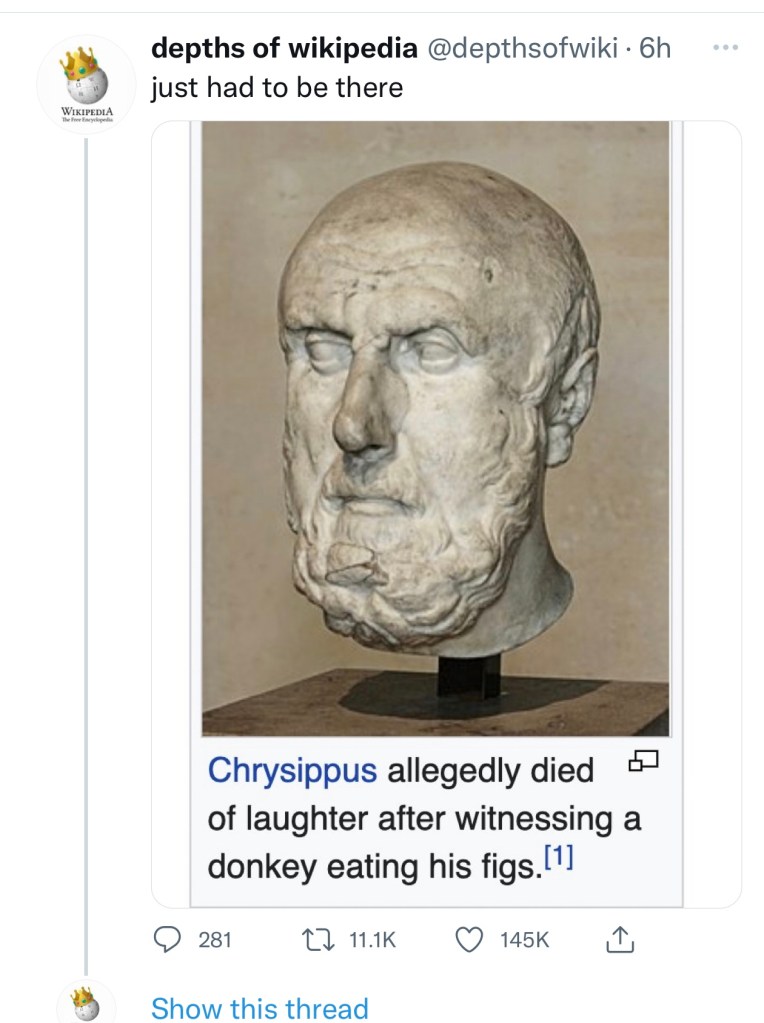
The best twitter account you’re not yet following is Depths of Wikipedia @depthsofwiki, which finds all the crazy fascinating stuff on Wikipedia that you wish you had time to look for.

Such as this gem from last week:

I didn’t know who Chrysippus was, but this is top shelf information. He died of laughter after witnessing a donkey eat his figs?!

That would make for one f***d-up game of Clue.

Here’s something that’s not a laughing matter.

Ever wondered why states seem so aggressive in fighting against companies that classify workers as independent contractors? Ok, yeah, there’s the crowd-pleasing pitch that they’re looking out for the little guy, and workers are being denied benefits, and companies are cheating the systems, etc.

But also comes down to money. State governments claim they are losing hundreds of millions of dollars a year in unpaid taxes and unpaid contributions to unemployment and workers compensation funds. This policy brief by the National Employment Law Project cites to 30 state law studies with varying estimates of losses to state coffers.

Are these studies accurate, or are they merely self-serving reports designed to justify misclassification audits? Probably some of both, but the point is that it doesn’t matter. Whether motivated by workers’ rights or bolstering state coffers, states are doing two things to make it harder to classify workers as independent contractors.

First, several pending state bills would make it harder to classify workers as independent contractors.

Second, states are taking enforcement seriously. Through audits and lawsuits, the states are going after companies directly.

For companies, defending against state action can be a lot harder than defending against private lawsuits. State prosecutors and agencies claim to be fighting for the little guy, and they tend to get dug in with their positions. State prosecutors and agency enforcers get paid the same salary, win or lose, and it can be harder to persuade them that your company’s classifications are legitimate and that they should be spending their limited time and resources elsewhere.

Plaintiffs’ lawyers, on the other hand, are business people and are generally more open to business solutions that are driven by a cost-benefit analysis of how best to use their limited time and resources. A strong set of facts supporting independent contractor classification can lead to a victory in court or can create leverage for a favorable settlement with private litigants. Private settlements can also be reached with no admission of wrongdoing.

The lesson here is that enforcement efforts by state governments are no laughing matter. While a donkey trying to eat your figs may be drop-dead hilarious, an enforcement action by the state isn’t so funny. But it can still kill your business.

Enter your email address to subscribe to this blog and receive notifications of new posts by email.

© 2022 Todd Lebowitz, posted on WhoIsMyEmployee.com, Exploring Issues of Independent Contractor Misclassification and Joint Employment. All rights reserved.

2018_Web100Badge
 

Don’t Get in Over Your Head: Set Up a Gatekeeper

Last month in Washington State, at a trailhead on the Olympic Peninsula, a woman dropped her cell phone in a pit latrine. Yes, that’s a flushless outhouse. The woman tried to retrieve the phone using a dog leash, then tried to use the dog leash to support herself as she reached down into the stinky muck. Dog leashes, however, are not meant for such endeavors, and — yes, this really happened — the leash failed. The woman fell head first into the latrine.

Making the best of a shitty situation, the woman found her phone, which she then used to call for help. The fire department rescued her, and the dispatch operator will be telling the story of that intake call forever.

The lesson here is: Know when to get help.

That lesson also applies to your company’s independent contractor relationships. Today’s tip is to set up a Gatekeeper System.

If your company is like most businesses, it’s simpler to contract with outside labor than to hire new employees. Operations managers or a procurement team are the people most likely to approve contracts for services. Because there are no employees being engaged in these contracts, the contracts don’t go to Human Resources, and they probably don’t get reviewed by Legal.

But every contract for services carries a risk that the individuals providing the services may be misclassified. Even if treated as independent contractors, those workers might be your employees under federal or state law. Or, if they’re being treated as employees of the business you contract with, they might be your joint employees. Both scenarios – independent contractor misclassification and joint employment – present legal risks.

But your operations managers or procurement team have not been trained to recognize those risks. They likely have never considered that the people providing those services might be deemed your company’s employees.

To protect against these risks, set up a Gatekeeper System. That would be a policy that says, anytime we retain non-employees to provide a service, there must be a written contract and it must be reviewed by a specific individual, the gatekeeper.

The gatekeeper will be trained to issue-spot and to recognize circumstances that may present an elevated risk of misclassification or joint employment. The gatekeeper can raise concerns with the legal department. Or maybe the gatekeeper is part of the legal team.

Setting up a Gatekeeper System is easy. It’s just a policy requiring a specific layer of review whenever non-employees are retained to perform a service. Make sure everyone authorized to enter into contracts for the business knows of the policy. Then train your gatekeeper to issue spot and to escalate for further analysis when necessary.

The point is that someone needs to know to look out for these risks. You can only protect yourself against the risks you have identified. Once you get sued or hit with an audit, it’s too late.

Just like it was too late for our friend the Washington hiker, who should have asked for help a bit earlier — before getting in over her head.

Enter your email address to subscribe to this blog and receive notifications of new posts by email.

© 2022 Todd Lebowitz, posted on WhoIsMyEmployee.com, Exploring Issues of Independent Contractor Misclassification and Joint Employment. All rights reserved.

2018_Web100Badge
 

It’s a Mistake? Too Bad. NLRB Might Soon Make Misclassification an Automatic Unfair Labor Practice

Cover art from the single, released on Epic Records

In the early 80s, I had two cassettes by the Australian band Men at Work — Business as Usual, released in 1981, and Cargo two years later.

Cargo includes the single, “It’s a Mistake,” a satirically upbeat Cold War-inspired song in which a soldier tries to figure out whether the Cold War is about to turn hot. The video features too-short shorts, bad lip syncing, and old ladies hitting the band members with umbrellas on the battlefield, all of which leads to an accidental nuclear launch, triggered when an officer tries to stub out his cigar in an ashtray but hits the wrong button.

All in all — a good song, a mediocre video, and a strong commentary on the politics of the day.

A recent move by the NLRB’s General Counsel revives the “It’s a Mistake” narrative, this time in the context of independent contractor misclassification. There are no accidental nukes involved, but the move is definitely politically motivated.

If the General Counsel has her way, the Board will rule that independent contractor misclassification is an automatic unfair labor practice (ULP), even if it’s a mistake.

To reach that conclusion, the Board would have to overturn its 2019 decision in Velox Express, in which the Republican-controlled Board ruled that misclassifying a worker, by itself, is not automatically a ULP.

The GC’s actions are no surprise. In mid-2021, she issued a strategy memo announcing that one of her strategic (political) priorities was to get Velox Express overturned during her tenure. With the NLRB now featuring a 3-2 Democratic majority, she’s likely to prevail.

What does this mean for companies that use independent contractors?

It means the stakes are higher. If Velox Express is overturned, misclassification of independent contractors would likely become an automatic ULP, even if the classification was well-intentioned. Essentially, there would be strict liability for misclassification.

Traditional remedies for ULPs include back pay and reinstatement, which could mean forced reclassification as employees. The GC has been pushing to further expand the scope of available remedies because, hey, why not.

If your business is hit with a ULP and forced to reclassify workers under the NLRA, good luck trying to maintain independent contractor status under wage and hour laws or other laws.

A reversal of Velox Express, therefore, may have sweeping ramifications, making it much harder to maintain independent contractor status across a broad range of federal and state laws.

The consequences of this expected reversal will be serious — not quite on the scale of nuclear devastation, but worse than old ladies hitting you on the head with an umbrella.

Enter your email address to subscribe to this blog and receive notifications of new posts by email.

© 2022 Todd Lebowitz, posted on WhoIsMyEmployee.com, Exploring Issues of Independent Contractor Misclassification and Joint Employment. All rights reserved.

2018_Web100Badge
 

Hold Your Horses! A Court of Appeals May Have Granted Independent Contractors the Right to Strike and Organize

On June 4, 1923, jockey Frank Hayes rode 20-1 long shot Sweet Kiss to victory at Belmont Park. While that seems impressive, what made the win even more memorable is that at some point during the race, poor Frank died. He somehow stayed on the horse and ended up in the winner’s circle. Or six feet under it. It was his first (and last) win as a jockey.

Jockeys are in the news again, and we’ve got another surprise finish. But this one has implications far beyond the racetrack.

Click here for the rest of the story, originally posted yesterday on the BakerHostetler blog, Employment Law Spotlight.

Enter your email address to subscribe to this blog and receive notifications of new posts by email.

© 2022 Todd Lebowitz, posted on WhoIsMyEmployee.com, Exploring Issues of Independent Contractor Misclassification and Joint Employment. All rights reserved.

2018_Web100Badge
 

Upside Down? U.S. Companies Can Learn from Australian High Court Ruling on Independent Contractors

Source: Hema Maps

There’s no reason our maps are oriented the way they are, with Australia at the bottom and Canada near the top. There’s no right side up in space, and we could just as easily think of the world with Australia on top, in the middle.

Same with our way of deciding Who Is My Employee? The process for determining whether someone is an employee or an independent contractor doesn’t have to be the way Americans conduct that analysis.

Two High Court decisions this month in Australia highlight a key difference between the American approach and what is now the new Australian approach.

In the U.S., courts look past the written contract and analyze a worker’s status based on the actual facts of the relationship.

The Australian High Court says the U.S. approach is upside down.

In two highly publicized decisions, the Australian court ruled that the contract establishes the rules of the relationship and therefore also determines the worker’s status. In one case, the agreement said the work would be controlled by the hiring party. By contractually reserving the right to control the work, the hiring party inadvertently made the worker an employee. The court still looked past the fact that the parties called the worker an independent contractor, but the court said the contractual requirements of the relationship — the terms and conditions — controlled the outcome.

The other High Court case involved two truck drivers. Their contracts exhaustively set forth terms preserving their flexibility to work for others and to control how their work was performed. Their contracts also called for the drivers to use their own equipment, which involved a significant investment by the drivers. The court overruled a lower court decision that deemed the workers to be employees. The lower court focused on actual control exerted by the hiring party. But the High Court said the contract controls and, in this case, the contract established requirements consistent with independent contractor status. It is up to the parties to follow the contract, but the contract establishes the independent contractor relationship.

There are lessons for American companies here too.

While under U.S. law, the actual facts of the relationship control whether the worker is an employee, the independent contractor agreement is an opportunity to memorialize the helpful facts. That’s why off-the-shelf templates in the U.S. are of no value. (Hot tip: Google & Bing is not a law firm.) See related posts here and here, including how to discomfit a bear.

An independent contractor agreement in the U.S. should be drafted with the particular facts of the relationship in mind. Does the worker get to decide when and where the work is done? If so, put that in the contract. The worker controls when and where the work is performed, and the hiring party has no right to control when and where.

If the worker’s status is challenged, you want the contract to be a helpful piece of evidence. You want to be able to say to a court: Not only does the worker get to decide when and where the work is done (or insert other factor), but the contract forbids us from controlling that.

In the U.S., contract terms like that will be persuasive evidence, but only if the actual facts align. In Australia, the contract sets the rules, and the parties are in breach if they fail to follow the rules established in the contract.

But no matter where you sit, and no matter which way your map is aligned, companies should view independent contractor agreements as an opportunity to build the case that an independent contractor is properly classified.

By planning ahead and drafting carefully, you can maximize your chances of coming out on top.

Enter your email address to subscribe to this blog and receive notifications of new posts by email.

© 2022 Todd Lebowitz, posted on WhoIsMyEmployee.com, Exploring Issues of Independent Contractor Misclassification and Joint Employment. All rights reserved.

2018_Web100Badge
 

That’ll Cost You 96 Camels: Court Headlocks Staffing Agency with $7.2M Misclassification Judgment

Mom feeding a non-wrestling camel, May 2010

If you weren’t in Turkey last month, you missed the annual Selçuk Efes Camel Wrestling Festival, which featured 162 competitors in four categories.

The camels are paired by weight and skill, and their techniques include tripping their opponents with foot tricks or applying headlocks then sitting on their opponents. Some just push until the other camel gives up. A winner is declared when one camel scares away the other, making him scream or collapse. The camels are muzzled so there is no biting.

Among those missing the spectacle were the owners of Steadfast Medical Staffing, a Virginia-based firm that maintains a database of nurses and pairs them with healthcare facilities. That’s because they were in federal court, defending against a lawsuit by the Department of Labor. The DOL alleged that they had misclassified the nurses as independent contractors in violation of the Fair Labor Standards Act (FLSA).

After a bench trial, the judge agreed with the DOL and ruled that the nurses — which included CNAs, LPNs and RNs — were employees of the staffing agency. The Court applied the Economic Realities Test, which is the proper test for determining who is an employee under the FLSA.

The Court considered all relevant factors, then applied camel-style headlocks while sitting on the defendant, causing the staffing agency to either scream or collapse (unclear from the opinion). The Court ruled that the staffing agency failed to pay overtime and failed to comply with FLSA record keeping requirements. The agency will be liable for approximately $3.6M in back wages plus another $3.6M in liquidated damages.

Following the judgment, the DOL issued a statement with quotes from the Secretary of Labor, Marty Walsh, and the Solicitor of Labor, Seema Nanda, that the DOL was sending an “unequivocal message” to Steadfast and other staffing companies that the DOL is serious about pursing independent contractor misclassification.

Staffing agencies that treat workers as independent contractors are on notice that the DOL is serious about enforcement. Remember, the facts of the relationship determine whether a worker is an employee or an independent contractor, not how the parties choose to characterize the relationship.

More than 1,100 nurses will share in the award, with a healthy-but-to-be-determined amount of fees headed to the plaintiffs’ lawyers.

A prized wrestling camel can be sold for more than a million Turkish lira. That’s about $75,000. Large awards like this for systemic misclassification are not surprising. This one will cost the staffing firm about 96 wrestling camels.

Enter your email address to subscribe to this blog and receive notifications of new posts by email.

© 2022 Todd Lebowitz, posted on WhoIsMyEmployee.com, Exploring Issues of Independent Contractor Misclassification and Joint Employment. All rights reserved.

2018_Web100Badge
 

>