This is a photo of the sun setting last week over the Tiber River, with St. Peter’s Basilica in the background. I’m not a great photographer, but it’s a nice record shot from my trip to Italy last week.
The National Labor Relations Board (NLRB) last week created its own record shot, formally readopting its 2020 joint employer rule and sunsetting the never-implemented Biden administration rule from 2023.
The NLRB skipped the normal rulemaking process, which typically requires a proper review and comment period, jumping directly to the final rule. It was able to avoid these steps because the final rule isn’t actually changing anything. The 2020 rule applied before the Biden administration tried to change the rule in 2023, but a federal court rejected the 2023 rule, which the Biden administration then withdrew. The result of that withdrawal was that the 2020 rule was still in effect. Last week’s action by the NLRB formalizes that outcome by officially readopting the 2020 joint employer rule.
What’s the Rule?
Read more here, originally posted today on BakerHostetler‘s Labor Relations blog, The Bargaining Table.
I took last week off work to visit Asheville. The first morning, we woke up at 5 am for a sunrise hike at Craggy Pinnacle, along the Blue Ridge Parkway. This was our view at the top.
Fortunately, the fog burned off after an hour or so. We waited and were rewarded with some spectacular views. Our 7-month old puppy Louie was just happy there were other dogs at the top to play with. Here he is, admiring the view.
The lesson, of course, is to be patient and sometime the fog will clear. (Or check the weather report?)
Franchisors are hoping for the same reward, through the proposed American Franchise Act, introduced in the House in September and now before the House Committee on Education and Workforce.
The bill, which has at least some bipartisan support, would change the definition of joint employment under the NLRA and FLSA for franchisee-franchisor relationships.
The bill would establish that a franchisor can be a joint employer only if it exercises “substantial direct and immediate control” over one or more “essential terms and conditions of employment of the employees of the franchisee.”
“Essential terms and conditions of employment” means wages, benefits, hours of work, hiring, discharge, discipline, supervision, and direction.
To be a joint employer, the franchisor would have to control these terms with respect to individual employees. Setting baseline standards and brand guidelines would not create joint employment.
The risk of joint employment liability is an ongoing concern for franchisors. The franchise business model requires a level of control to ensure brand consistency and a uniform customer experience across locations. The American Franchise Act, if passed, would help to protect the franchise model and establish clear guidelines for what level of control is needed to create a joint employment relationship.
For three hours each night, a policeman appears out of thin air in a busy park in Seoul, South Korea. His presence has, according to police data, reduced crime in the park by 22%. The policeman, however, has never arrested anyone, and he doesn’t even move around the park.
That’s because he’s a hologram.
The police chief attributes the program’s success to “citizens’ perceived safety,” although I’m not sure why anyone would perceive themselves safer in the presence of a hologram. Maybe I should not be so cynical. If it works, it works.
A new federal bill seeks to increase employers’ perceived safety, but without holograms.
The Save Local Business Act, H.R. 4366, would amend the National Labor Relations Act (NLRA) and the Fair Labor Standards Act (FLSA) to create a uniform test for joint employer status. By adding a new joint employer test to the statutes, Congress would prevent the NLRB and DOL from trying to change the test every time there’s a new party in the White House.
The Act is a pro-business bill. If it passes, joint employer status would be much harder to establish.
Under the proposed text, joint employer status could exist “only if each employer directly, actually, and immediately, exercises significant control over the essential terms and conditions of employment of the employees of the other employer.”
“Essential terms and conditions” would mean, for example, “hiring such employees, discharging such employees, determining the rate of pay and benefits of such employees, supervising such employees on a day-to-day basis, assigning such employees a work schedule, position, or task, or disciplining such employees.”
The bill is sponsored by James Comer (R-Ky.). It was introduced July 14, 2025. Previous versions of the bill were introduced in 2021 and 2023. Obviously, they failed.
With Republicans controlling the House, passage in the House seems possible, but the likelihood of getting 60 votes in the Senate is pretty remote.
So the bill, while it seems good for businesses, is probably the legislative equivalent of a Korean holographic police officer. It looks nice but exerts no real authority.
The Aztec Death Whistle is shaped like a human skull and produces a hideous shrieking sound, as if conjuring up 1000 piercing human screams. These whistles have been discovered in burial site excavations. Scholars believe that they played a role in warfare or burial ceremonies.
Either way, they make a pretty awful sound. Here’s a youtube video demonstration. Enjoy! 😳
Rep. Kevin Kiley (R-CA) hopes that two new bills will sound a death whistle to the confusing morass of independent contractor tests.
The Modern Worker Empowerment Act (MWEA) would codify the test for employee status under the Fair Labor Standards Act (FLSA) and the National Labor Relations Act (NLRA). The new test would create a two-part test. It would be a blend of the Right to Control Test and the Economic Realities Test.
An individual would be deemed an independent contractor if (1) the hiring party does not exercise significant control over how the work is performed, and (2) the person performing the work has the opportunities and risks inherent to entrepreneurship.
The bill would also prohibit consideration of certain facts, such as any requirement to comply with legal and safety standards.
The Modern Worker Security Act (MWSA) would create a safe harbor so that companies could provide portable benefits to independent contractors.
These laws would apply only to classification under the FLSA and NLRA. The bills do not attempt to modify the IRS’s Right to Control standard or any state law tests.
So are these bills a death whistle for the current IC tests?
Probably not. My Aztec-themed prediction device says the bills are not likely to become law. But I like the thinking. Any increase in clarity for the IC tests would be helpful to the business community.
Meanwhile, if you’d like to learn more about Aztec death whistles, there’s an actual study published in Nature that investigates the “Psychoacoustic and Archeoacoustic nature of ancient Aztec death whistle.” Here’s the link.
I ran a search for songs about Washington DC. I didn’t recognize any that popped up, but there is one that caught my eye — and ear.
“Washington DC Hospital Center Blues” is a 1966 release by blues guitarist Skip James. You can check it out here.
Although it may seem like nothing newsworthy is happening in DC lately (tee hee hee, bahahahaha), there is a DC Court of Appeals case worth watching.
The NLRB had ruled that Google is a joint employer of YouTube contract workers, who are represented by the Alphabet Workers Union. The impact of NLRB’s decision would be that Google is forced to the bargaining table to negotiate with workers it does not directly employ. Google defied the order and appealed to the DC Court of Appeals, arguing that it is not a joint employer.
There are a few joint employment issues in the case that are worth watching:
First, what is the proper test for joint employment under the NLRA? Historically, courts have held that a common law right-to-control test applies, but the NLRB keeps issuing its own regulations defining (and changing) the joint employer test.
Second, will courts pay any attention to what the NLRB thinks the test is? If the proper test is a common law test, then the courts don’t need the NLRB to tell it what the common law is.
Finally, whatever the DC Circuit decides, will the NLRB listen? Historically, the NLRB follows the doctrine of non-acquiescence. That’s a fancy of way of saying it doesn’t care what the courts say. If it wasn’t the Supreme Court that ruled, the NLRB tends to ignore the ruling, except as it applies in that particular dispute.
If you’re looking for something interesting that might be happening in DC, this case is a good one to follow.
Sometimes things don’t make sense when you read them. Like this: Here’s an adorable video of a dog getting hit by a car.
You need to dig deeper to make sense of it. If you watch the video, you’ll understand. The sentence is true, and the video is adorable.
Another thing that didn’t make sense to me when I first read it is that Trump’s pick for Secretary of Labor, Lori Chavez-DeRemer, was a co-sponsor of the PRO Act.
I had to dig deeper. Is that really true? It is.
Remember the PRO Act? It’s an acronym for Protecting the Right to Organize. It’s a Democrat-sponsored bill that threatens to blow up the gig economy and convert most independent contractors to employees.
The PRO Act would change the definition of “employee” under the NLRA so that all workers are presumed to be employees, not independent contractors, unless the strictest version of the ABC Test is met. That’s the same test as in California, but without all the exceptions.
In the 2023 version of the PRO Act, a worker is an employee under the NLRA unless (all 3):
(A) the individual is free from control and direction in connection with the performance of the service, both under the contract for the performance of service and in fact;
(B) the service is performed outside the usual course of the business of the employer; and
(C) the individual is customarily engaged in an independently established trade, occupation, profession, or business of the same nature as that involved in the service performed.
Yes, that’s the same dreaded Part B that makes California such a difficult place to maintain independent contractor relationships.
The PRO Act would also broaden the definition of joint employment under the NLRA.
Chavez-DeRemer was one of three Republicans to co-sponsor the bill.
The PRO Act will not get the 60 votes needed in the Senate, so it’s not going to pass anytime soon (so long as the filibuster rule remains intact). But this bill is so pro-union that her support should be of concern to any business that engage contractors.
Chavez DeRomer served only one term in Congress, so she did not build an extensive record. But her support of the PRO Act is a part of that limited record.
I expect we’ll learn more about her views during the confirmation process. Her support of the PRO Act is something to keep an eye on. Getting hit with the PRO Act (or some DOL-authorized version of it) would be far worse that the damage done by the car hitting the dog in the video, which you really should watch if you skipped over the link above.
There was no post last week because I was on vacation. We went to Lake Michigan for a week of lakeside R&R, which was terrific and relaxing. I mostly unplugged, read books having nothing to do with lawyering, and went on two long beach runs (memo to the autocorrect gods: not Long Beach (CA) runs).
The only sad part was that blog mascot and loyal friend Zippy passed away after 16 years of labradoodling. She had been fighting dementia and cancer, which is not a winning combination. The only positive was that the whole family was together, and the kids got to see her one last time.
You may remember Zippy from such blog lists as Face It: The New DOL Independent Contractor Rule Faces Court Challenges; andHow to Support Prong C of the ABC Test, and Why You Can’t Lie Down When Faced with an Audit; and Get Aligned on Commissions: Ten Tips for Using Independent Contractor Sales Reps.
Now that I’ve got that out of the way, and now that we’re back home, the refrigerator is empty and so it’s time to go shopping.
The NLRB is going shopping too, despite what you may have read elsewhere.
On July 19, the NLRB submitted a motion to voluntarily dismiss its appeal in the Fifth Circuit. The NLRB had filed this appeal after a district court judge in Texas invalidated the NLRB’s 2023 joint employer rule. The effect of that ruling was to reinstate the 2020 rule, which makes it difficult to find joint employment under the NLRA.
So the 2023 rule is dead, right? That’s what I’ve been reading. The NLRB must be hanging its head and admitting defeat, right?
I’m not so sure that’s what the NLRB is doing. You see, there is another set of appellate challenges to the 2023 joint employer rule pending in the District of Columbia Court of Appeals. The D.C Court of Appeals is viewed as a more favorable venue for the NLRB to litigate than the more conservative Fifth Circuit.
In June, the D.C. Circuit ruled that it would hold its case in abeyance until the Fifth Circuit ruled, handing a win to business groups fighting the rule, since employers would rather have this issue decided in the Fifth Circuit.
By withdrawing its Fifth Circuit appeal, the NLRB ensures that the dispute will shift back to the D.C. Circuit. Presumably, the D.C. Circuit will reopen its case and consider whether the new joint employer rule can survive.
So when the NLRB withdrew its appeal in the Fifth Circuit, I don’t think that means the Board is giving up the fight. I think they might just be going shopping for a more favorable venue.
I could be wrong. In its Motion for Voluntary Dismissal, the NLRB writes that it “would like the opportunity to further consider the issues identified in the district court’s opinion” and that it seeks dismissal “to allow it to consider options for addressing the outstanding joint employer matters before it.”
I think that means judge shopping, not quitting. We’ll see what happens in the D.C. Circuit.
The government loves acronyms. Sometimes a little too much. If you check the DHS.gov website for its guide to acronyms, you’d see that AA can refer to eight different things, all entirely unrelated. AA can mean Affirmative Action, Approval Authority, or my favorite, Atomic Absorption. (A close second is Anti-Aircraft Improvised Explosive Device Incident. Sadly, no explanation is provided for why DHS drops the IEDI part.)
AAA has four approved meanings, including American Ambulance Association and Area Agency on Aging.
In law we get lots of acronyms too, and sometimes they show up in case names. Today we’re looking at the case of SEIU v. NLRB, which is battle over JE (joint employment, heh heh).
SEIU v. NLRB is one of two cases involving a challenge to the NLRB’s recent joint employer rule.
The NLRB joint employer rule is being challenged in both the D.C. Court of Appeals and the Fifth Circuit. The Fifth Circuit is generally viewed as more pro-business, with the D.C. Court a bit more deferential to the NLRB. So to U.S. businesses intent on squashing the new joint employer rule, location matters.
Last week, the D.C. Circuit issued an order that it will stay its case, and the Fifth Circuit gets to decide first.
How did we get here?
In October 2023, the NLRB issued its new joint employer rule, which would vastly expand the scope of joint employment.
In November 2023, the SEIU, seeking a friendly ruling, filed a petition in the D.C. Court of Appeals, asking the court to review and uphold the rule. For those of you wondering how the SEIU could file directly with the Court of Appeals, there’s a rule allowing it.
Meanwhile, at about the same time, the U.S. Chamber of Commerce (and others) filed a lawsuit in the Eastern District of Texas, asking the court to stop the rule. In March 2024, the federal court in Texas enjoined the rule. The NLRB then appealed to the Fifth Circuit.
Then we had a potential stalemate, with two federal Courts of Appeal being asked to review the same rule.
Now that the D.C. Court of Appeals has agreed to hold its case in abeyance, the Fifth Circuit will go first, which is likely a good thing for the business community.
The Fifth Circuit case is just getting started. the NLRB’s appellate brief is due June 26, 2024. Until the Fifth Circuit rules, the joint employer rule remains stayed. The joint employer rule did not take effect. So now we wait to see what the Fifth Circuit will do, and we should not expect a ruling until 2025.
This past weekend, the solar storm was supposed to be strong enough that we could see the aurora borealis in Cleveland. At 11:30 Friday night, my family went to the Polo Fields in nearby South Chagrin Metropark to see for ourselves.
Lots of others had the same idea, and the fields allowed us an unobstructed view of the sky, where we saw…. nothing really.
We read that iPhones capture light better than our eyes, so we too photos of the blank sky. Turns out there’s some truth to that. I took the photo above, which makes it appear that I saw a nice light show. But I didn’t. I took a photo of what appeared to me to be dark sky. So it was there, but I couldn’t see it.
The NLRB also wants us to see something that isn’t there.
Last week, the NLRB filed an appeal in the Fifth Circuit Court of Appeals, asking the court to reinstate its new joint employer rule.
A quick rewind, for context: In 2023 the NLRB tried to implement a new rule for determining whether joint employment exists. The rule would have made it much easier to find joint employment, including in situations where most of us never would have thought joint employment would exist. On March 8, 2024, a federal judge in Texas vacated the rule, just days before it was scheduled to take effect. You can read more about that decision here.
So with this latest filing, the NLRB is trying to revive the rule, but the NLRB faces an uphill battle in a largely conservative Fifth Circuit.
For now, the NLRB rule remains dead. It’s possible that could change, depending on how the Fifth Circuit rules.
But if you take an NLRB-issued iPhone to the courthouse in New Orleans that houses the Fifth Circuit Court of Appeals and snap a photo, you just might see a glimpse of the rule, invisible to the naked eye. Or maybe that’s just a picture of gumbo.
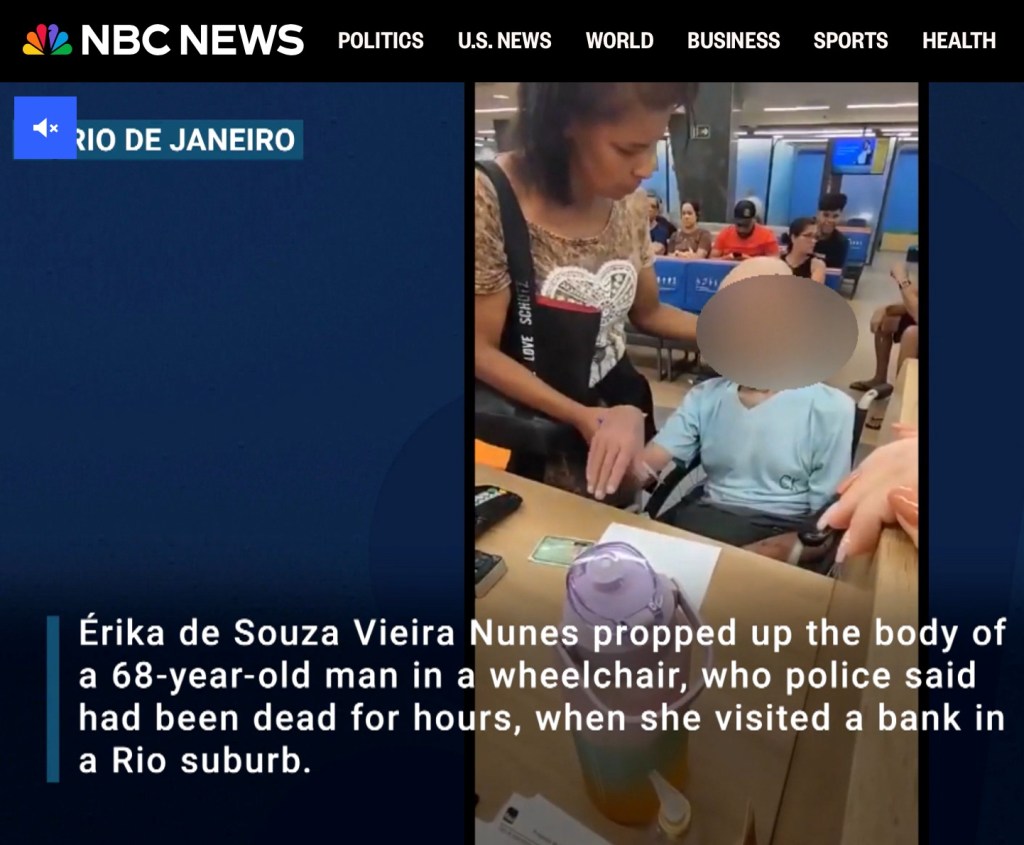
A Brazilian woman brought her Uncle Paolo to a bank branch so he could sign a loan document for her. Uncle Paolo was in a wheelchair and couldn’t seem to grip a pen, despite the woman’s best efforts to get him to cooperate.
But Uncle Paolo had good reason not to grip the pen and sign. You see, Uncle Paolo was dead. The woman brought the deceased to the bank in a wheelchair, thinking that — well, I don’t know she was thinking.
The bank called the police, and the woman was arrested. Uncle Paolo, reportedly, is still dead. The best part? There’s video.
Also still dead is the NLRB’s recent joint employer rule, struck down by a federal judge on March 8th.
Congress just took action to try to make it deader.
On April 10, the Senate voted 50-48 to invalidate the NLRB rule, following a 206-177 vote by the House.
President Biden has indicated he would veto the resolution, but the fact that the resolution received support from moderate Democrats, not just Republicans, may be a sign of how far out of touch the NLRB’s rule really was. Two Democratic Senators and eight Democratic members of Congress voted for the resolution.
Assuming the district court decision survives on appeal, the NLRB rule will remain dead, and the Congressional vote doesn’t make any difference anyway. That’s because dead is dead.










 Who Is My Employee?