
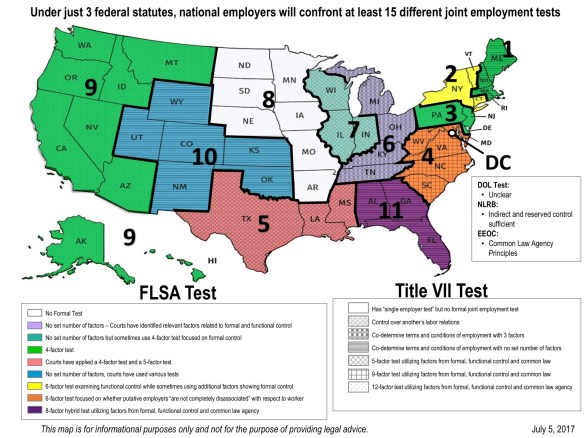
 The tests for determining whether a business is a joint employer vary, depending on which law applies. That means there are different tests under federal labor law, wage and hour law, and employee benefits law, to name a few. There are also different tests under different states’ laws.
Further complicating the analysis, there are even different tests when applying the same law — depending on where you live.
Yes, you read that right. Even though the Fair Labor Standards Act (FLSA) is a federal wage and hour law that applies across the country, federal courts in different states use different methods for determining whether a business is a joint employer under that single law.


 In the Lynyrd Skynyrd song, “Gimme Three Steps,” we find our hero cutting a rug down at a place called The Jug with a girl named Linda Lou. This catchy song has nothing to do with labor law but does deal with someone who finds himself in a bad situation (shakin’ like a leaf on a tree!) and needs three steps to get out the back door.
 The Family and Medical Leave Act (FMLA) is already one of the hardest employment laws to comply with. Add joint employment into the mix, and the level of difficulty further increases.
 It seems like every month another professional athlete is caught using a prohibited substance. The typical script (after getting caught) is to blame the maker of a supplement. “I should have more carefully checked the label,” or “I had no way of knowing what was in that synthetic elephant urine.”
 Are franchisors responsible for the wage and hour violations of their individually owned franchisees?
