The Munker-White Illusion, image by David Novick (UTEP)
This is one of my favorite optical illusions. The spheres here are all beige. They are not red, green, or purple. Look closely and you’ll see. David Novick, a professor of engineering at UTEP, explains the illusion here.
It’s fun to be fooled with optical illusions. But it’s not fun to be fooled with federal immigration law.
Companies retaining independent contractors should remember these key points for I-9s and immigration law compliance:
1. Properly classified independent contractors do not need to complete I-9 forms.
2. Misclassified independent contractor — that is, those who are really employees under federal law — are employees and should have a completed I-9. A multi-factor test is used to make this determination. According to federal regulations, these factors should be considered:
Who supplies tools or materials;
Whether the worker makes services available to the general public;
Whether the worker works for a number of clients at the same time;
Worker’s opportunity for profit or loss as a result of labor or services provided;
Worker’s investment in facilities for work;
Who directs the order or sequence in which the work is to be done; and
Who determines the hours during which the work is to be done.
3. Federal law prohibits individuals or businesses from contracting with an independent contractor to provide services in the U.S., knowing that the contractor is not authorized to work in the U.S. [8 U.S.C. 1324a(a)(4)]
4. Staffing agency temps employed by the staffing agency must complete I-9s as employees of the staffing agency. Contracts with staffing agencies should make clear the staffing agency accepts this obligation. If an agency sends a bunch of undocumented temps to your worksite, you might get an unscheduled visit from ICE, which is not a good look.
For those keeping a list at home (wait, that’s just me?), you can add immigration law noncompliance to the list of Things That Can Go Badly When Independent Contractors are Misclassified.
The one on the left is now 6-foot-5. The one on the right? Whereabouts unknown.
When my kids were younger, we used to play a guessing game. The questioner would think of someone, real or imaginary. The object was to figure out who. We’d go around the table, and each person gets one question that could only be answered with yes or no, then they’d get one guess. Then it goes to the next person to ask one and guess one.
The best strategy was to ask broad questions first: Is the person real? Is the person alive? Then narrower: Have I ever met the person?Is it someone in our family? It usually took about 10 questions for someone to figure it out, even if the answer was obscure or fictional.
The running gag in our house, though, was that sometimes the answer would be “half-man, half-goat.” I don’t remember how that started, but it’s still a thing in our house. Is it half-man, half-goat? Yes.
This creature has many of the great powers inherent to goats (can butt heads without feeling pain, eats paper cups), but it can’t do everything a goat can do because it’s also saddled with being half-man.
Arbitration agreements can be like that too, especially when included in independent contractor agreements. Arbitration clauses can require independent contractors to arbitrate all disputes, including misclassification claims. One of the great powers of an arbitration clause is the power to require claims to be resolved individually, with each party waiving the right to file class or collective actions. Another great power is to keep the proceedings mostly confidential, in contrast to a court proceeding, which is open to the public.
But one thing arbitration agreements can’t do is bind governmental agencies. A recent decision from the Ninth Circuit Court of Appeals reminds us that if the Department of Labor (DOL) claims that a business is misclassifying its independent contractors, that dispute is not subject to arbitration. The DOL can escalate the dispute to court.
The Ninth Circuit ruling reminds us that the DOL is not a party to the arbitration agreement and, therefore, cannot be bound by it. Government agencies also have different interests than private litigants. When the government files suit, it can aim to deter similar misconduct and “vindicate a public interest.” Like a bureaucratic superhero.
This outcome is no surprise. In 2002, the Supreme Court ruled that the EEOC was not bound by an arbitration agreement and could pursue relief outside of arbitration for the same reason. The same rule applies for the DOL.
The lesson here is to remember that arbitration agreements can be valuable in many ways, but they’re also a bit (just a bit) like playing with only half a goat. They can’t do it all. When drafting independent contractor agreements, arbitration clauses can be helpful, but they can’t prevent all lawsuits–especially those filed by a government agency.
Remember when TV news was on at 6 p.m. and 11 p.m. and that was it? Every once in a while, there would be a Breaking News! alert, and it was always something really important. They wouldn’t interrupt Diff’rent Strokes for just anything. (Bonus points if you remembered there was an apostrophe in the title instead of the first ‘e.’)
But now, with 24-hour news on a dozen stations, everything is Breaking News! – even this story about a New Mexico man who went grocery shopping, then returned to his car to find 15,000 bees in the back seat. (Man walks back into store, returns jar of honey.)
The Breaking News! you’re reading about today is the Department of Labor’s (DOL) latest announcement, rescinding its proposed rule for determining independent contractor status under the Fair Labor Standards Act (FLSA).
Click here for the rest, posted by me on Friday on the BakerHostetler Employment Law Spotlight blog.
By Todd Lebowitz, posted on WhoIsMyEmployee.com, Exploring Issues of Independent Contractor Misclassification and Joint Employment. All rights reserved.
Have you heard of Schrödinger’s cat? It’s not a real cat, like Felix or Brian Setzer. It’s a hypothetical, seemingly impossible cat that exists only in the world of quantum physics. Schrödinger’s cat refers to a thought experiment in which a cat in a box is simultaneously alive and dead, until you open the box and observe the cat. Then, stubborn as cats are, it will be only one or the other, and that’s when you realize you prefer dogs anyway.
In a ruling last week, the Ninth Circuit has tried to give the trucking industry Schrödinger’s cat.
The issue was whether California’s infamous ABC Test applies to the trucking industry. The answer now is both yes and no, depending on where you look.
If you’re in California, the Ninth Circuit says yes, the ABC Test applies to the trucking industry. Under the ABC Test, now part of California’s Labor Code, most workers are classified as employees, not independent contractors, unless the work they perform is “outside the usual course of the hiring entity’s business.” (There’s more to the ABC Test, but that’s Part B, the hardest part to meet.)
In the trucking industry, it’s hard to argue that owner-operator truckers retained by a trucking company are performing work that is “outside the usual course” of the trucking company’s business. The ABC Test would likely reclassify most owner-operators as employees. The California Trucking Association brought a lawsuit in 2018, arguing that the Federal Aviation Administration Authorization Act of 1994 (FAAAA) preempts this California law from being applied to trucking. The FAAAA preempts state laws “relating to a price, route or service of any motor carrier … with respect to the transportation of property.” Cal Trucking argued that applying the ABC Test and reclassifying owner-operators as employees would affect the prices, routes, and services provided.
Last week, the Ninth Circuit ruled that the ABC Test is a “generally applicable” law that does not sufficiently affect prices, routes, or service to be preempted. California’s ABC Test therefore applies to trucking and is not preempted by the FAAAA.
Now remember the cat – both alive and dead?
If you’re in Massachusetts, the answer to the same question is no, the ABC Test does not apply to trucking. In 2016, the First Circuit ruled that the FAAAA preempts Massachusetts’ ABC Test (which is the same as California’s) because of its effect on prices, routes, and service, when applied to trucking.
So what happens now? How can one federal law simultaneously mean two different things?
There are three ways this can play out:
The full Ninth Circuit might rehear the case and could reverse its ruling (which was a 2-1 split) to conform with the First Circuit’s view;
The ruling might stay as it is, meaning that the interpretation of a federal law (the FAAAA) is different in California and Massachusetts, even though their state ABC Tests are the same; or
The Supreme Court will take the case and resolve the circuit split.
I grew up in Miami where they had greyhound racing, which you can bet on. I don’t think there’s anywhere you can go and bet on cats. But if I were a betting man on this one, I’d wager that the Supreme Court weighs in at some point.
The owner-operator model in the trucking industry is so well-established and has been permitted for so long under federal law that it seems impossible for the Supreme Court to allow the FAAAA to mean two different things in two different states.
And what about the rest of the country?
The Third and Seventh Circuits have ruled that the FAAAA does not preempt state wage and hour laws when applied to trucking, but those courts were not considering strict ABC Tests like those reviewed by the First and Ninth Circuits. The ABC Test aims to reclassify most contractors as employees; it is no ordinary wage and hour law. More states are considering adopting strict ABC Tests and, in those states, we don’t know whether the FAAAA would preempt state classification law for truckers or not.
In other words, for most of the country, the cat is both alive and dead, and we won’t know which it is until we look. Unfortunately for tens of thousands of truckers, this is not a mere thought experiment. The disruption to the industry is massive, and the sooner we get a clear answer, the better it will be for everyone. Except maybe the cat.
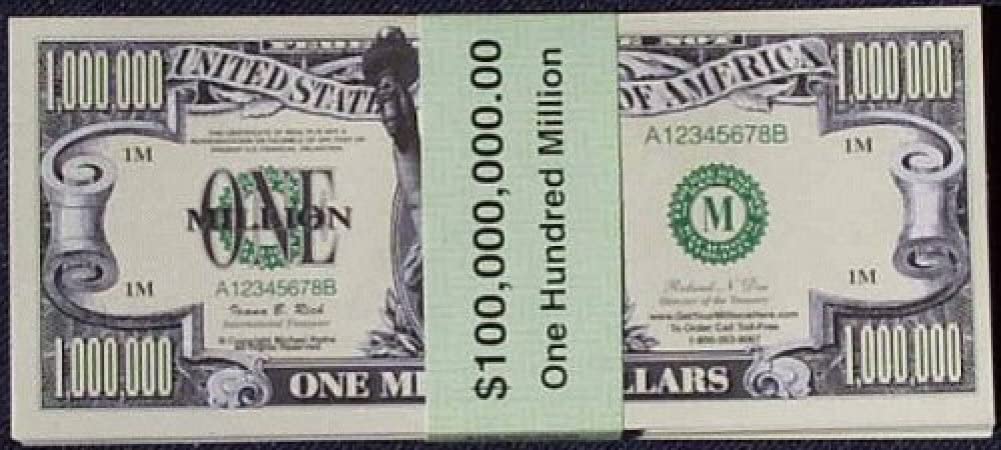
All this cash is available on Amazon for just $13.67!
A Tennessee woman was recently busted for trying to use a $1 million bill to buy a cartful of personal items at a dollar store. The clerk reported the woman to Blount County police, who issued a no trespass order.
That really had no chance of working. Did the woman really think the register at a dollar store had $999,900 or so in change? She did not think that one through too carefully.
Thinking things through is important in all walks of life, including when classifying sales personnel as contractors or employees.
You may have heard that the Internal Revenue Service treats a “direct seller” as an independent contractor, not an employee. But don’t assume all directs sellers are contractors, not employees. Here are two important notes of caution:
First, the definition of “direct seller” is narrow. Here’s what it means, according to IRS Guidance on Direct Sellers:
Direct sellers include any of the following:
A person who sells consumer products in the home or a place of business other than a permanent retail establishment,
A person who sells consumer products on a deposit or commission basis, or to other persons who will sell the products in the home or place of business,
A person who delivers and/or distributes newspapers or shopping guides.
Direct sellers have certain things in common. Their compensation is related to sales rather than to the number of hours worked. Services are performed under a written contract between the seller and the person for whom the seller performs the services.
And the contracts involved provide that sellers are not treated as employees for federal tax purposes.
But wait, there’s more. The Internal Revenue Code also requires, for someone to be a “direct seller,” that:
(B) substantially all the remuneration (whether or not paid in cash) for the performance of the services described in subparagraph (A) is directly related to sales or other output (including the performance of services) rather than to the number of hours worked, and
(C) the services performed by the person are performed pursuant to a written contract between such person and the person for whom the services are performed and such contract provides that the person will not be treated as an employee with respect to such services for Federal tax purposes.
The full statute is here. Further IRS Guidance can be found here.
Second, even if someone is a “direct seller” under the Internal Revenue Code, that doesn’t mean they’re automatically independent contractors under other laws, including federal wage and hour laws state laws.
For example, the FLSA says that “outside sales” professionals are exempt from minimum wage and overtime requirements, but the requirements are different. DOL Fact Sheet #17 explains this exemption.
California’s ABC Test does not apply to “direct salespersons,” but only if those individuals meet the test in California’s unemployment law. Other states have different rules for sellers.
The bottom line when classifying direct sellers is to remember that different tests apply to different laws. Be thorough, and remember that a worker’s classification may be different under federal tax law than under wage and hour law or state law. You’ve got to think this all the way through.
Getting it wrong can be costly, especially for businesses that use lots of independent contractors, and — most important — novelty U.S. currency like million-dollar bills won’t cover those penalties or litigation damages. But, according to the seller of these bills on Amazon, these are the “million dollar bills that get the WOW response.” So there’s that.
Sign up now for the BakerHostetler 2021 Master Class on The State of Labor Relations and Employment Law. Twelve sessions, one hour every Tuesday, 2 pm ET, all virtual, no cost. Click here for more information. List me as your BakerHostetler contact so I know you’ve registered.
On Victoria Island in Northern Canada there is a series of long finger lakes. In one of the lakes there’s an island. Inside that smaller island, there’s a smaller lake, which contains a still smaller island about a fifth of a mile long. It is the largest known island in a lake on an island in a lake on an island. You can see it here.
I like maps and islands. I like exclaves and enclaves and have lots of questions about islands.
One of my questions is why Rhode Island came to be called that, since it’s not an island. This was particularly confusing to me in elementary school but I have come to terms with it and no longer lose sleep over this.
But now Rhode Island is causing me to lose sleep again.
Why? ABC Tests.
There are bills pending in both Rhode Island and New York that, if passed, would adopt strict ABC Tests for determining who is an employee and who is an independent contractor. The tests would follow the California AB 5/Dynamex model and the Massachusetts model, meaning that a worker providing services would automatically be classified as an employee unless (all 3):
(A) the individual is free from the control and direction of the hiring entity in connection with the performance of the work, both under the contract for performance of the work and in fact;
(B) the individual performs work that is outside the usual course of the hiring entity’s business; and
(C) the individual is customarily engaged in an independently established trade, occupation, or business of the same nature as that involved in the work performed.
As discussed here, Part B is the killer B, the destroyer of most independent contractor relationships.
The bills have not yet passed either house, but both have popular support among legislatures that are heavily Democratic. Both bills seem to have a good chance at passing in 2021.
Keep an eye on these bills.
Meanwhile, Victoria Island is the eighth largest island in the world but has only about 2,100 people. I am not aware of any push among the mostly-Inuit inhabitants to reclassify independent contractors anywhere in Nunavut, but I also don’t feel like I have my finger on the pulse of Nunavut politics. It’s harder to track legislation there.
Sign up now for the BakerHostetler 2021 Master Class on The State of Labor Relations and Employment Law. Twelve sessions, one hour every Tuesday, 2 pm ET, all virtual, no cost. Click here for more information. List me as your BakerHostetler contact so I know you’ve registered.
The New River is actually one of the world’s oldest rivers and, unusually, flows south to north.
The nickname and team mascot for Poca High School in Poca, WV is the Dots.
West Virginia just adopted the most pro-business worker classification test in the nation.
While I would love to write about the Poca Dots, I’m going to focus on the state’s new worker classification test, enacted March 11, 2021. It takes effect 90 days later, on June 9, 2021.
The new test creates a safe harbor. If you comply with a list of requirements, including a written contract, your worker is automatically an independent contractor under WV wage and hour law, anti-discrimination law, workers’ compensation, and unemployment.
The bill nearly had a disastrous flaw. In its original form, passed by one chamber, if you failed to meet the safe harbor criteria, you’d automatically be deemed an employee. That would have had absurd unintended consequences, including that a worker would automatically be an employee if there was no written contract or if the contract did not include all required clauses.
I drafted a last-minute amendment that was adopted and inserted into the bill at the eleventh hour. The amendment said that if the safe harbor was not met, the worker would not automatically be an employee. Instead, the worker’s status would determined by using the 20-factor Right to Control Test in IRS Rev. Ruling 87-41. (The 20 factors are explained here in this PDF from the Texas Workforce Commission.)
The bill is very pro-business.
Businesses retaining contractors in WV should review the safe harbor provisions and be sure to comply. Compliance means a free pass for independent contractor status under state law (but not under federal law). Contracts may need to be adjusted to include the required clauses. Now is the time to do that.
Here is a link to the bill. The blue text contains the safe harbor. Read it closely and make sure these provisions are in your WV independent contractor agreements.
Sign up now for the BakerHostetler 2021 Master Class on The State of Labor Relations and Employment Law. Twelve sessions, one hour every Tuesday, 2 pm ET, all virtual, no cost. Click here for more information. List me as your BakerHostetler contact so I know you’ve registered.
Photo by Hectonichus and, yes, this fella is sticking his tongue out at you (but he can’t remember why).
A Swedish study concluded that baboons, pig-tailed macaques, and squirrel monkeys have some of the worst short-term memories in the animal kingdom, barely exceeding that of bees. The point is, never ask a pig-tailed macaque where you left your car keys.
Having a short memory can be a problem in some situations, but not it’s not an issue if you’re just trying to recall the latest Department of Labor test for independent contractor misclassification. Everything you recall from six weeks ago is being undone anyway. (Or Undun, if you’re a fan of the spelling-impaired Canadian band The Guess Who.)
Remember the new rule issued by the DOL in January 2021 for determining employee vs. independent contractor status? It was going to modify the Economic Realities Test to focus on two core factors: (1) the nature and degree of the worker’s control over the work, and (2) the worker’s opportunity for profit or loss based on personal initiative or investment. The new rule was to take effect March 8. The test would apply only to claims under the Fair Labor Standards Act (FLSA).
No more. Last week, the DOL delayed implementation until May, but the rule most likely will be rescinded completely. Undun.
This decision comes on the heels of the DOL rescinding two opinion letters that were also issued in January. Undun. The letters provided guidance on determining independent contractor status in a few particular situations.
The Economic Realities Test remains the test used to determine who is an employee under the FLSA. It’s a multi-factor balancing test.
So if you’ve been relying on recent DOL guidance for how to apply that test, channel your inner pig-tailed macaque. Whatever you recall from January can be forgotten. And where did I put my car keys?
Sign up now for the BakerHostetler 2021 Master Class on The State of Labor Relations and Employment Law. Twelve sessions, one hour every Tuesday, 2 pm ET, all virtual, no cost. Click here for more information. List me as your BakerHostetler contact so I know you’ve registered.
We saw this fella in Yellowstone. (C) my wife. Used with permission after arms-length negotiation involving chocolate.
Sometimes trouble comes at you from an unexpected direction. One Alaska resident learned this the hard way when she sat on her outhouse toilet and was bitten by a bear — from below. Didn’t see that coming.
US law on Independent Contractor vs. Employee is based on federal and state statutes and common law, but a decision last week from overseas has US businesses concerned. Should they be?
On Thursday, the UK High Court ruled that Uber drivers were “workers” under UK law, not independent contractors, and were therefore protected by minimum wage and other laws.
But I don’t think this ruling will bite US businesses in the arse. There are important differences between US and UK law, and those differences drove the outcome here.
In the US, someone is either an employee or an independent contractor. Those are the only two options. But under UK employment law, there are three categories:
Those employed under a contract of employment (US: employee; UK: employee/worker);
Those self-employed people who are in business on their own account and undertake work for their clients or customers (US/UK: independent contractor);
and an intermediate class of workers who are self-employed but who provide their services as part of a profession or business undertaking carried on by someone else (UK: worker).
Some UK statutory rights, such as the right not to be unfairly dismissed, are limited to those employed under a contract of employment; but other rights, including those claimed in the UK case, apply to all “workers.”
The question in this case, therefore, was not whether the Uber drivers were employees, but merely whether they were “workers.” They were.
The decision also turned largely on a City of London requirement relating to licensing requirements for drivers for hire. The Uber drivers were under contract with Uber London, which had the required license.
The court considered elements of control, but this case was not decided under a US-style Right to Control Test, Economic Realities Test, or ABC Test. The rules we are used to seeing in the US don’t apply in the same way overseas.
In the end, this case is noteworthy in its result — that Uber drivers were protected by UK minimum wage law and other worker protections — but the legal basis for reaching that conclusion just doesn’t apply in the US.
We will continue to see increased pressure in the US for more worker protections, and we will continue to see challenges to worker classification. But US businesses don’t need to worry about the bite from this ruling from a few thousand miles east. Of more immediate concern, at least to Alaskans visiting the outhouse, is what might be waiting a few feet below.
Sign up now for the BakerHostetler 2021 Master Class on The State of Labor Relations and Employment Law. Twelve sessions, one hour every Tuesday, 2 pm ET, all virtual, no cost. Click here for more information. List me as your BakerHostetler contact so I know you’ve registered.
Who says the news is always negative? Not so in Alabama, where we were treated this headline on AL.com:
Teen reunited with pet rooster lost at Alabama Cracker Barrel after Civil War reenactment
It seems an 18-year old Civil Ward reenactor brought his Buff Orpington rooster, Peep, to a civil war reenactment in nearby Tennessee, then stopped for lunch afterward. Our hero dutifully put on Peep’s leash and secured him to the bed of his truck while dining at a nearby Cracker Barrel after the event. But when he returned, the rooster was gone.
Police and animal control were summoned to the scene. The parties were later reunited when Peep wandered back to the Cracker Barrel, and this story had a happy ending. This had been Peep’s third Civil War reenactment, although his role in the battle plan was unclear. Fortunately for Peep, further battles lie ahead.
Further battles lie ahead in Congress too, not for roosters but for businesses everywhere. Rep. Bobby Scott and 200 Democratic co-sponsors have re-introduced a massive labor bill that fulfills every wish of the unions.
The PRO Act – Protecting the Right to Organize – would bring a massive overhaul to the National Labor Relations Act. Two portions of the bill would affect independent contractor misclassification and joint employment.
First, the PRO Act would re-adopt the Browning-Ferris test for determining whether someone is a joint employee of two employers. This test had been adopted by the Obama Board but reversed by the Trump Board. The test would consider two entities to be joint employers if they “share or codetermine” control over workers’ terms of employment. The notion of control would be broad. It would include not just actual direct control, but reserved control or indirect control. Under the original Browning-Ferris test, control over the speed of an assembly line was considered sufficient control to make a business a joint employer.
Second, the PRO Act would adopt a nationwide strict ABC Test for determining whether someone is an employee or independent contractor. The new rule would require that all workers performing services be considered employees under the NLRA unless (all three):
(A) the individual is free from the employer’s control in connection with the performance of the service, both under the contract for the performance of service and in fact; (B) the service is performed outside the usual course of the business of the employer; and (C) the individual is customarily engaged in an independently established trade, occupation, profession, or business of the same nature as that involved in the service performed.
This is the same test adopted by California (recall Dynamexand AB 5) but without the exceptions. California lawmakers recognized this test wouldn’t work in all industries and adopted a long list of exceptions to this test.
The PRO Act would not have any exceptions.
It’s no surprise that the bill was reintroduced. A similar bill was passed by the House last year but never considered by the Senate.
While 60 votes in the Senate isn’t going to happen, this bill deserves a close and watchful eye. (Follow its progress here.)
That means really watching it, not just tying it to the bed of your truck and hoping it’s still there after you finish your Cracker Barrel omelet.
Sign up now for the BakerHostetler 2021 Master Class on The State of Labor Relations and Employment Law. Twelve sessions, one hour every Tuesday, 2 pm ET, all virtual, no cost. Click here for more information. List me as your BakerHostetler contact so I know you’ve registered.










 Who Is My Employee?